
One of the stories in the New York Times this past Sunday focused on Italian olive oils, comparing those from Tuscany (“delicate, like a pinot noir”) to those from Puglia (“like a big cabernet, it’s much heartier”). We’ve biked in both Tuscany and Puglia, and there’s no competition.
Puglia reigns supreme in the olive category. The ancient olive trees that produce these heartier olive oils are such an omnipresent part of the landscape and so defined our bike trip in the heel of Italy’s boot that they earned their own post.
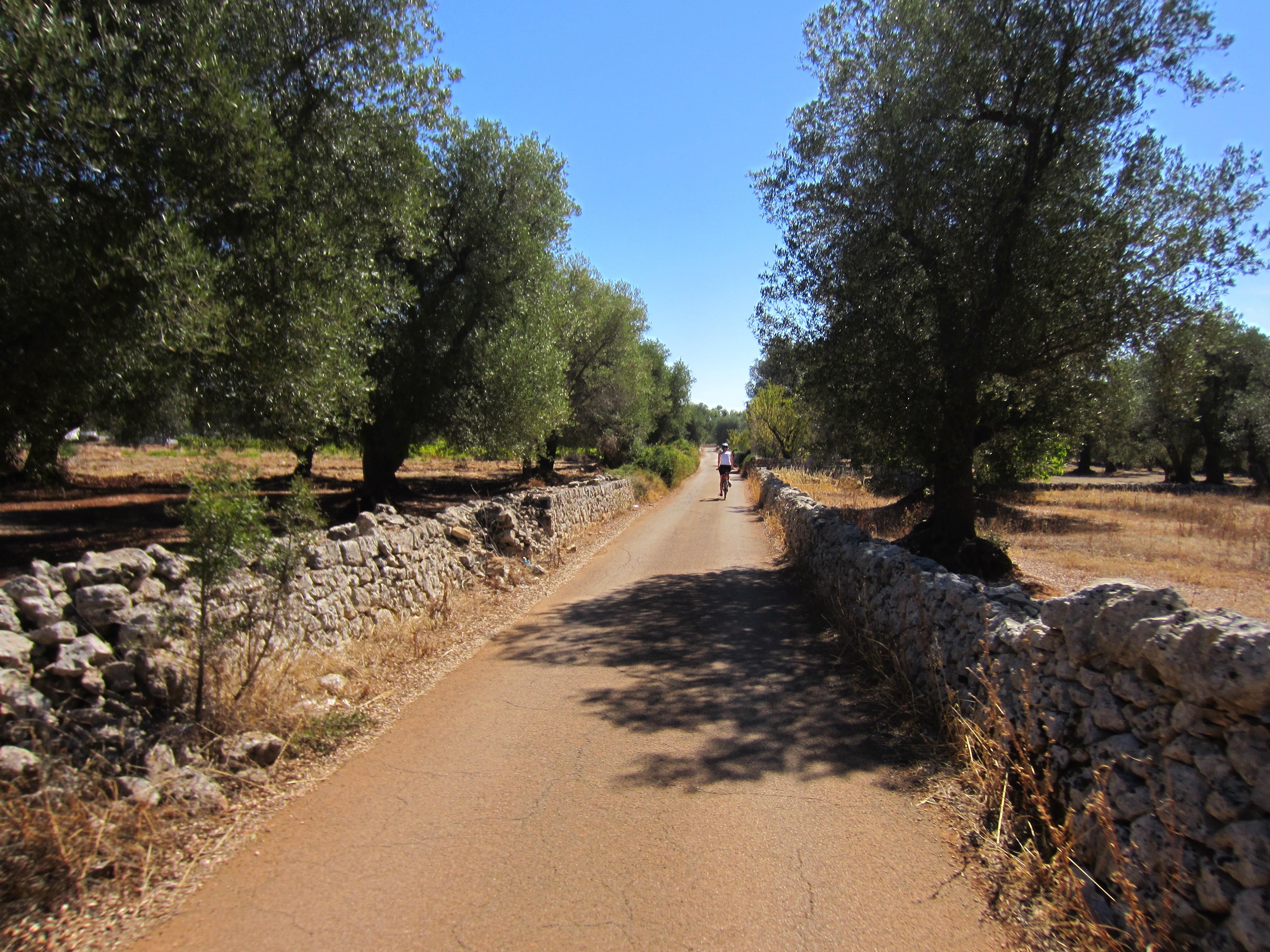
Ubiquitous olive groves in Puglia

Some of the really old olive trees that were common across Puglia
The New York Times article is well worth a read. The author’s characterization of Puglia and comparison to Tuscany, in both olives and landscapes, is below. Here, the article is dead on, in our view; elsewhere, not so much. The story also includes a caveat that olive oils from other countries are increasingly smuggled into Puglia and passed off fraudulently as extra virgin Italian olive oil.
“’In Italy, we say, the bread of one day, the oil of one month, the wine of one year,” said Paolo Rossi, the property manager, establishing parameters for freshness and essentially articulating my entire Italian summer diet. “Olive trees are a generous plant. Here in Tuscany, one tree can produce one liter. In Puglia, one tree can produce 30 liters. If you go to Puglia, you will see trees so big you need three people to hug them. You won’t believe your eyes.’
The next morning, it was time. We set off to not believe our eyes.
Driving south, the hillsides of Tuscany gave way to craggy mountains, then lush countryside, until finally, after hours in the car, we entered a low, flat plateau that ran along the coast of the Adriatic; dry and rocky, and vaguely prehistoric. Puglia is stark, beautiful, almost North African. The air is dry and salty and the earth is rough and stony and burned red with clay under an unforgiving blue sky. And everywhere, in every direction, at every turn: olive trees. It was like the gods had chosen to carpet the entire heel of Italy with a shaggy, olive green rug.
Puglia produces almost 40 percent of the olive oil in Italy. There are some 60,000,000 olive trees here, and millions of them are so old they are protected by the government. With water on three sides, it’s the perfect place to bring in olive oil from outside Italy, process or bottle it in Puglia and pass off fake stuff for the real thing, as the region allows easy access to the Italian market.
This is a real problem, and a reason to go to the source.”
The article ends with reliable sources of genuine Italian olive oil that we’ll be looking for the next time we buy (using the second list, of course, featuring robust Puglian olives).
The article later gushes over both the town of Ostuni and the village of Ceglie Messapica in Puglia. We’ve been to both and certainly agree with the Times’ assessment of Ostuni. We were entranced by the White City (“Città Bianca”):

La Città Bianca


Ostuni’s cathedral

Bishop’s Palace Bridge in the cathedral’s piazza
The Times’ characterization of a charming Ceglie Messapica, though? Either the journalist was drinking olive oil that had inadvertently fermented or we went to different places. We thought it was a bland “nothingburger” of a town, according to the pics in our 2013 post:

A stopover in the nothingburger town of Ceglie Messapica

Inside the old 11th-century fortress – nothing to see here

Other than a mildly creepy set of guys holding a crest from some long-ago ruling family

The streets of Ceglie Messapica – they aim to bore.
Maybe the residents of Ceglie Messapica historically have just focused all of their efforts outside the town . . . in the olive groves.
 WolfeStreetTravel