
Our first, 6-week, shoulder-season session of 2025 is complete! We’ve had a yen to return to Europe after our last five trips, all of which have been elsewhere, including and in particular our last three, long-duration trips to French Polynesia and New Zealand, South America, and New England and Canada. We also wanted to get out of stifling Alexandria for the summer like we did last year with the New England and Canada road trip, during which we fled Old Town for the entirety of July and August, as well as the first week or so of September.
The problem with this convergence – return to Europe and get out of Dodge for the summer – is being in Europe in the summer. This we were not keen on. Not only are all of the spastic Germans, Dutch, and English rampaging all over the continent during the high season, but too many Americans are there now, too. We love traveling, but we hate crowds, abhor lines, and are not too keen on being around other tourists. We’re super hypocritical like that.
Our imperfect solution? Avoid the high season and instead head to Europe for two, 6-week trips during the shoulder seasons that flank the insanity that is July and August in Europe. The first trip would hit the early summer shoulder and the second would take us to Europe in the very late summer / early fall. Our strategy would (hopefully) grant us sufficiently warm weather for swimming (in the locations where we’d be coastal) but still avoid the crowds that come with the hotter peak periods. However, our strategy would not get us out of steamy Alexandria for the peak summer period, so there’s a downside.

For the first trip, we’d finally return to Croatia and explore this country more. We spent about 10 days in Slovenia and Croatia in 2007 and loved that trip so much that when people ask us our favorite country, we’d almost always respond with Croatia. Despite this, we had never been back, despite returning to Italy, Spain, and France again and again (just see the list with years visited on the home page).
So, we’d spend most of the first, 6-week European road trip in Croatia. And we’d sequence travel here first, over other trip targets, to hit the balance between suitably warm weather and low crowds, and then head to a more northerly location before the real heat hit in early July. What more northerly location has been on our list (and tantalizing us frequently in our Instagram feeds)? The Italian Dolomites. So, we’d spend 11 days there (and South Tyrol), across five locations.

But we’d bookend our time in Croatia and the Dolomites with a few days in a new country to us (no. 81, if you’re keeping track) on the front end (Bosnia and Herzegovina) and a series of Bavarian towns like a string of pearls that has been on our list since visiting Lansburg am Lech in 2008 (the Romantic Road). In short, we’d pick up a car in Sarajevo, drive through Bosnia, up the Dalmatian islands in the Adriatic, across mountain passes in the Dolomites, and into Bavaria, and drop it back off 6 weeks later in Munich. Pretty cool. Plus, we only had to board airplanes at the start and the end of the trip, resulting in much more flexibility in what we lugged around with us (mostly bottles of Aperol and prosecco, if we’re honest here. . .).
The route looked like this:
Before conveying the overview of the road trip delineated in the interactive map above, an acknowledgement: the WolfeStreetTravel’s Chief Adventure Officer – despite his expertise in trip planning earned from arranging scores of trips and overcoming the most vexing of logistical challenges – committed an embarrassing planning error. The route should have formed a perfect J, beginning at the lower right in Bosnia and heading down, then up and up until its conclusion in Bavaria. But as you’ll see at the top of the route above, there’s a weird jug handle at the top of the J. The CAO shamefully backtracked the WolfeStreetTravelers – a cardinal sin of trip planning in our view – at the end of the trip when this could have been avoided.

We flew back out of Munich at the end of that jug handle simply because the CAO (mistakenly) assumed that MUC would be the closest airport to Würzburg, our final Romantic Road town on the Bavarian leg of the trip. It is not. MUC is a 3-hour drive south, back the way we came. Had the CAO done his job and simply compared the driving time between Wurzburg and FRA Würzburg and MUC, he would have seen that FRA was only an hour away. We could have come back a day early and avoided the overnight stay in Munich the day before we flew out (although we also would have missed the chance to stay in another Rosewood, so there was an upside).
With that gaffe behind us, we will proceed to the the trip overview.
Bosnia and Herzegovina
We landed in Sarajevo, Bosnia and Herzegovina’s capital, midday, picked up our car (a brand new Renault Clio with only about 25 km on it) and headed into town. Founded by the Ottomans in the 15th century, the town is still a very Islamic country, much like parts of North Macedonia that we biked through back in 2019.
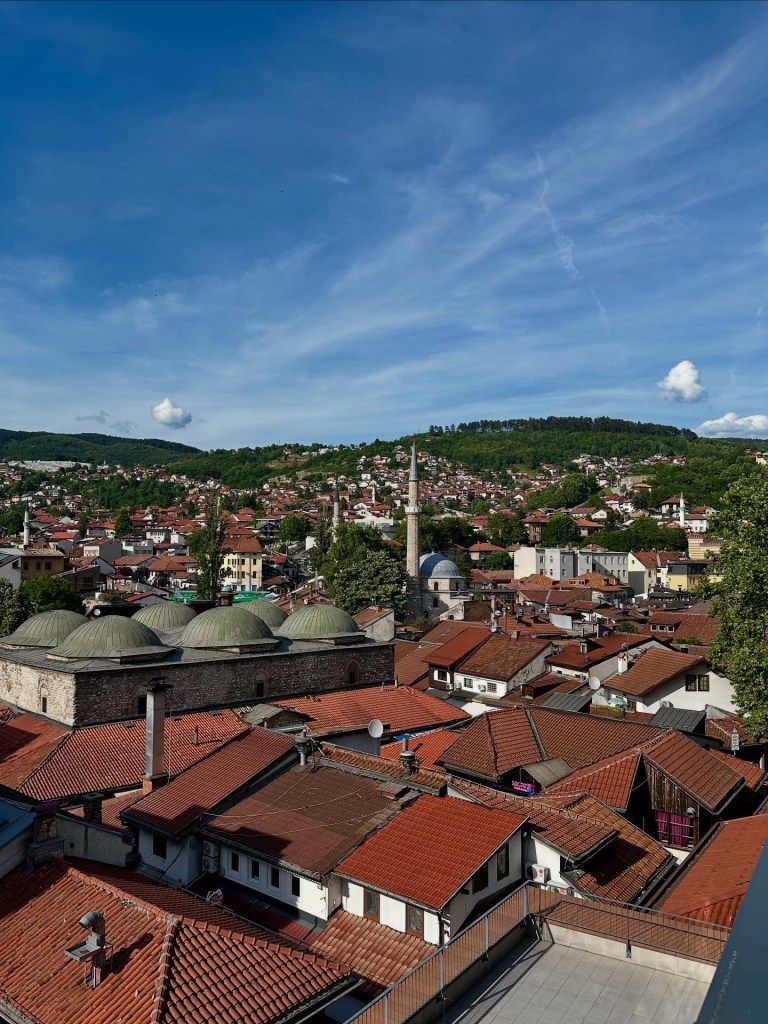
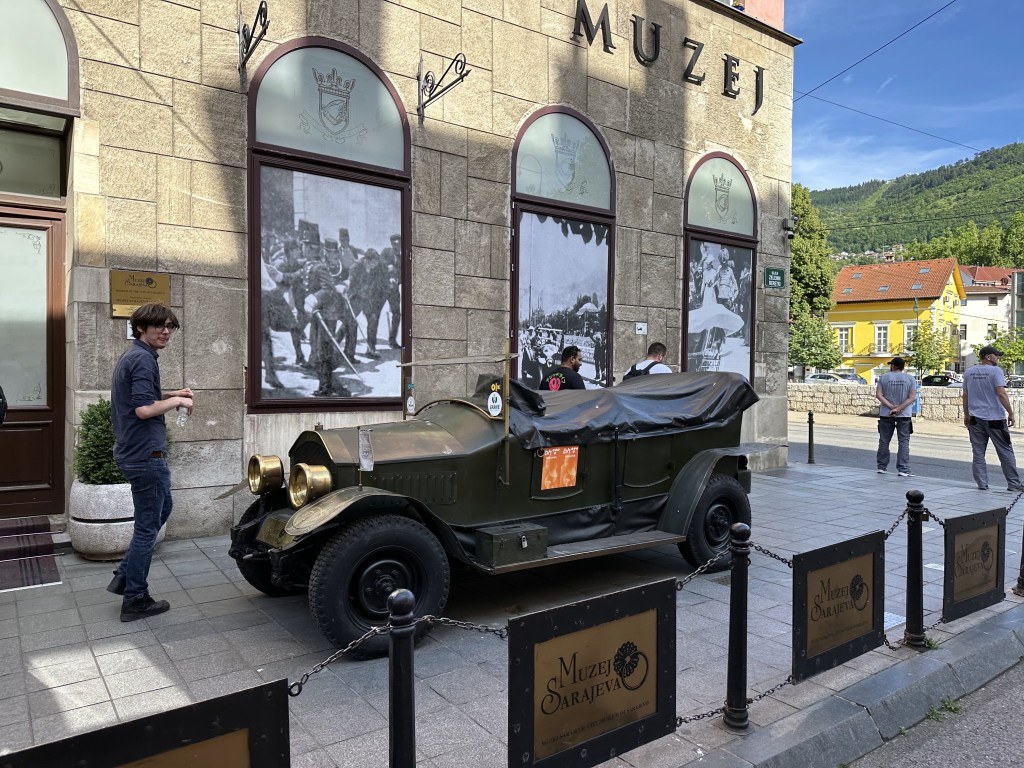
Famously, Sarajevo played the pivotal role in kicking off WW I with the assassination of Archduke Franz Ferdinand – right on this corner here:
The next morning(ish), we headed to our second stop in Bosnia: Mostar.
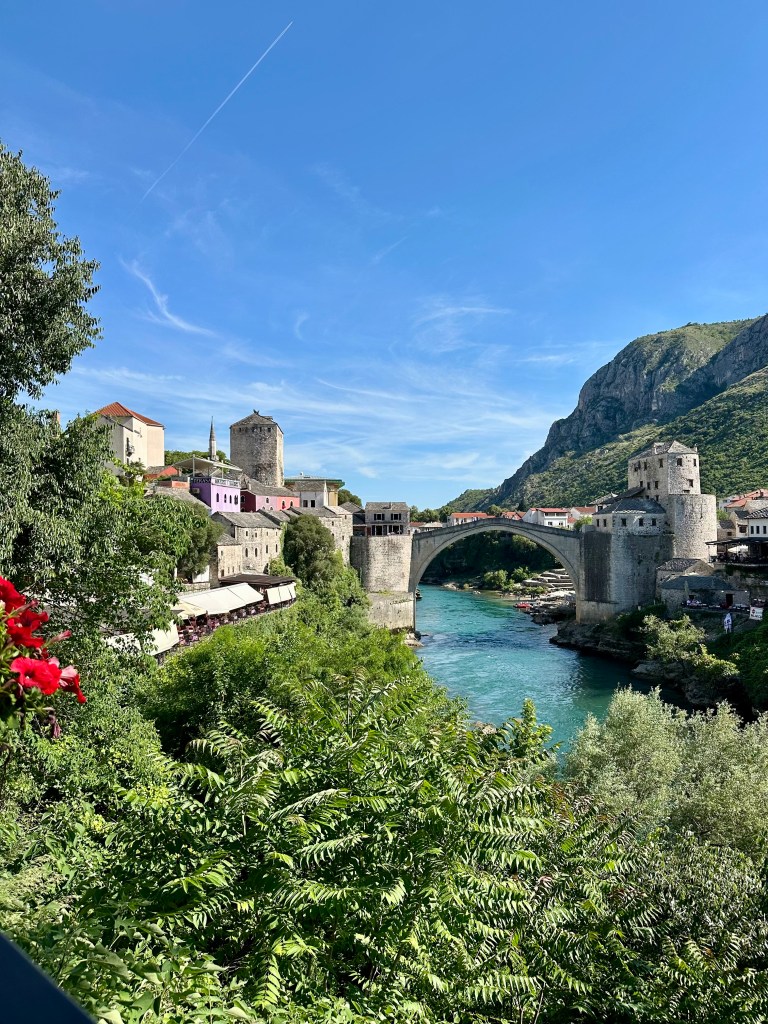
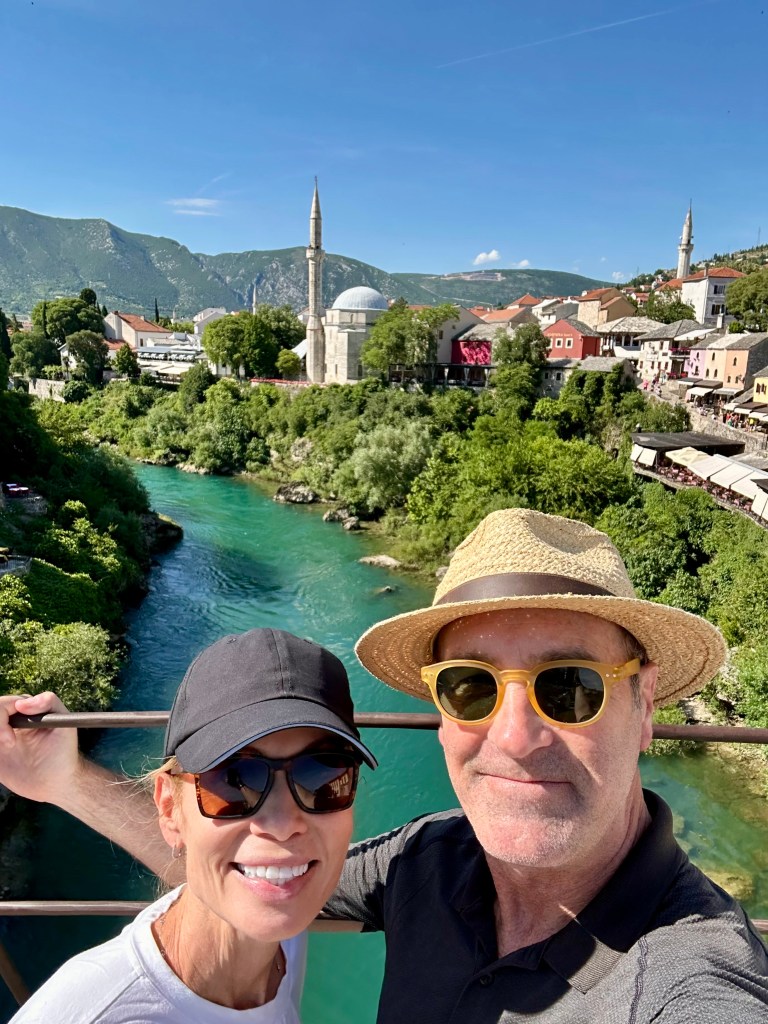
Mostar, established in the 15th century under Ottoman rule, became renowned for its iconic Stari Most (Old Bridge), a symbol of unity destroyed during the Bosnian War in 1993 and rebuilt in 2004 as a UNESCO World Heritage Site.
We’d spend 2 days here – pretty cool town.

Croatia – The Islands
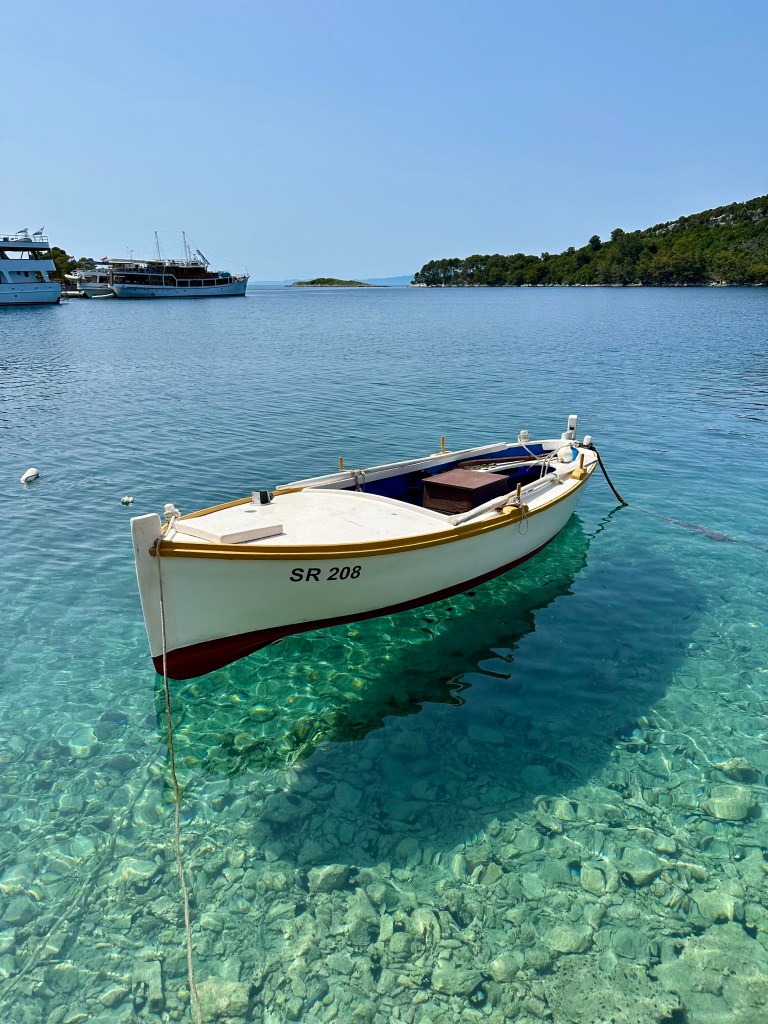
We then headed across the border and, via our first of five ferries, across a straight in the Adriatic to the Croatian island of Mljet, which is home to a really nice national park.
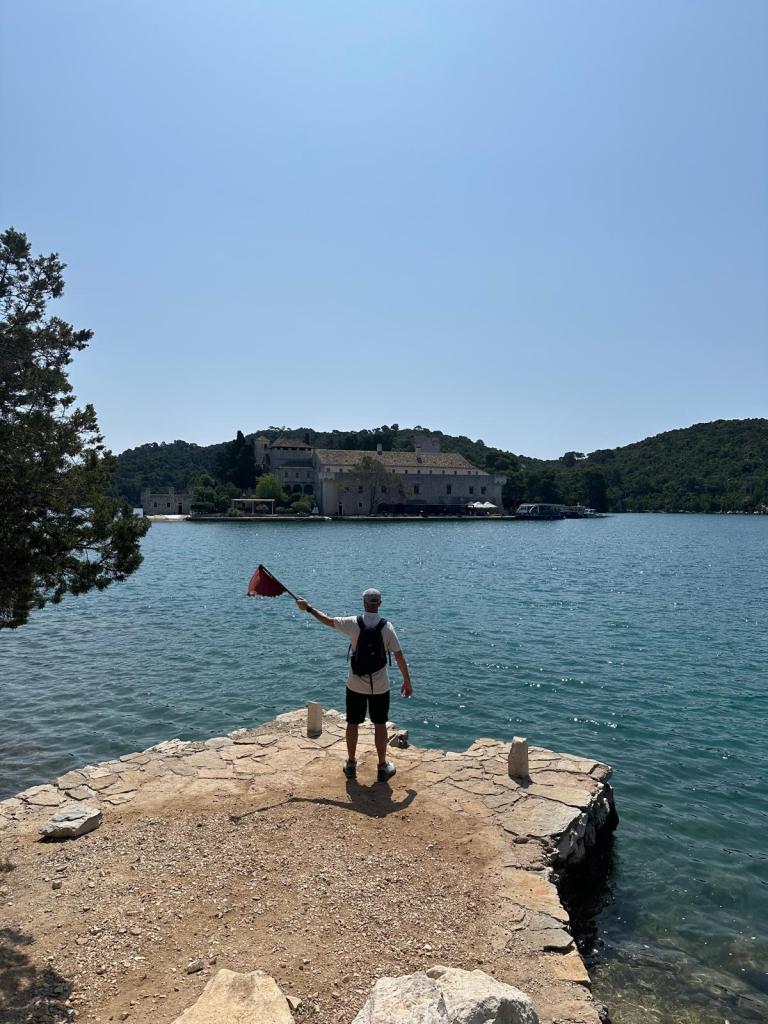
In the middle of which is The Benedictine Monastery, built in the 12th century on the islet of St. Mary in Veliko Jezero. You get there by waving a red flag on shore to summon a boat.
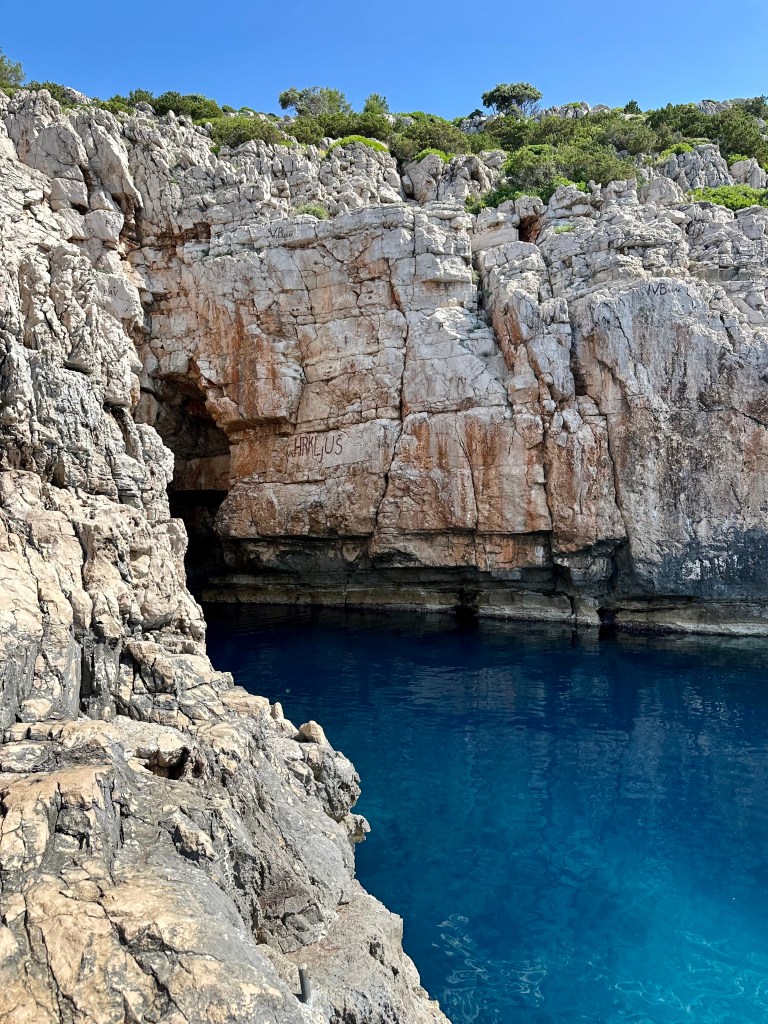
Probably our best (and first) swimming experience of the trip diving off the rocks at Odysseus’ Cave and swimming in and out of the cave in the awesome azure water.

After 3 days on Mljet, we headed off to our next destination. . .

The island of Korčula. One of our two favorite stops on the trip. Our AirBnB here may have been a factor.

Korčula’s Old Town had a great vibe, great history, and great architecture.
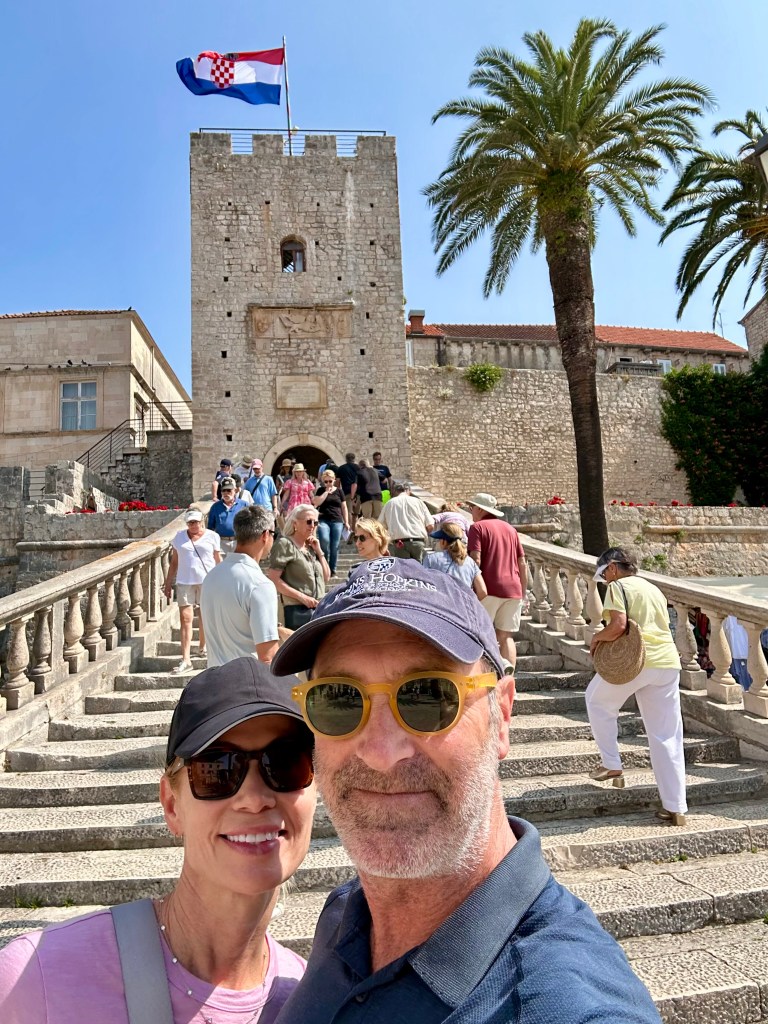

And great food, including our first Michelin-starred meal of the trip:

Very cool boat tour to Korčula’s nearby islands and swimming bays, complete with some outstanding fish grilled on the boat.

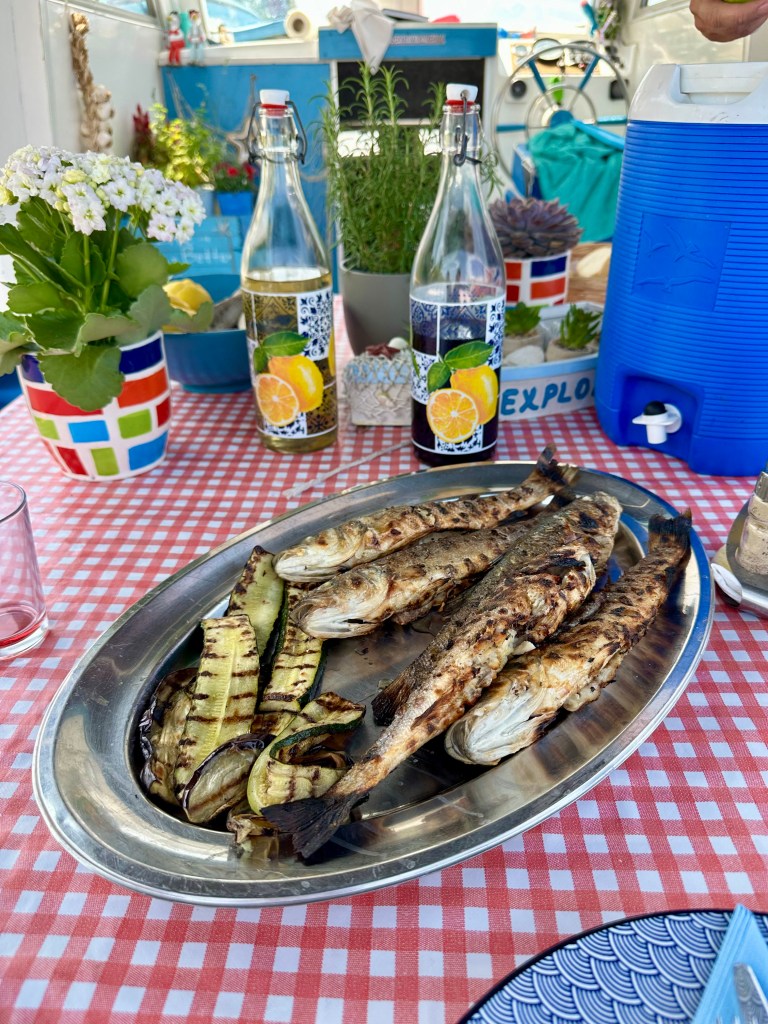
Frankly, most of our meals in Croatia consisted mostly of fish. Fish, cheese, and wine:
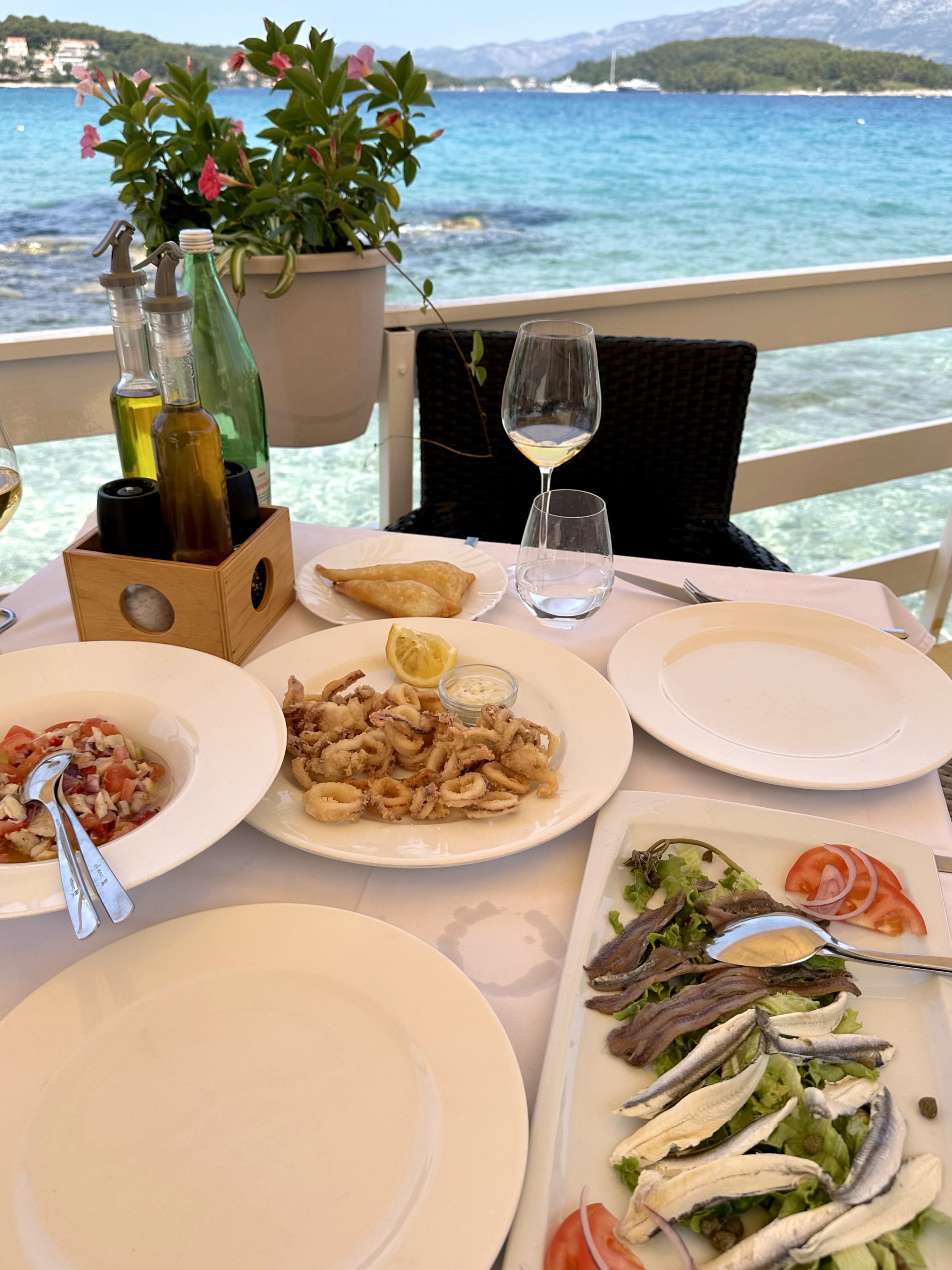
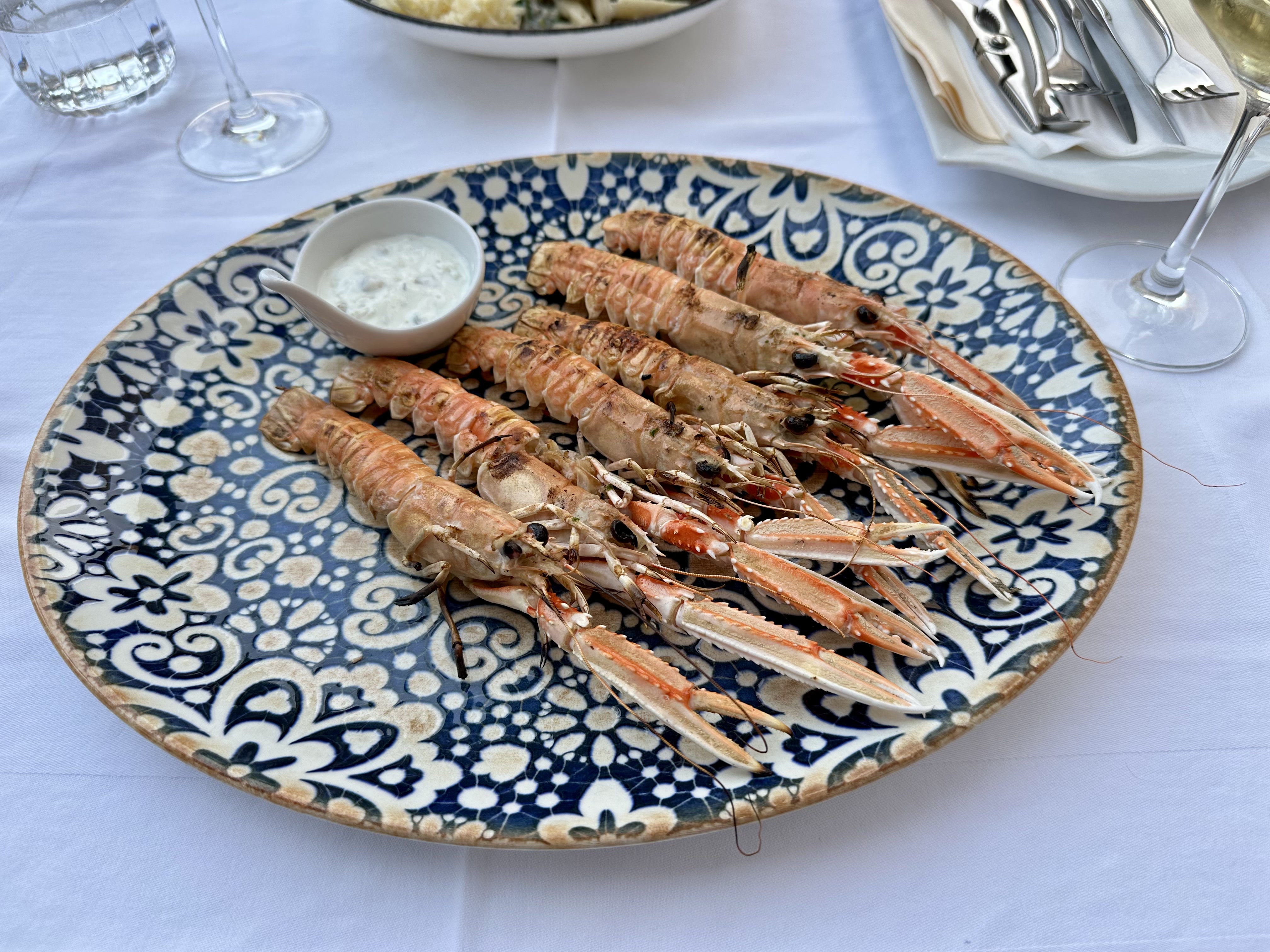
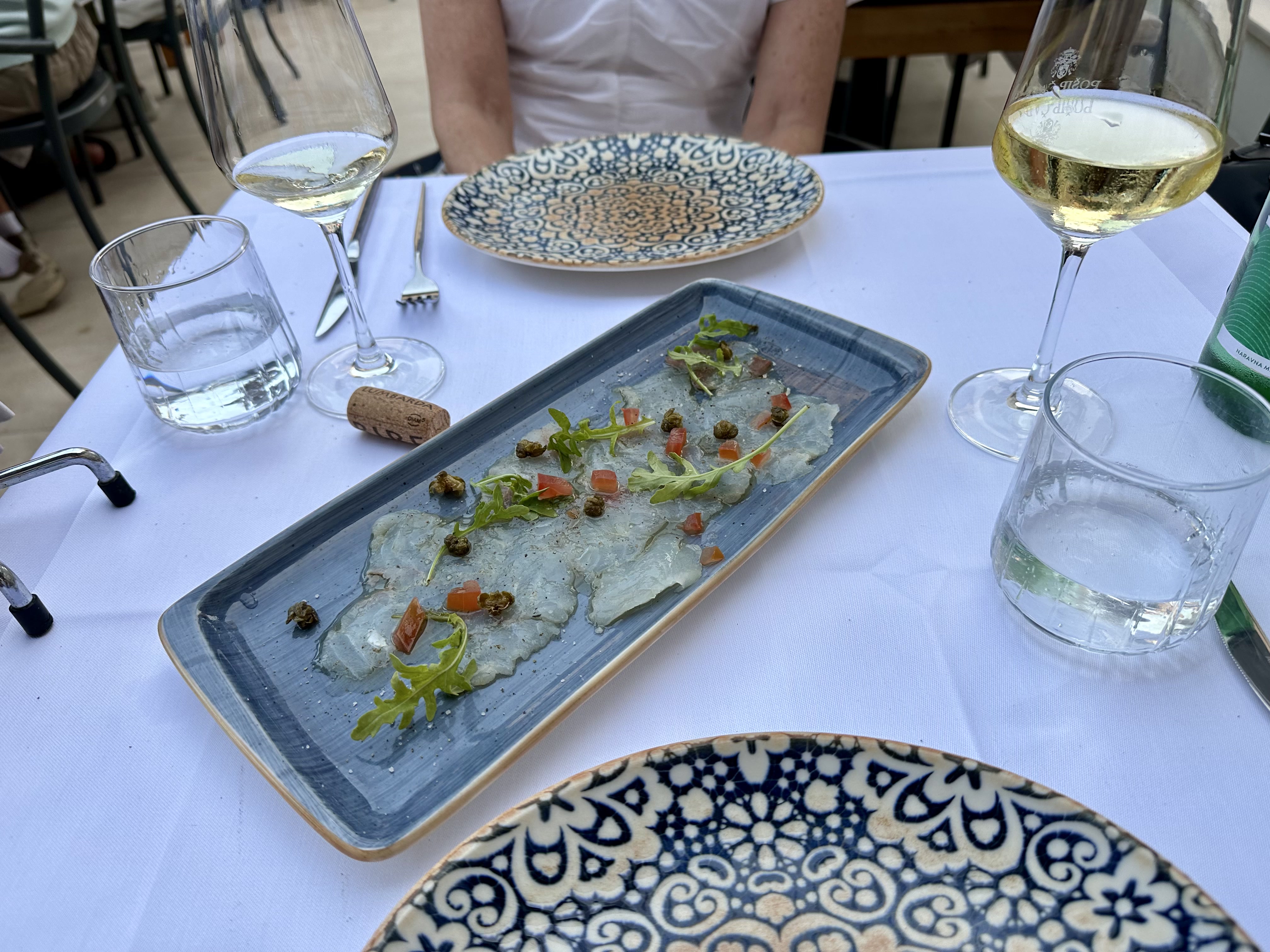
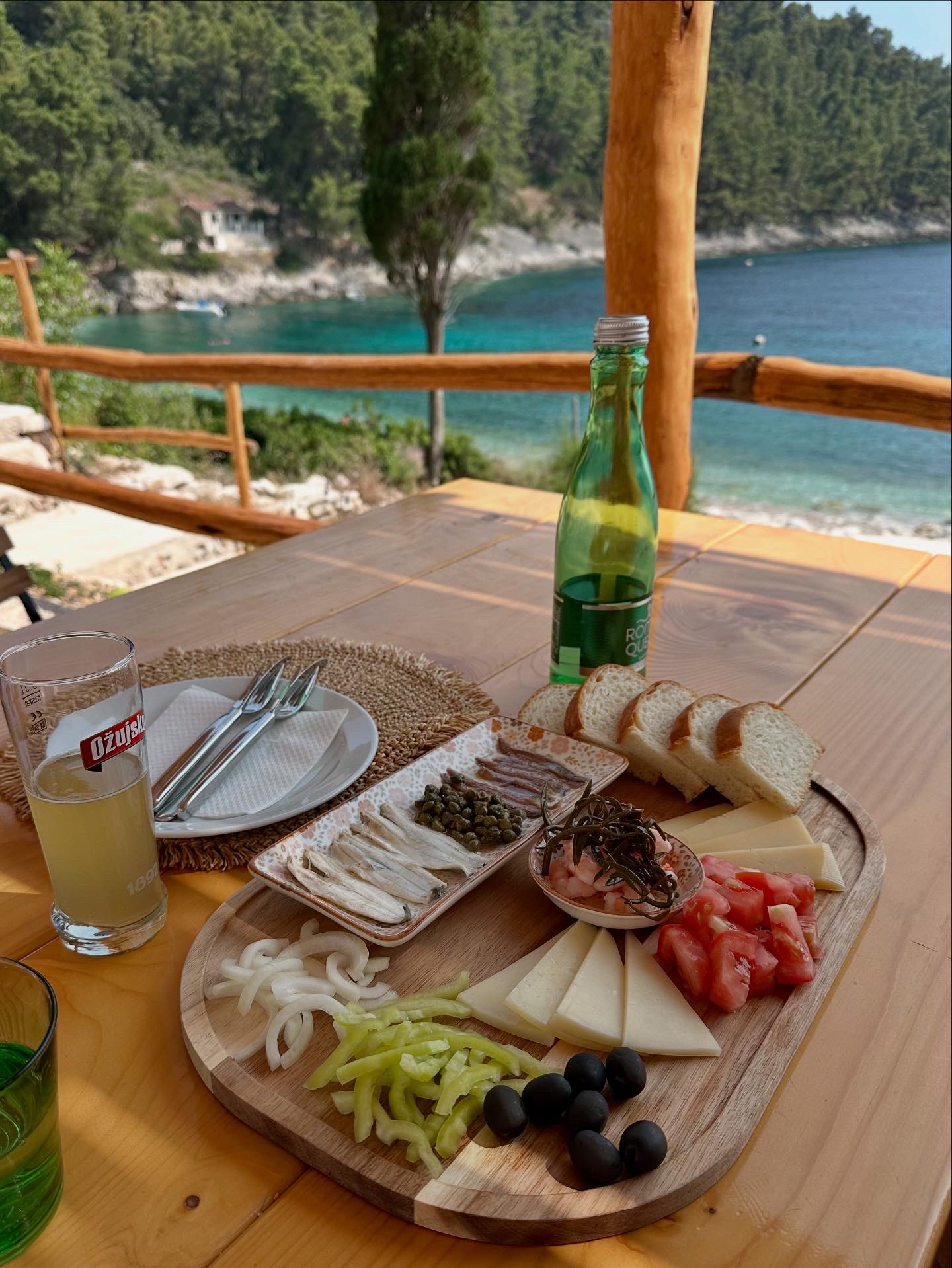
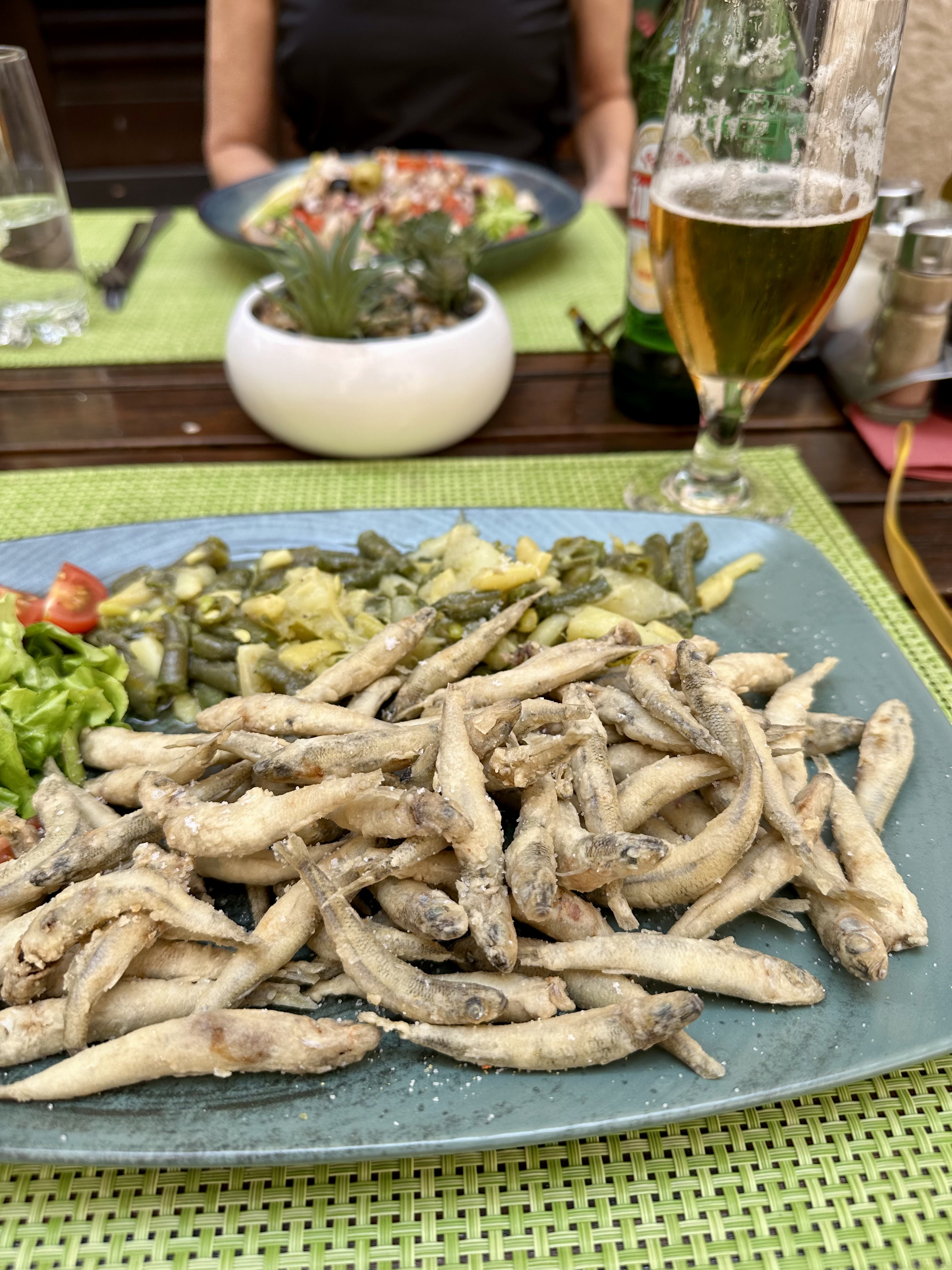


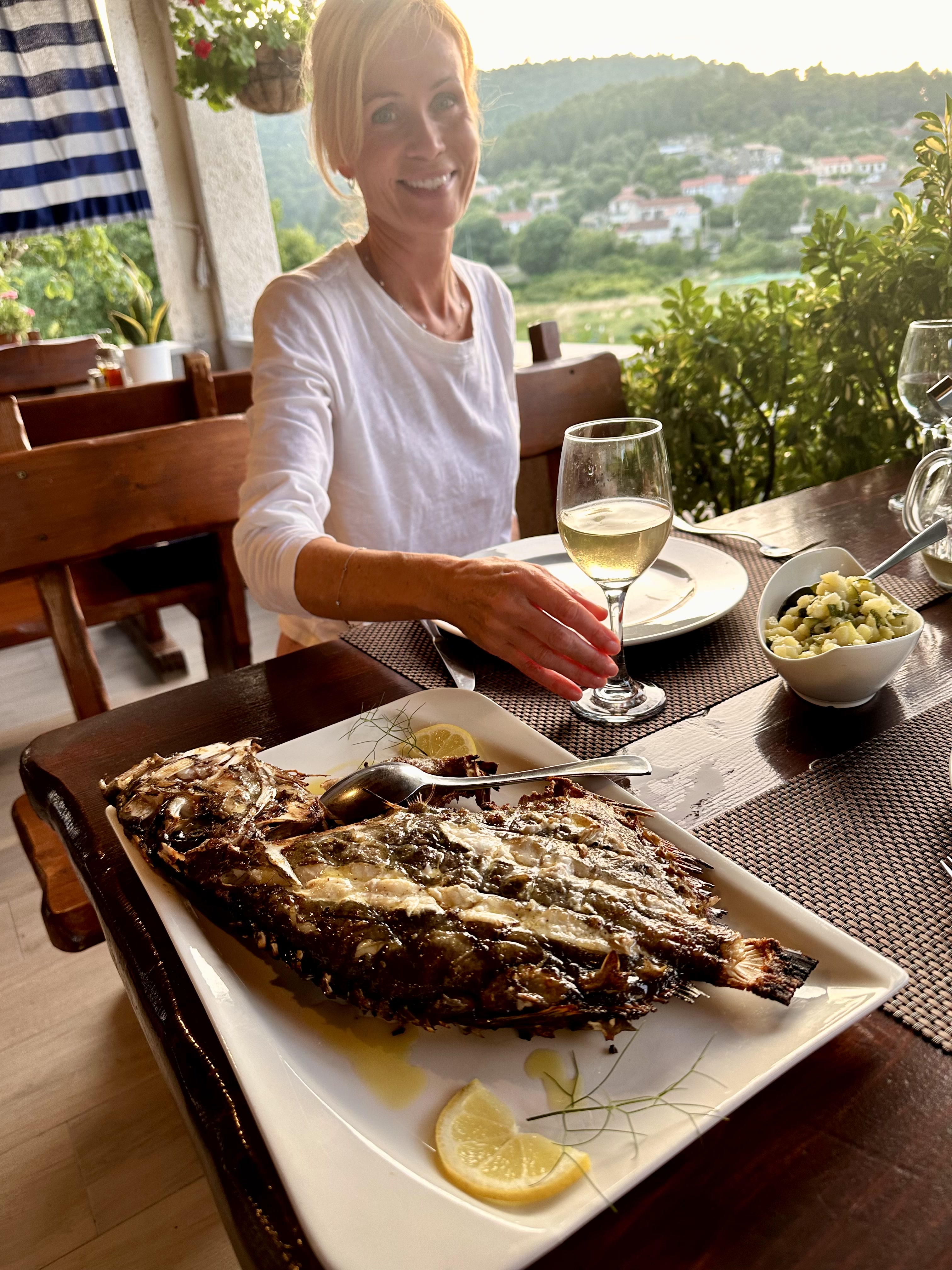


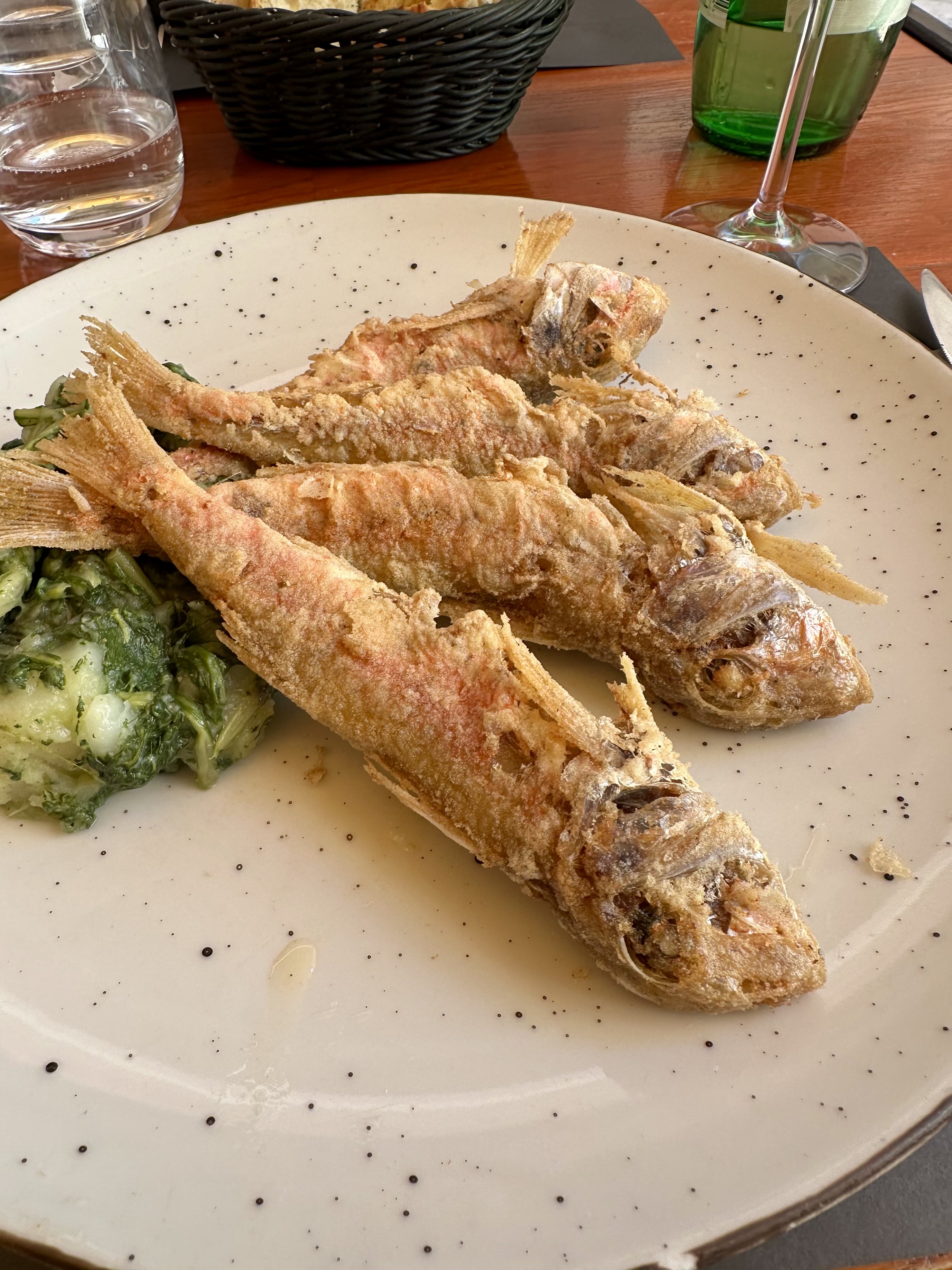
Pretty great living for a month!
After 5 days on Korčula, we headed to Hvar, where we’d spend another 5 days.

Hvar, settled since prehistoric times and founded as a Greek colony in the 4th century BC, flourished under Venetian rule from the 15th to 18th centuries as a strategic Adriatic port and cultural hub, famed for its Renaissance architecture and maritime trade.
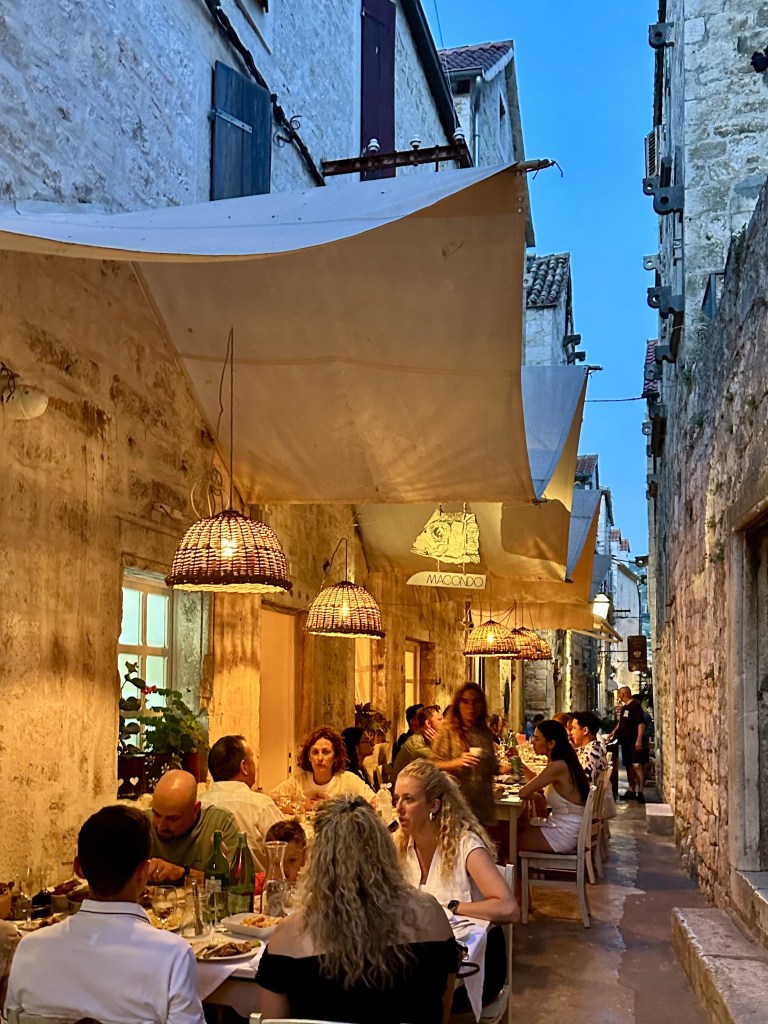
We visited Hvar in 2008 and fell in love with the place then.
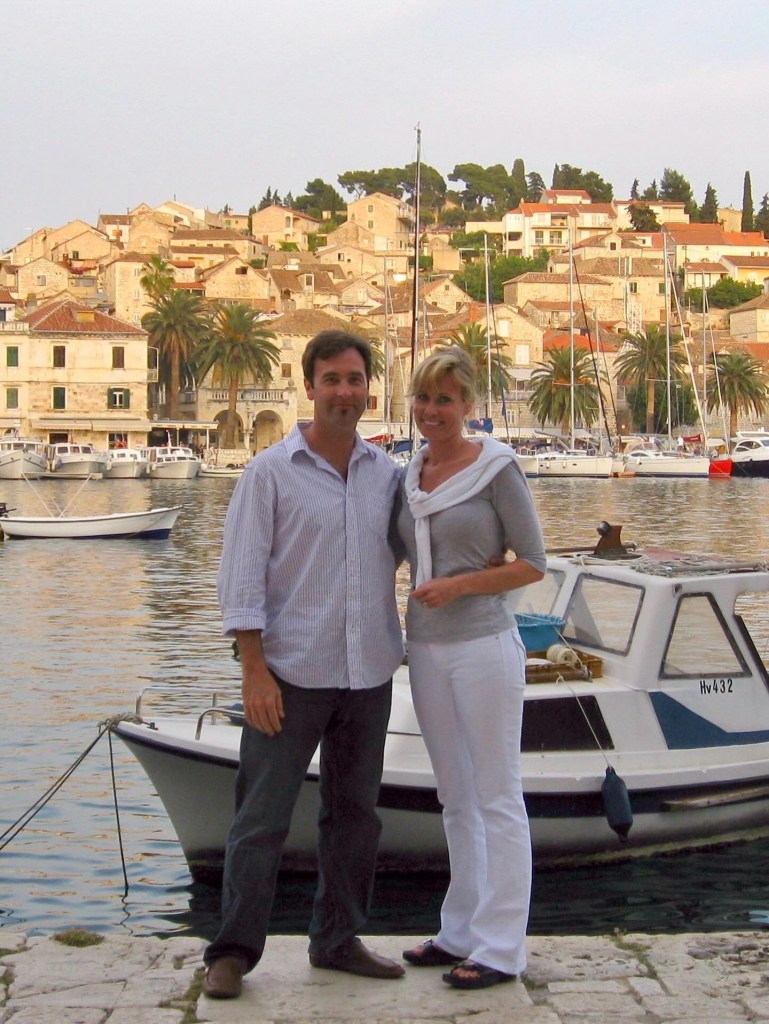
The island still captivated us in 2025, but it definitely exuded a clubbier, 20-something vibe that wasn’t nearly as idyllic as during our first stay.
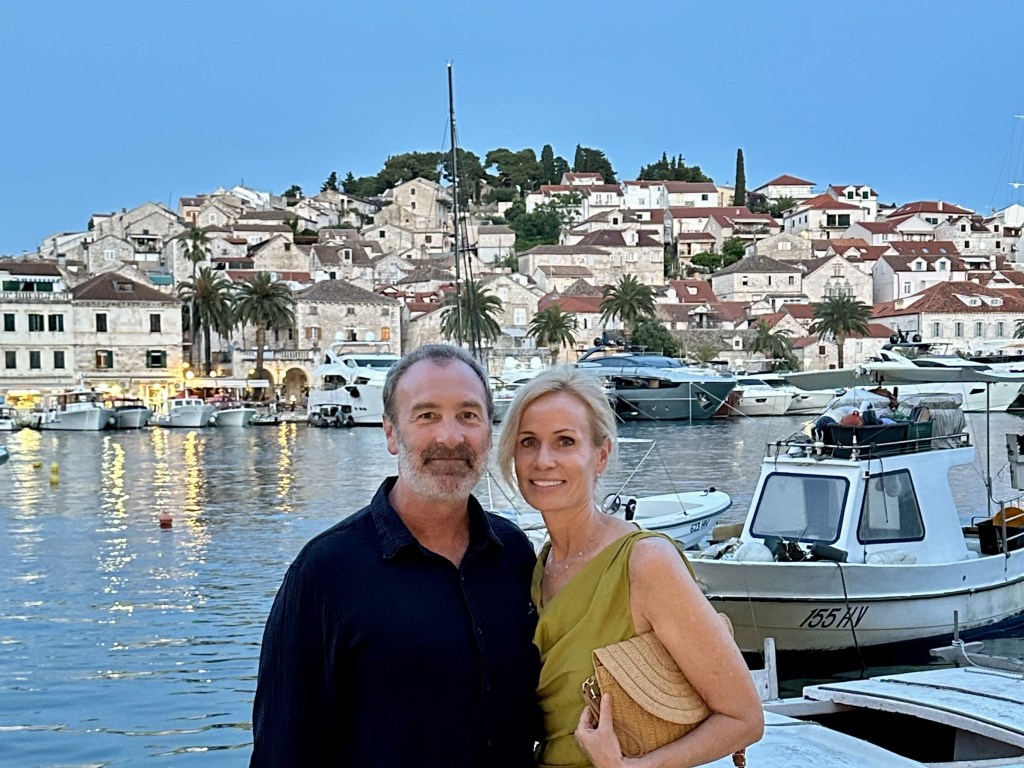
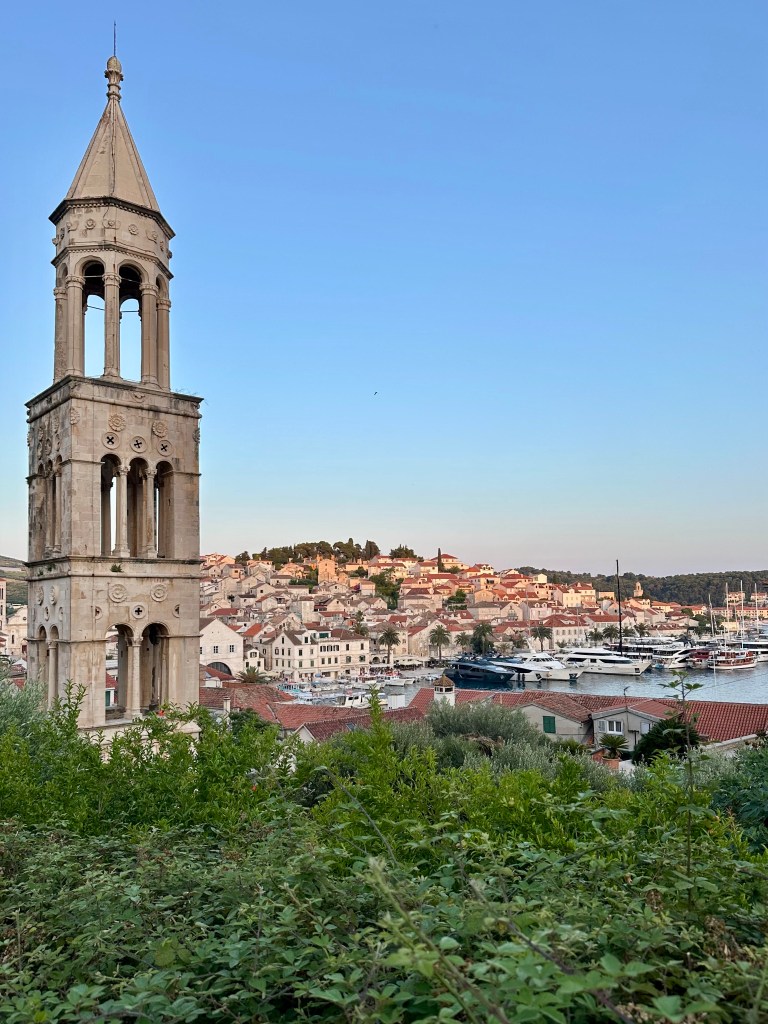
But it still had our favorite features – the historic port of the Venetian empire, always full of incredible yachts,
Super low-key atmosphere on the nearby Palmazini Islands,

and awesome, al fresco dining every night,

including one night at Dalmatino, one of the Boston Connell’s recommendations from their recent trip.

A little field trip one day to Hvar’s other town, Stari Grad, which turned out to be incredibly charming and atmospheric (and with no herds of 20 somethings around to degrade the vibe).

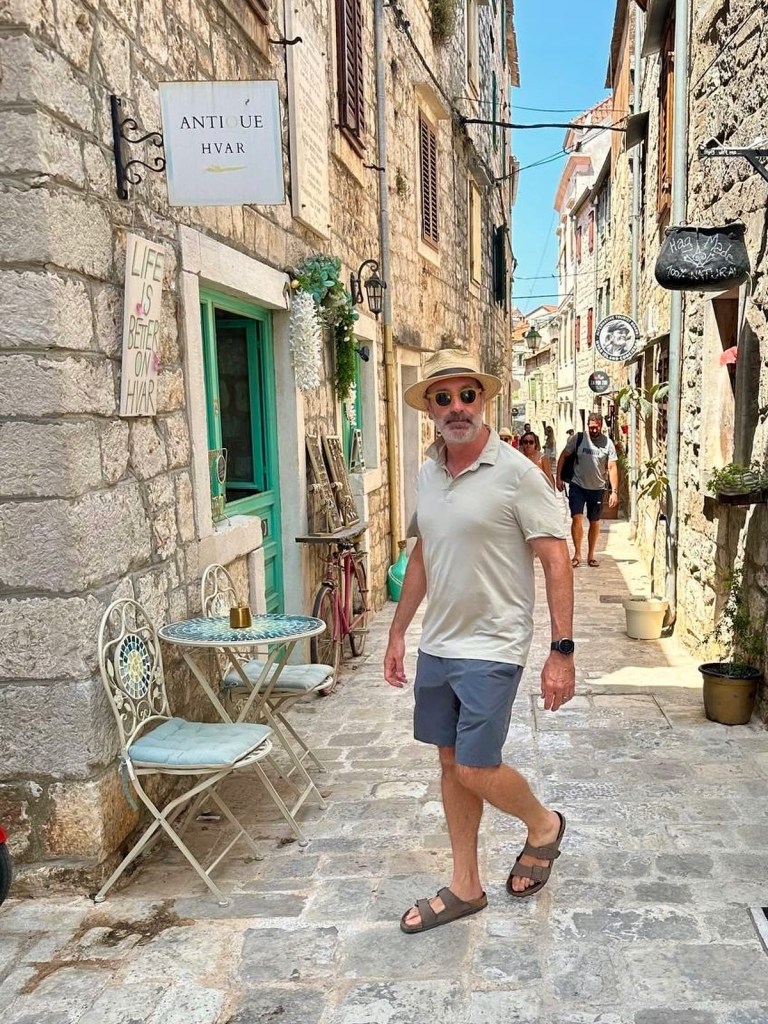
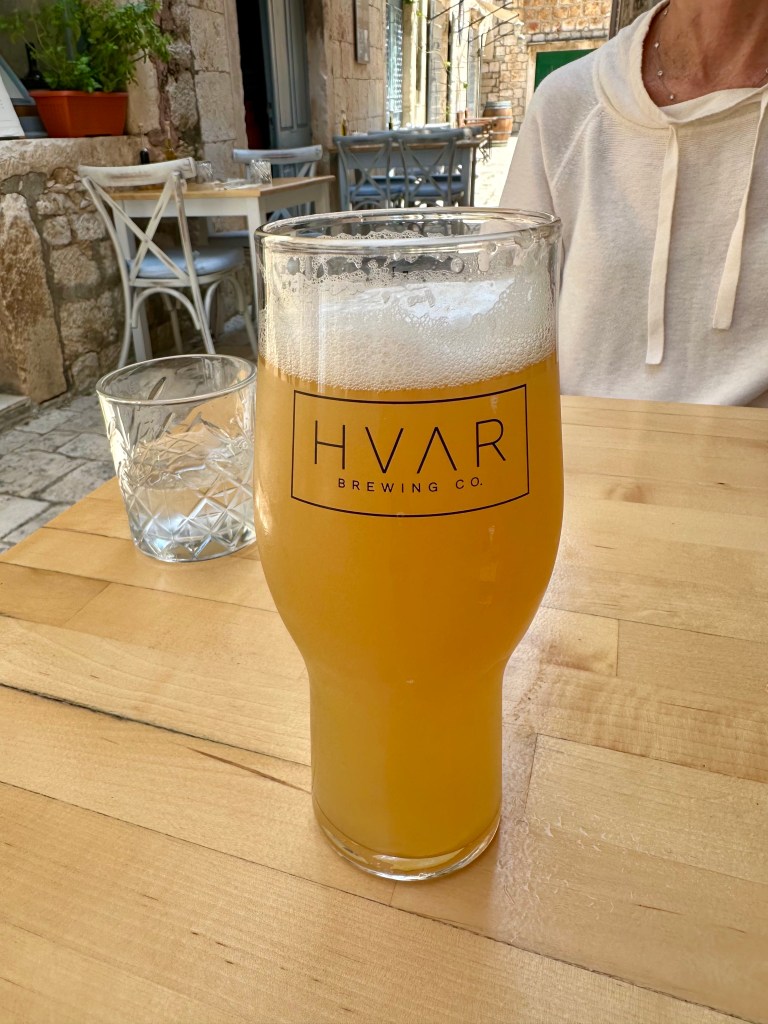
Very cool beach club at the foot of the hill below our AirBnB that we frequented two of the days of our stay.

Last night in Hvar before moving on.

Croatia – the Coast
To spend 4 days in Split, via the last of the five ferry rides of the trip.
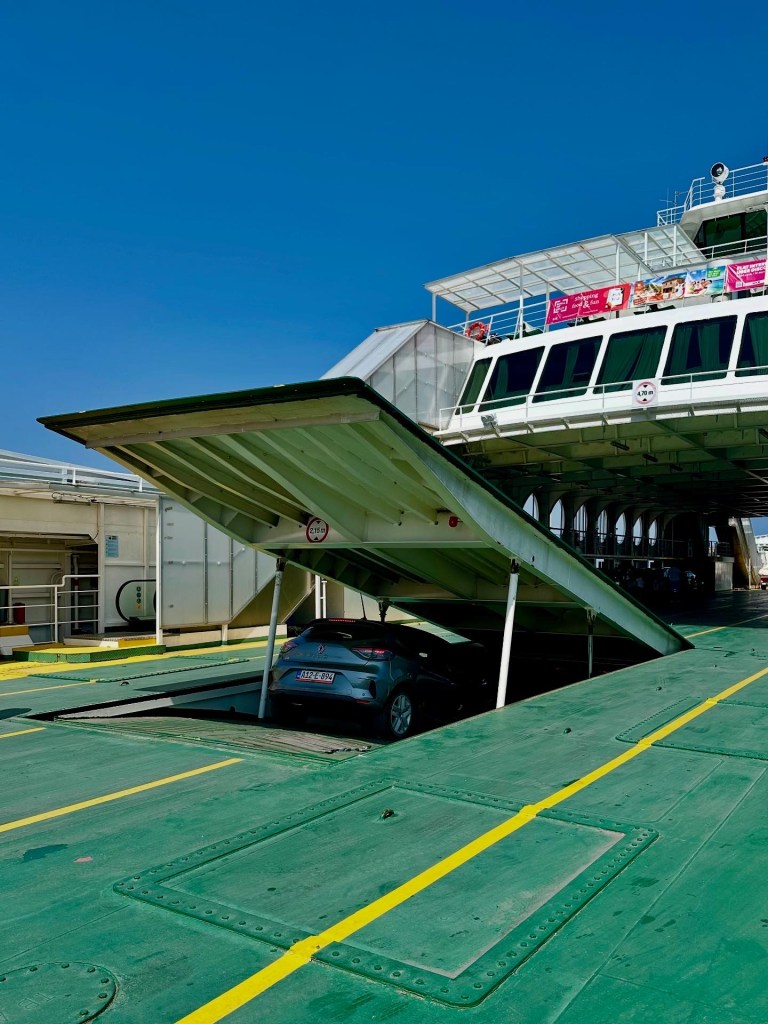
Split began as the Roman Emperor Diocletian’s Palace, built around 305 AD as his retirement residence, and grew into a bustling medieval town after refugees from the fallen city of Salona (which we would visit) settled within its walls, eventually evolving into Croatia’s second-largest city.
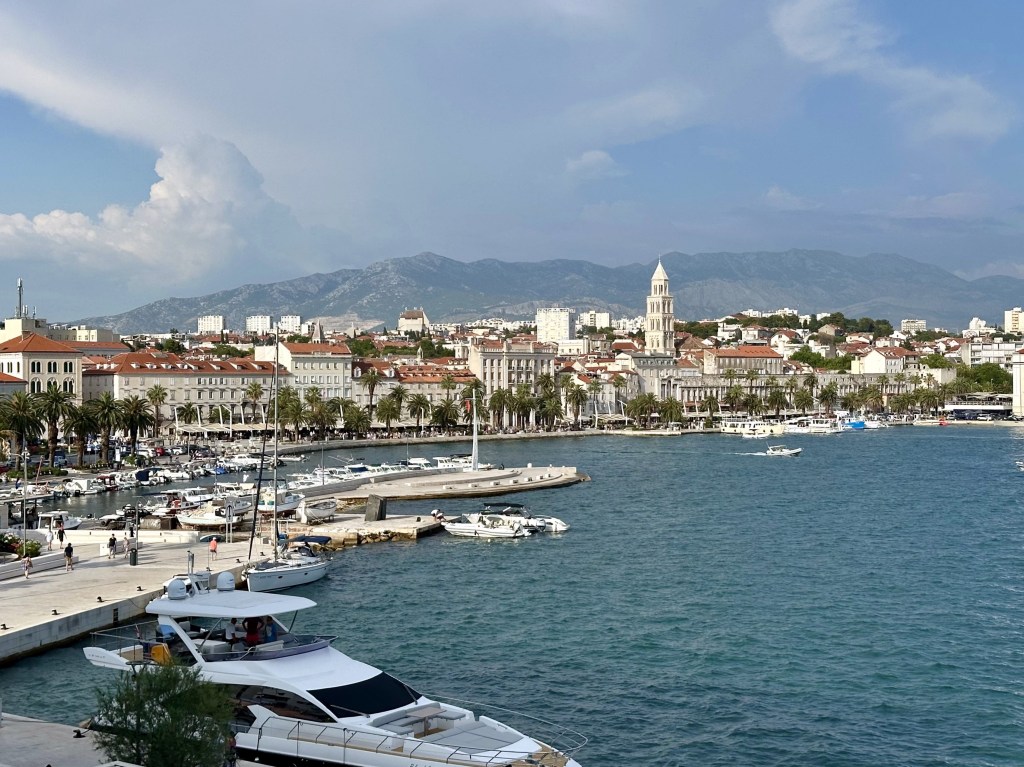
Split’s iconic Riva between Diocletian’s palace and the harbor – as appealing now as it was to us in 2008.

And the main square of the palace itself.


After AirBnBs on all of the Croatian islands so far, finally a hotel in Split (with a pretty cool setting, to boot).

A hot day trip to Klis Fortress, high above Split.

The fortress has served as a strategic stronghold since Illyrian times, famously defending Croatia against Ottoman invasions in the 16th century and later passing through Venetian, Napoleonic, and Austrian hands.

And another field trip to the ruins of the Roman city of Salona, once the flourishing capital of Roman Dalmatia with over 60,000 inhabitants.

The city was destroyed by invading Avars and Slavs in the 7th century, prompting its surviving residents to flee to the nearby coastal refuge of Diocletian’s Palace—laying the foundations of modern-day Split.

Yet another excursion from Split – this time to the incredibly charming Trogir just north of Split on the Dalmatian coast.
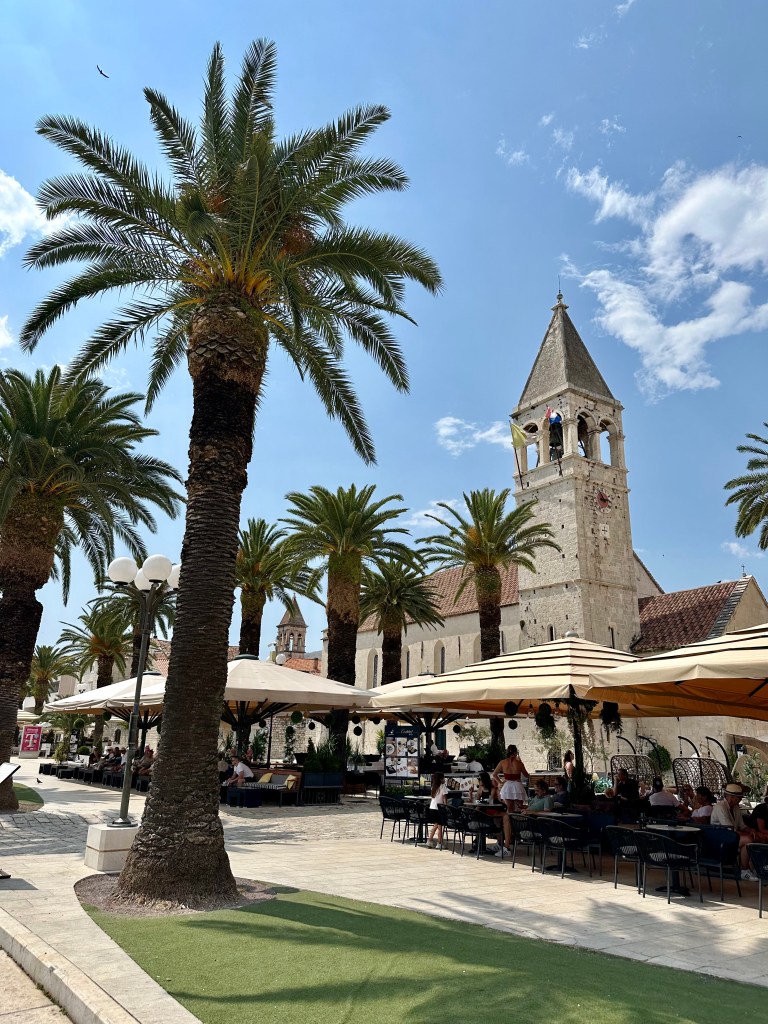
Trogir was founded by Greek settlers from Vis in the 3rd century BC and thrived under Roman, Venetian, and other rulers as a fortified port town, preserving a remarkable blend of medieval, Renaissance, and Baroque architecture that earned it UNESCO World Heritage status.

Sporting its own little Riva, Trogir struck us as Split’s Mini Me.

A final field trip from Split to the island of Brač (which is actually closer to Hvar, but we didn’t act on our original plan to visit it from there because the boat left Hvar way too early for us). Oh, and more little fried fish!

The Dalmatian islands and coast were pretty hard to beat – everything we were looking for.
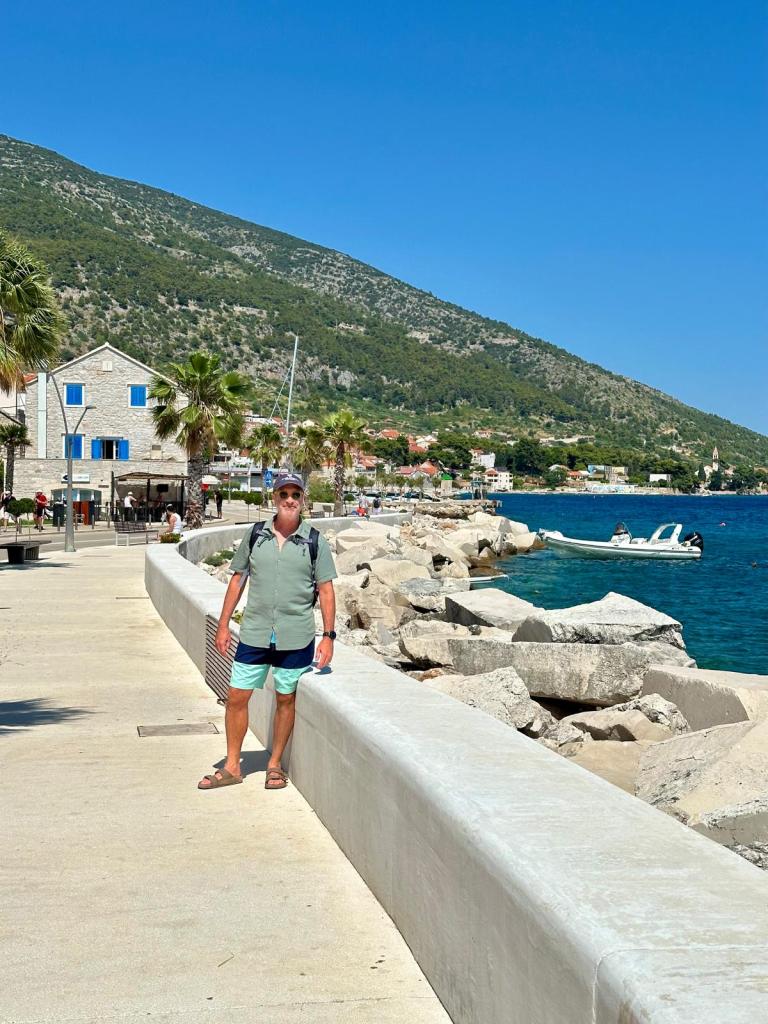
But we had to end our stay in Split and move on.
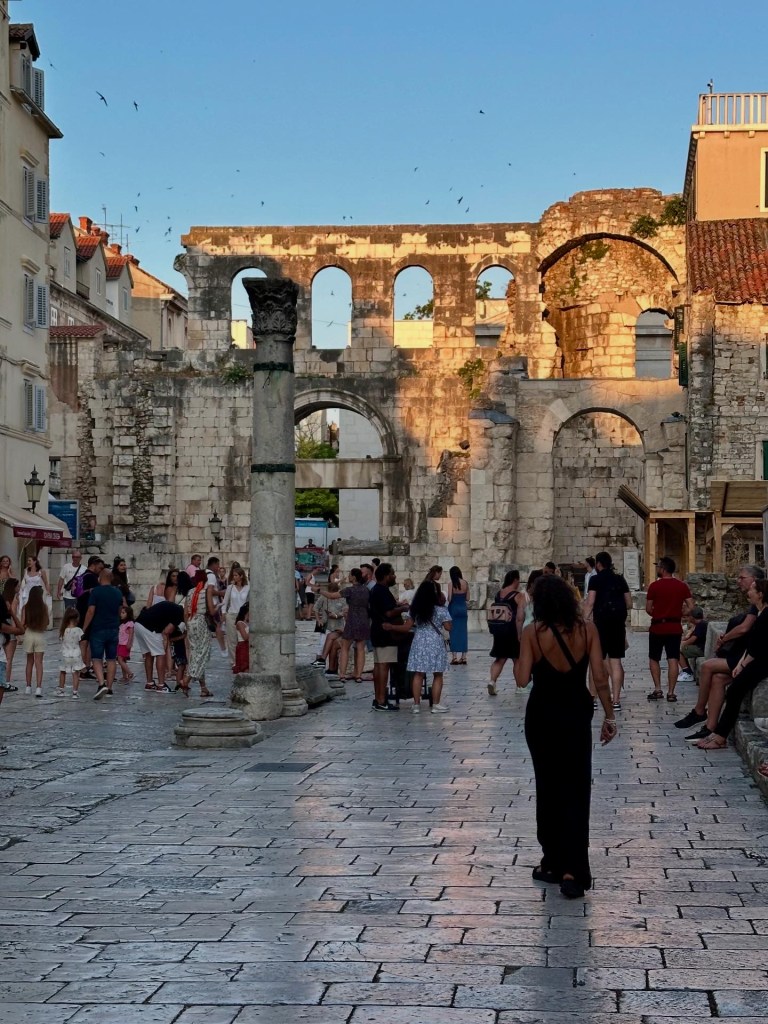


Cool free concert in Diocletian’s palace on the way home:
We continued to drive north, this time to Zadar – another Venetian masterpiece – where we’d spend another 3 days. Zadar, a settlement since prehistoric times, became a Roman colony in the 1st century BC and later a prominent medieval Dalmatian port, enduring Byzantine, Venetian, and Austro-Hungarian rule before joining modern Croatia.
Zadar’s Venetian Gate, built in 1543 during Venetian rule, which once served as the city’s grand entrance and a symbol of its strategic maritime importance.

The 10th century Basilica of St. Donatus built on the ruins of a Roman temple of Jupiter and Minerva.

The Five Wells Square, built in the 16th century, was engineered to provide the city with fresh water during Ottoman sieges and remains a testament to Zadar’s resilience:

The highlight of our stay was an all-day boat excursion that began with a visit to a ridiculously cool, Bond-villain-esque, abandoned Yugoslavian nuclear sub pen:
And then proceeded to swimming and snorkeling spots along the islands off the coast, including snorkeling on a freighter wreck. Throughout the trip and including here off Zadar, the Adriatic was spectacular.

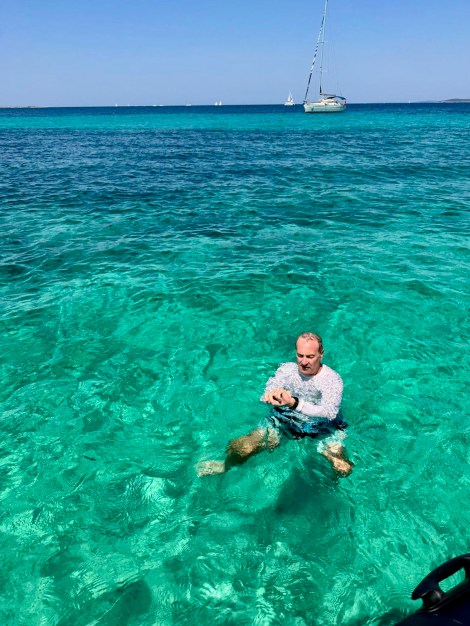
We then continued to drive north along the coast to Krk, a Croatian island perennially in search of its missing vowel. (A massive bridge connects the island to the mainland, so no ferries needed, and Krk does not get counted among the Croatian islands category addressed previously.)

The Frankopan Castle in Krk, built between the 12th and 15th centuries by the powerful Frankopan noble family, served as both their residence and a defensive stronghold protecting the island’s main town.
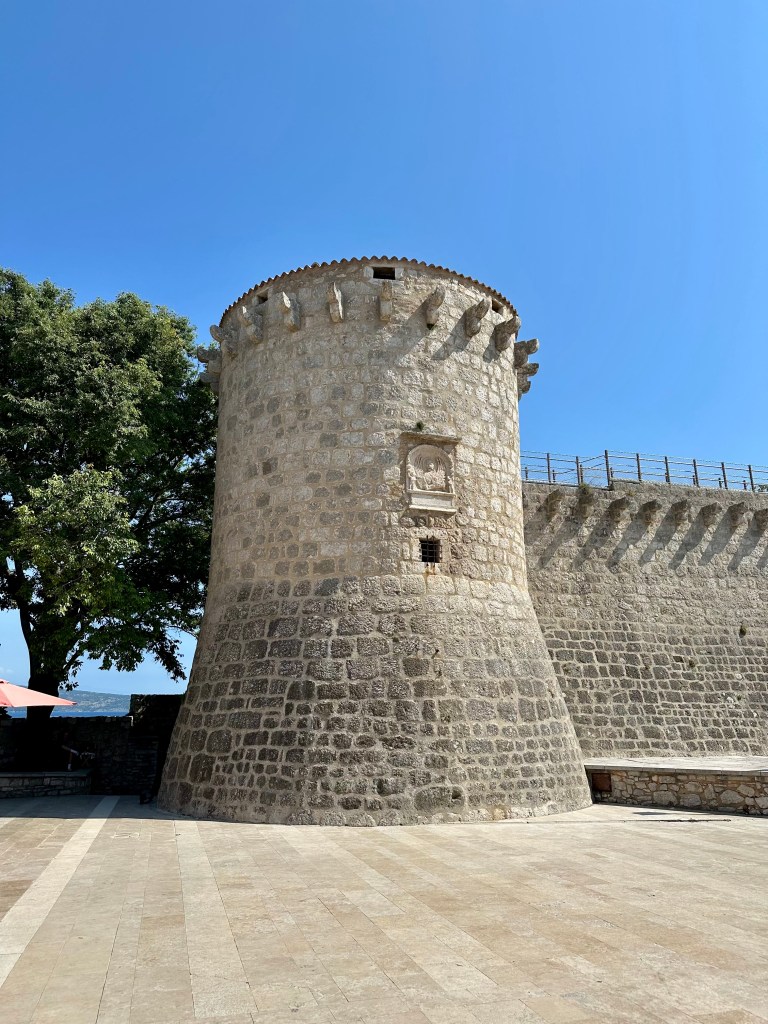
Krk harbor:

Pretty cool view from the AirBnB.

A view surpassed by that of our next lodging at our last stop in Croatia: Rovinj.
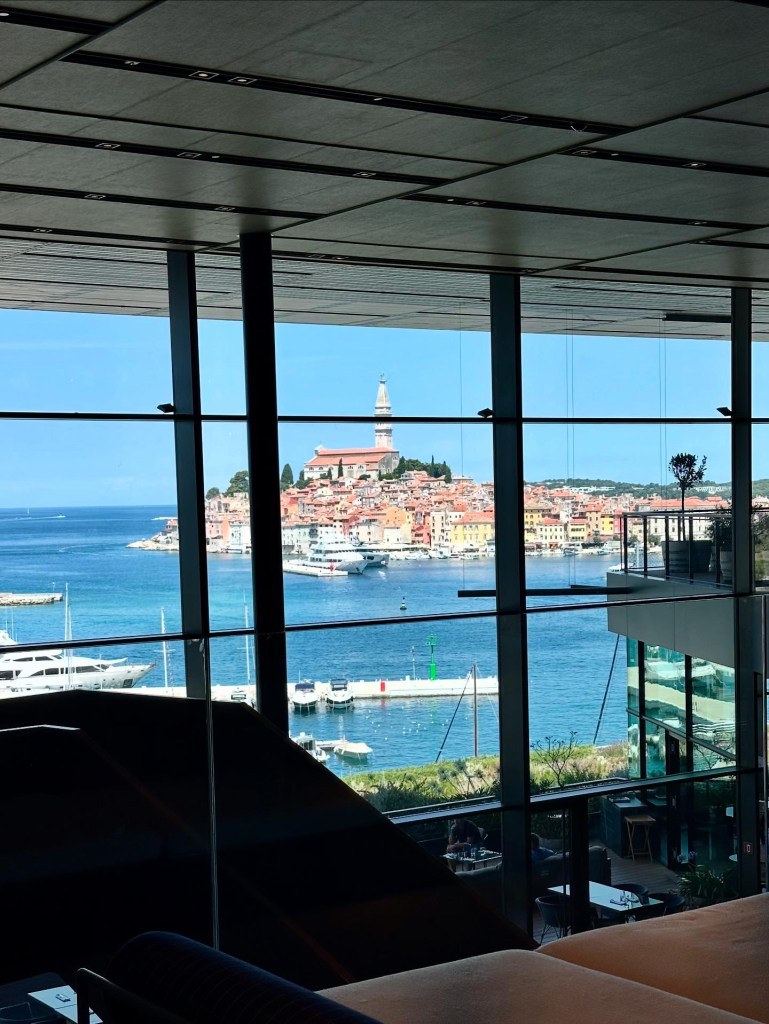
During our visit to Rovinj in 2008, we stayed inside the historic Venetian old town. This time, we stayed across the harbor so we had a view.

Pretty good decision.
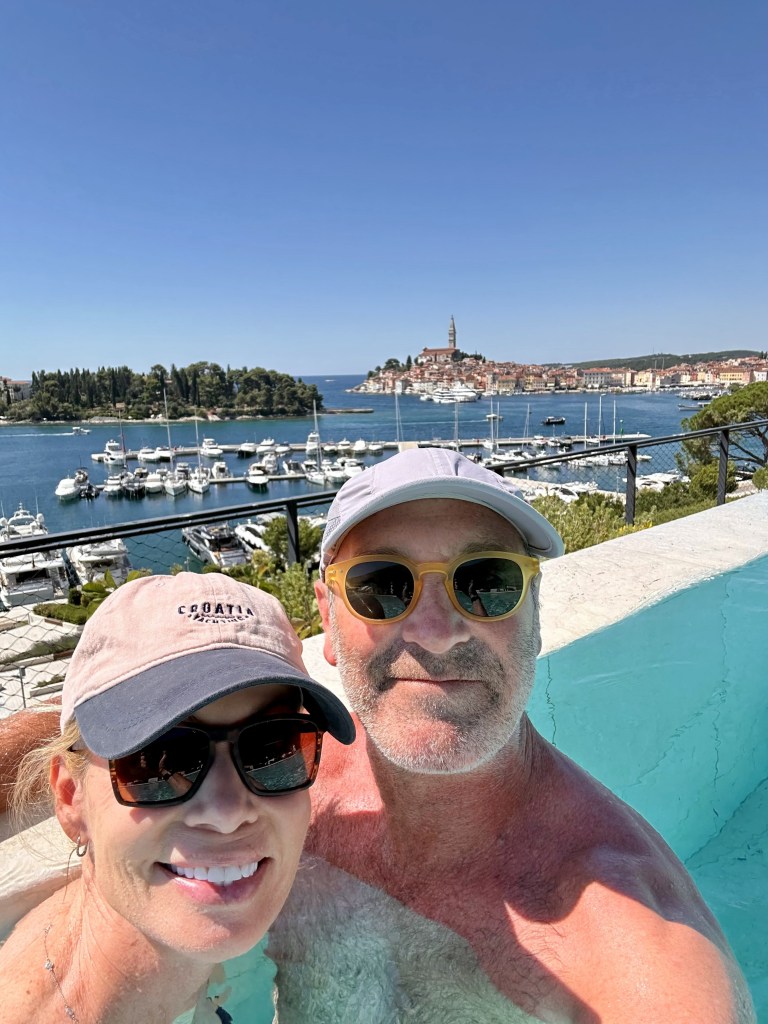
Rovinj evolved from a Roman settlement to a Venetian fishing village in the 13th century, and developed into a charming Adriatic coastal town known for its medieval architecture and vibrant maritime heritage.

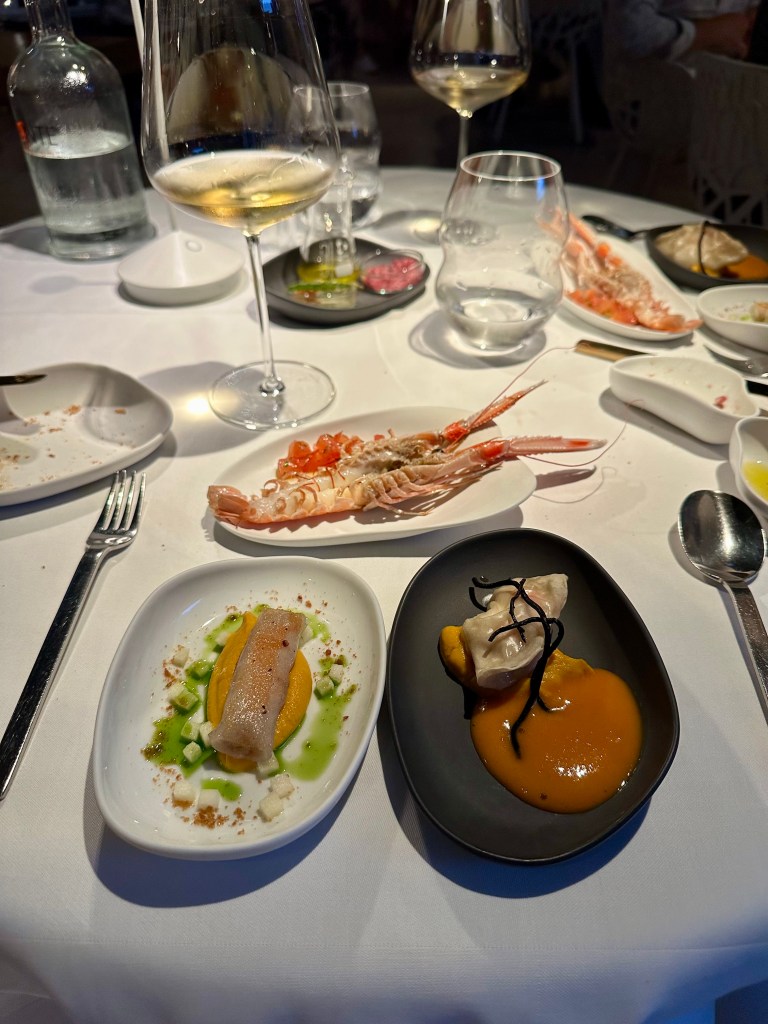
Second Michelin dining experience of the trip in the middle of Rovinj’s old town
Field trip to medieval hamlet of Bale. . .
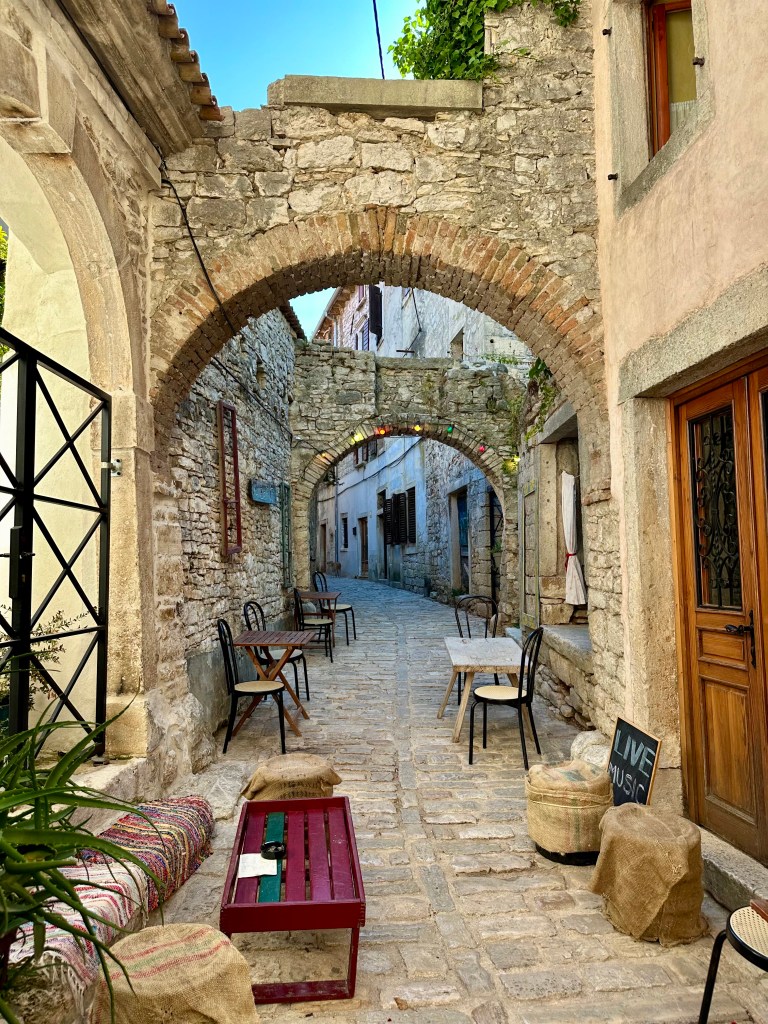
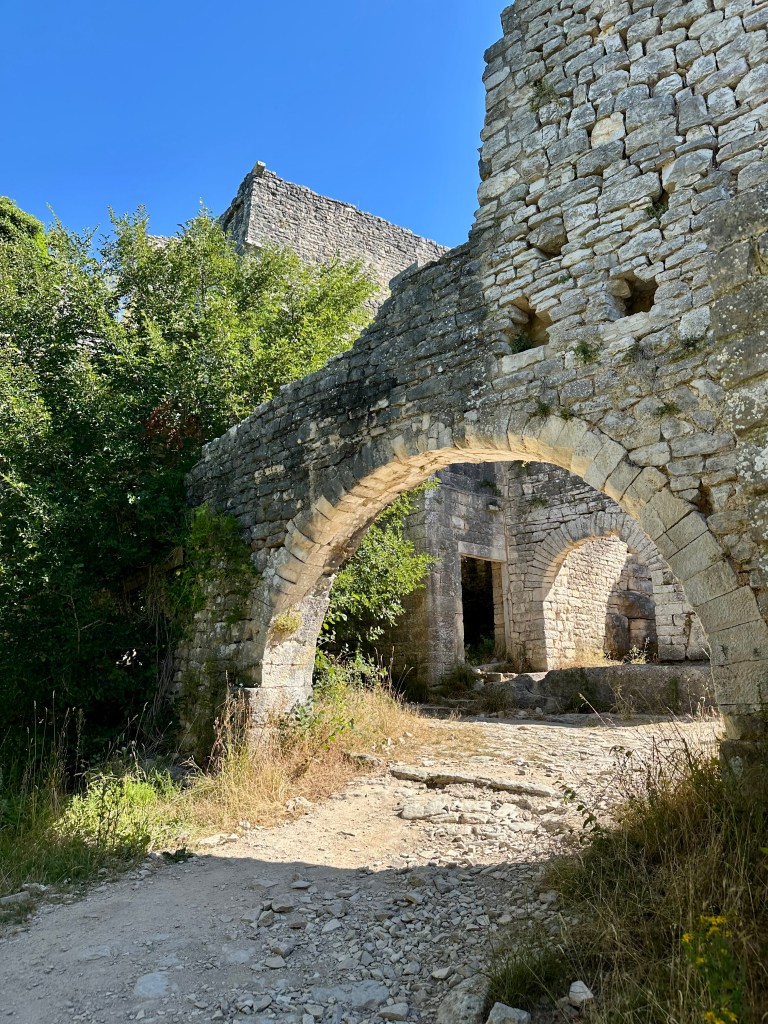
and the ruins of the medieval town of Dvigrad.
Last evening in Rovinj.

and last sunset at La Puntulina, where we had enjoyed our favorite dinner in 2008.

Dolomites
After 4 days in Rovinj (and 25 days in Croatia), we drove north to finally cross the border into Italy and the Dolomites – the second major segment of this trip (combined with South Tyrol). Our goal in the mountains was to experience the iconic hikes we kept seeing on Instagram, and so we based ourselves in towns with easy access to the trailheads of these hikes.
We stayed first in Cortina d’Amprezzo, which will co-host with Milan the 2026 Winter Olympics.
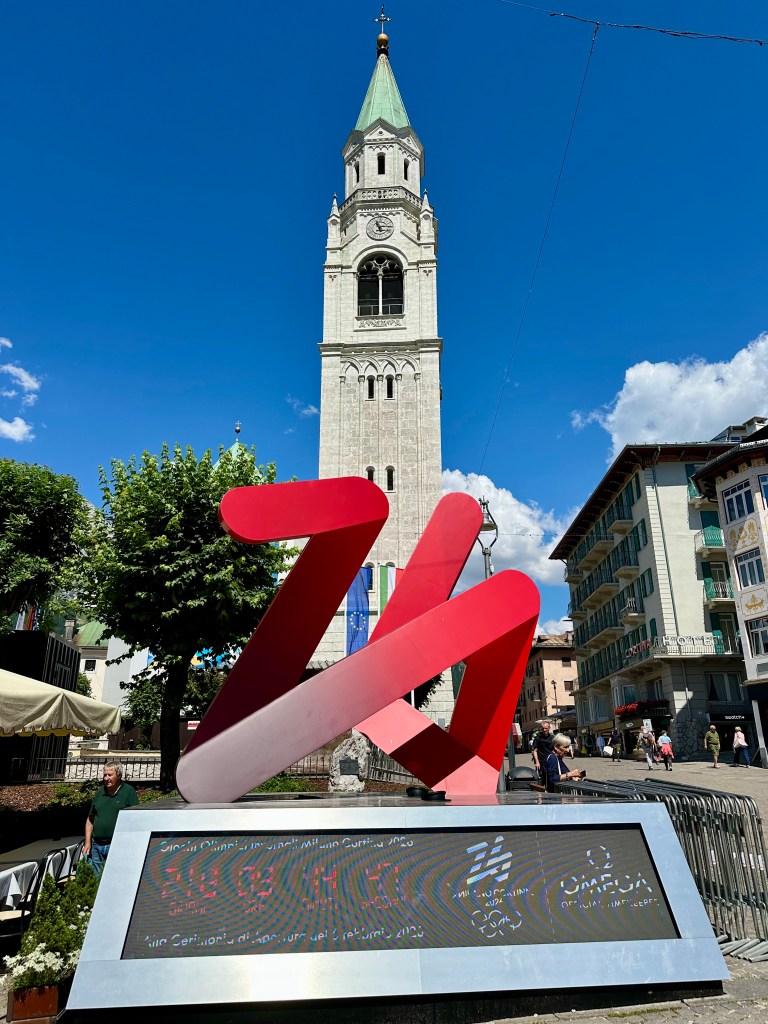
The next day, we hit the trails, first up was the out-and-back hike to Lago di Sorapis:

The day started out perfectly (then we’d get absolutely drenched in a downpour during the last 1.5 miles of the hike on the way back).
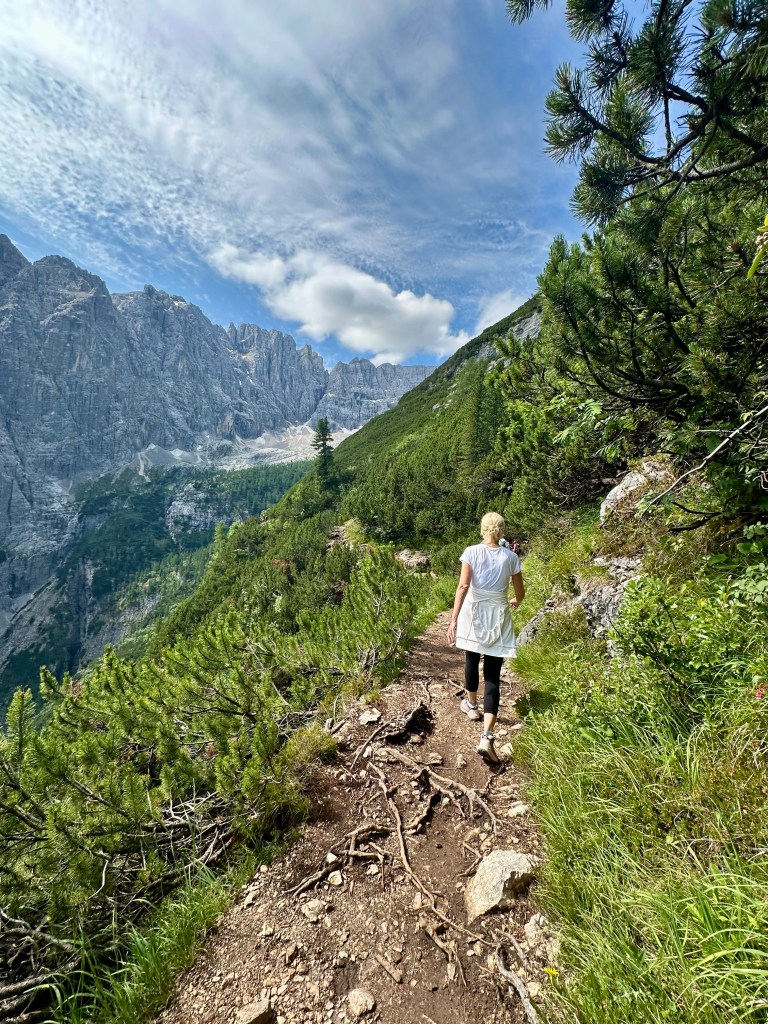
The lago at the apex of the hike was, indeed, pretty spectacular (although crawling with skeevy Instagrammers posing up a storm, which we took great pains to avoid including in our pics).

Then, thoroughly soaked from the rainstorm and while still drying off in the car, we drove about 45 minutes to Lago di Braies, another reportedly iconic experience in the Dolomites. The lake was spectacular, but it was pretty touristy. That didn’t stop us from doing the touristy thing and renting a boat to row across and around the emerald lake.

The next day, we first took three gondolas to reach the Cima Tofana di Mezzo, 10,573 feet above Cortina d’Ampezzo and above the clouds.

Where we encountered snow in July (and a reminder of why we ultimately chose to bring boots to hike in instead of our regular trip shoes – a choice we were surprisingly torn over, which seems absurd in retrospect).

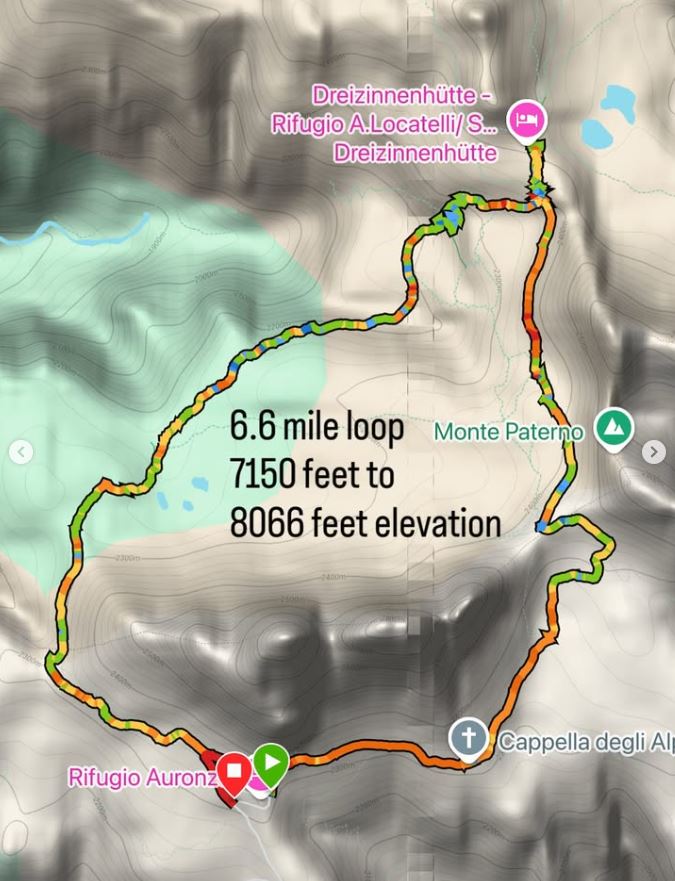
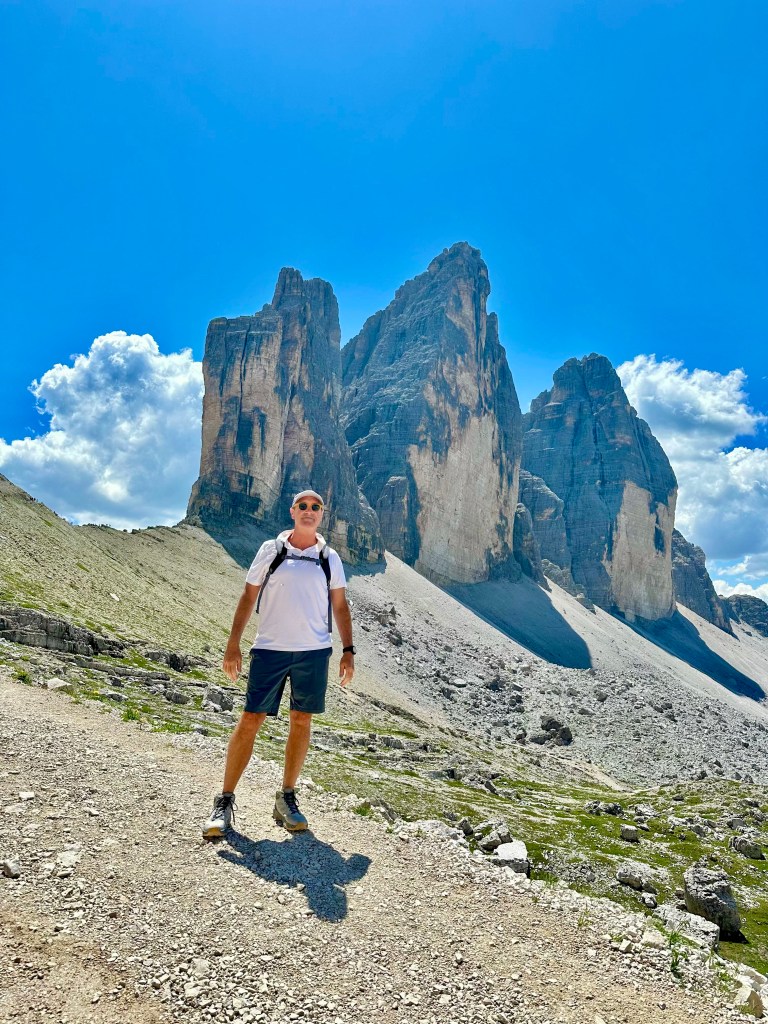
Then, we hit the Tre Cime loop hike, easily the hottest hike of the trip.
Tre Cime = Three Peaks:

After 3 days in Cortina, we headed west over some pretty incredible mountain passes to reach what turned out to be our other favorite spot on the trip: Ortisei.
And a new language for WolfeStreetTravel upon reaching it: Ladin. For years, our favorite obscure European language was the fourth official language of Switzerland, Romansch, which, tradition holds, resulted from the abandonment and isolation of Roman legions in Helvetica when the Western Roman Empire petered out. But in Ortisei we encountered Ladin (the first language on the trilingual sign below).

Like Romansch in the Alps, Ladin is living evidence of Roman history in the Dolomites. Its origins trace back to the Romanization of the Central and Eastern Alps. When the Romans conquered the region (1st century BC–1st century AD), Latin mixed with the local Raetian and Celtic languages spoken by the mountain tribes. Over centuries, this “vulgar Latin” evolved in the isolated Alpine valleys, diverging from mainstream Italian, French, and standard Romansh. The term Ladin historically referred to the word Latinus (Latin), underlining its Roman roots. Today Ladin survives in five main valleys in the Dolomites – including Val Gardena, where Ortisei is located – which are naturally secluded by mountains. Until modern roads and tunnels, each valley was quite cut off, preserving dialects and traditions.
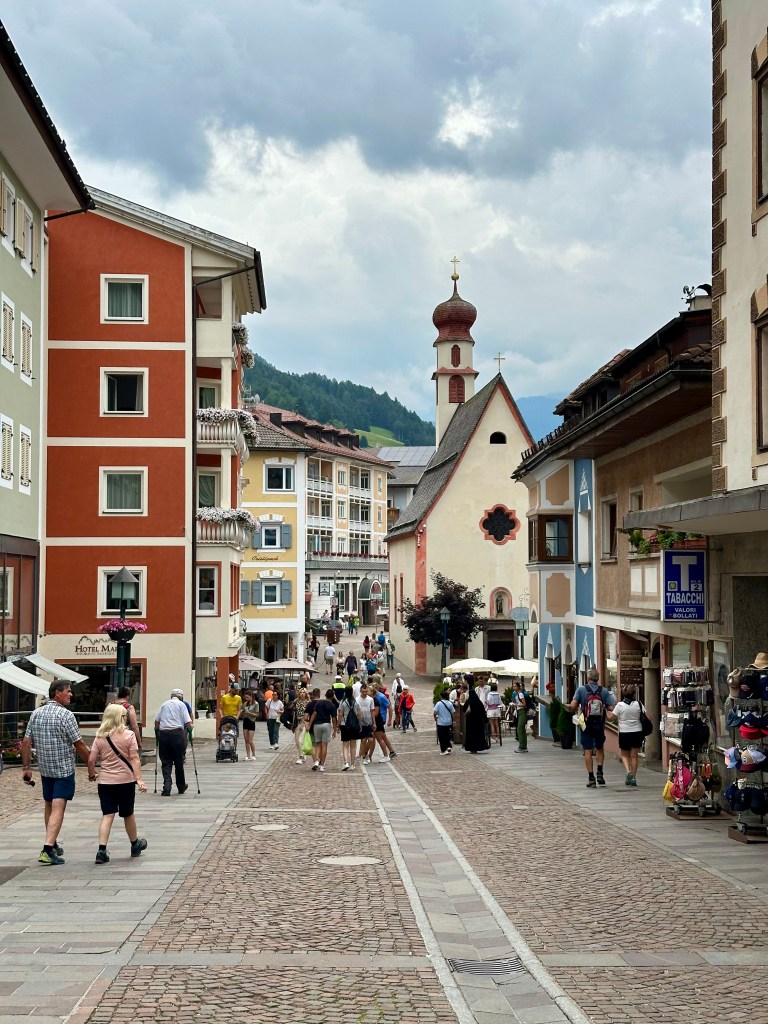
And Ortisei itself was super charming (and way more German Tyrolean than Italian).
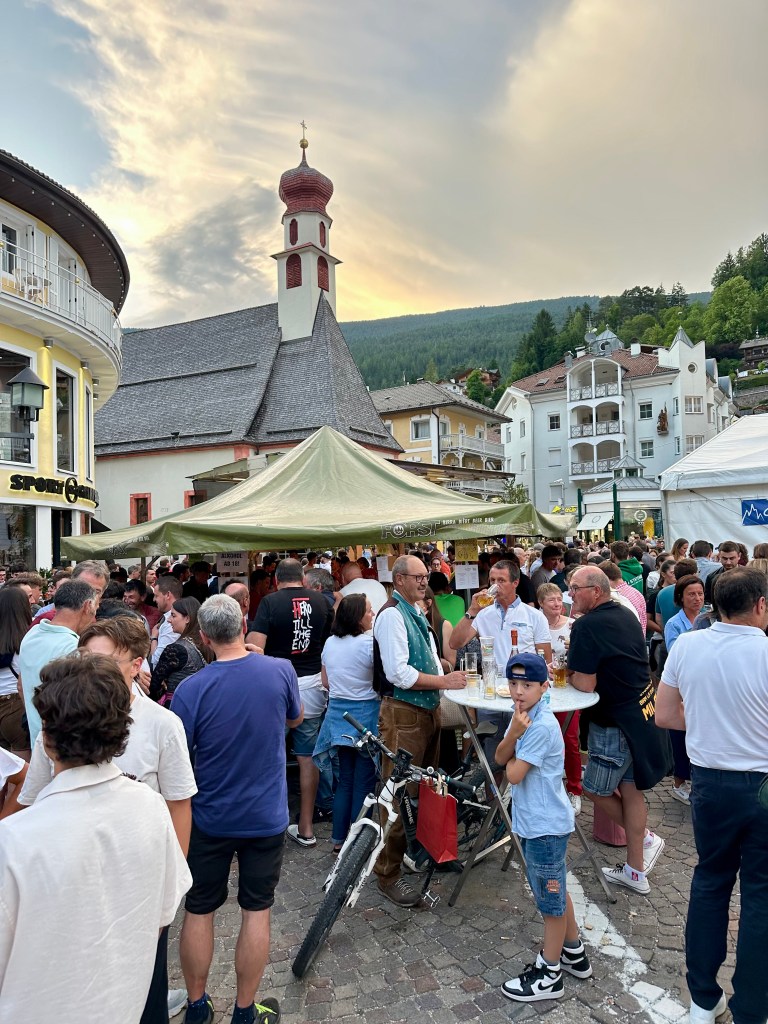
Including a decent smattering of lederhosen at the town’s beer festival.
Also, instead of driving to each of the trail heads like in Cortina, all three of the major hikes out of Ortisei were accessible just by walking down the street to three different gondolas. Way more civilized.
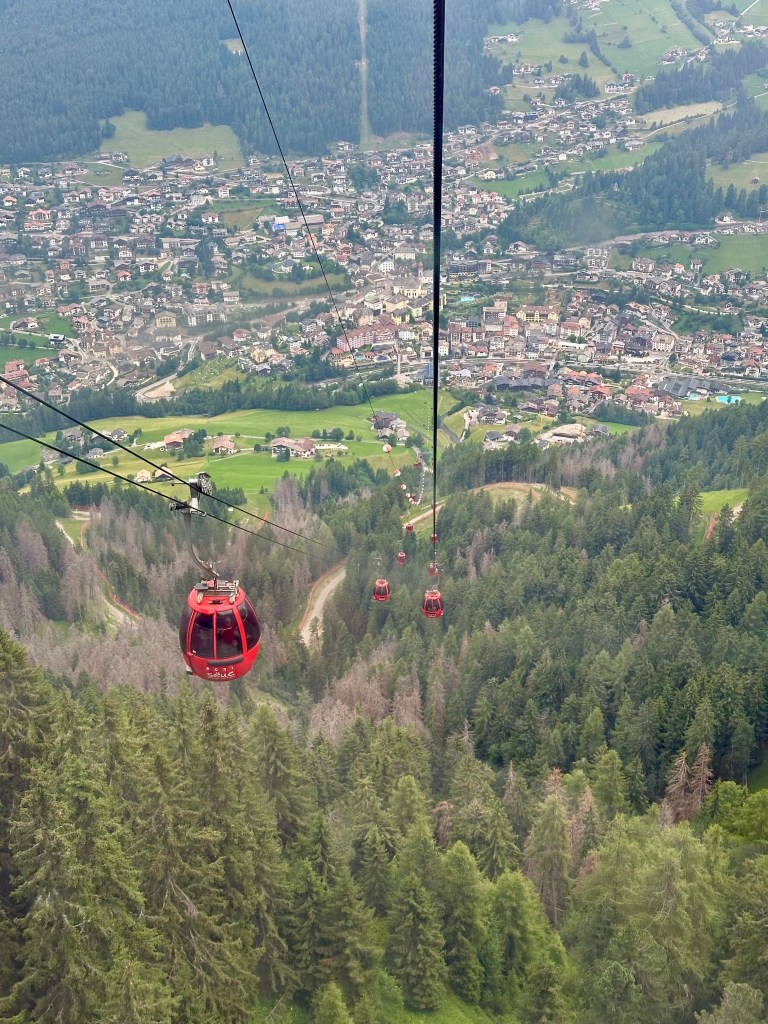
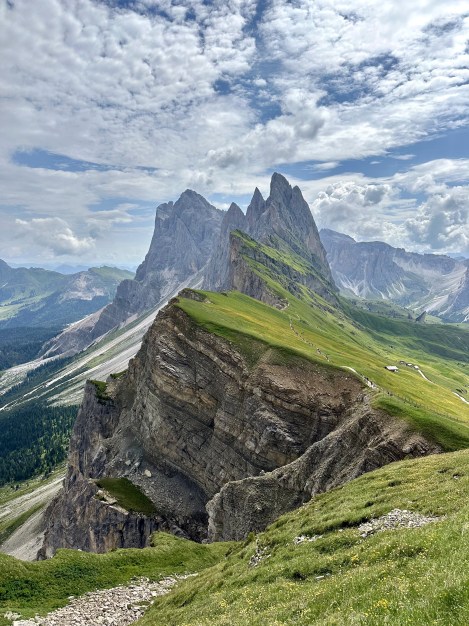
Just as Ortisei became our favorite town in this leg of the trip, our first hike out of Ortisei turned out to be the most spectacular of the trip: Seceda.
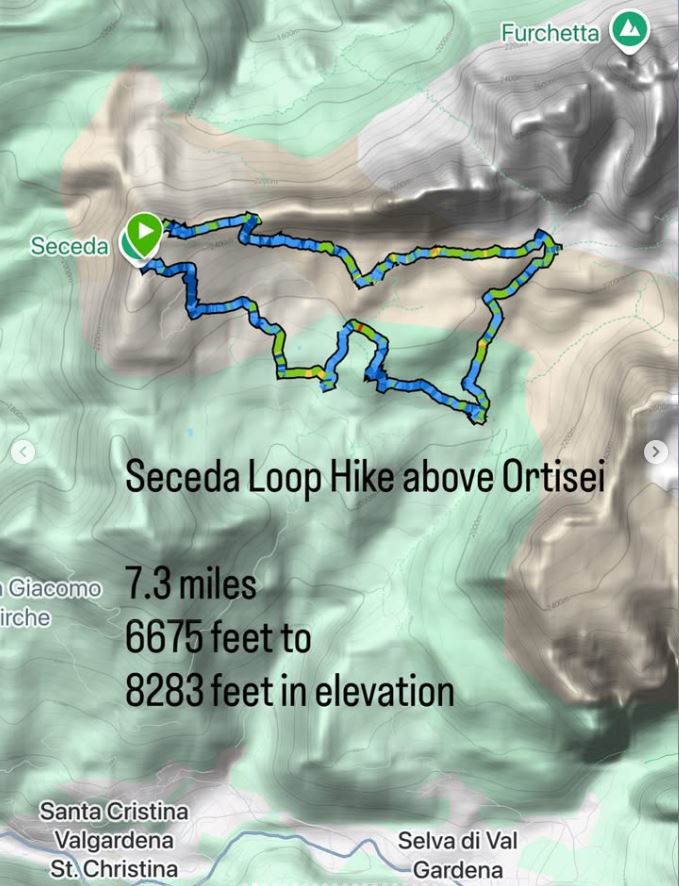
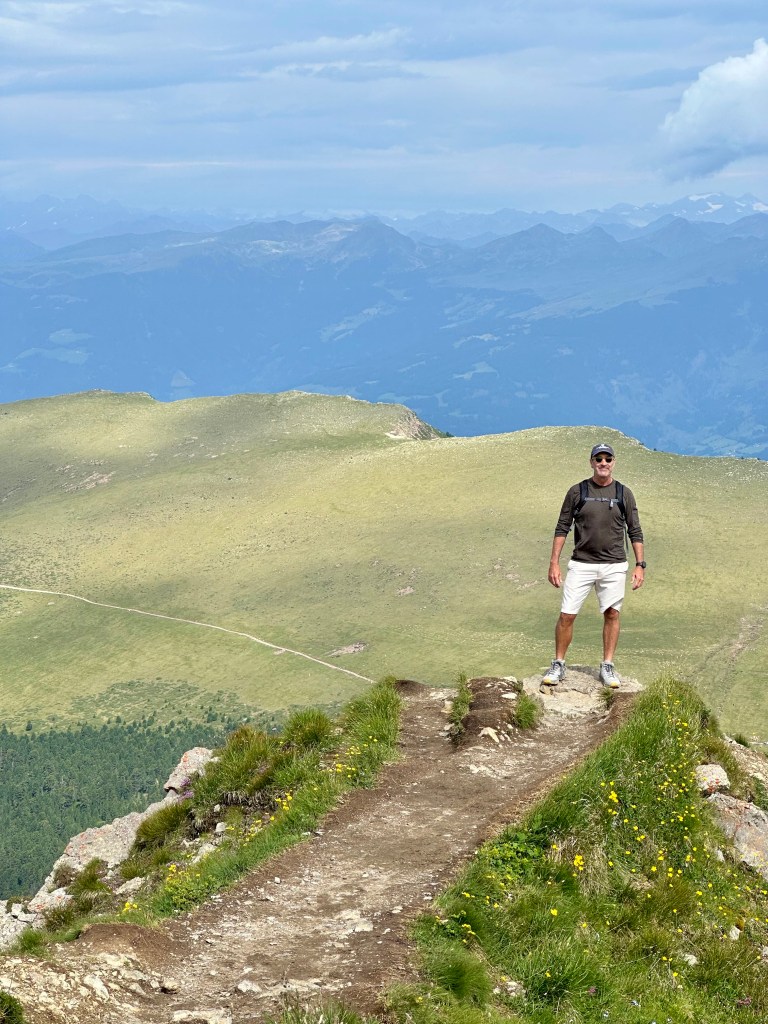

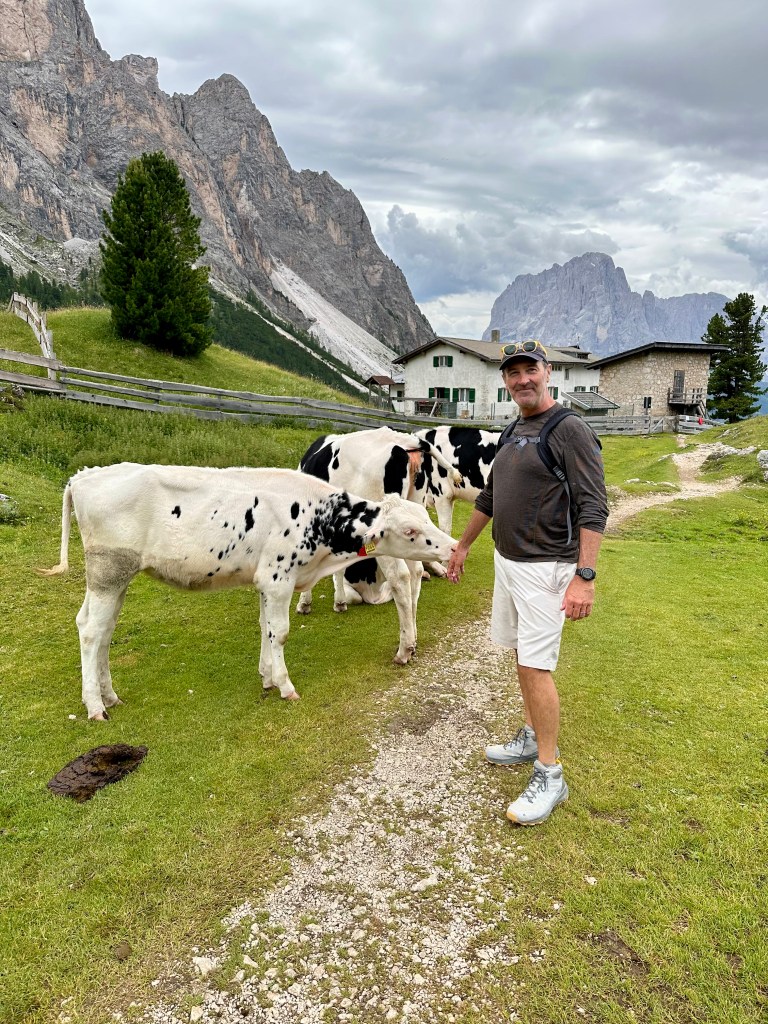

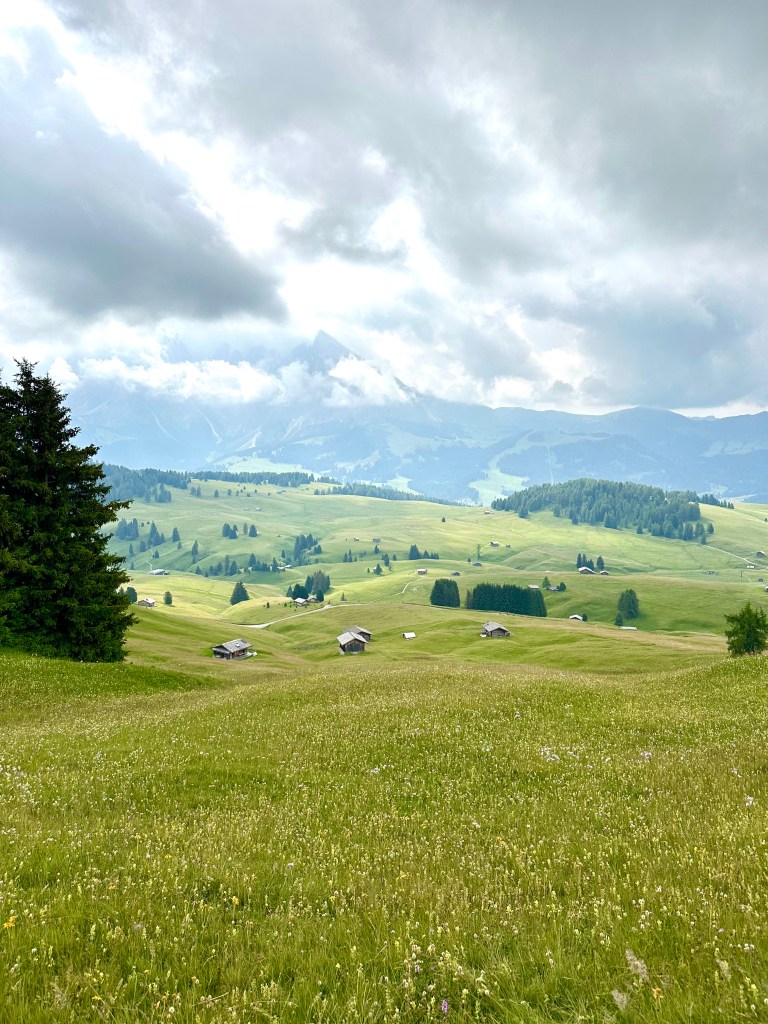
Our next hike across the Alpi du Siusi was the most boring. . .

Meh.
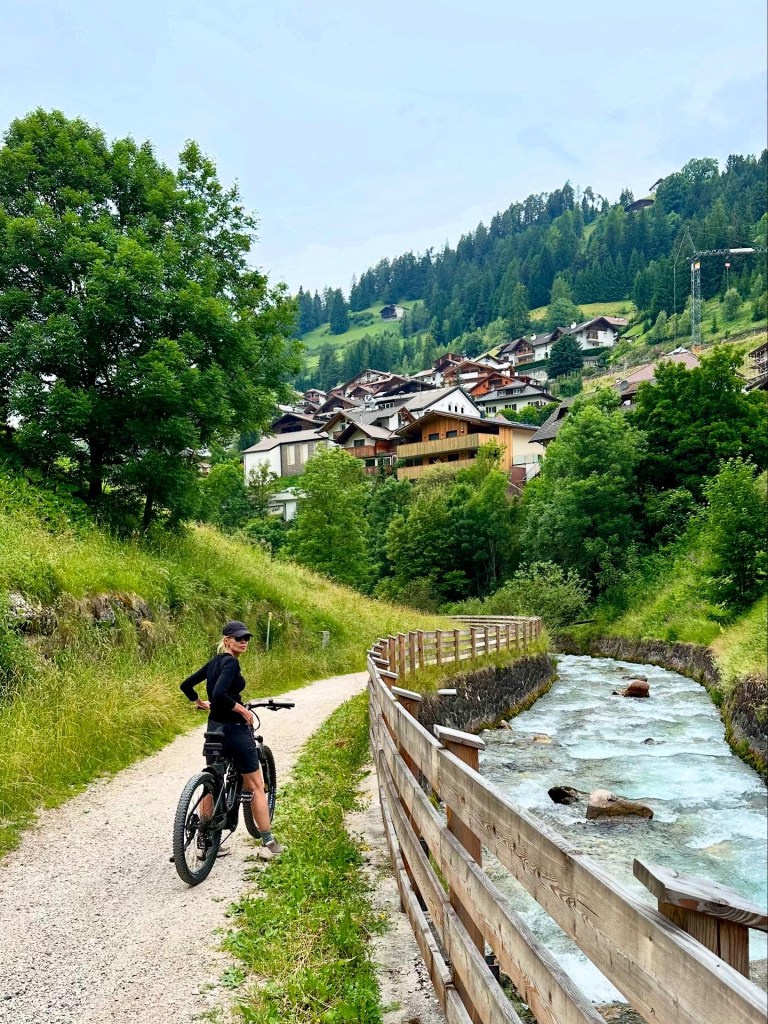
So we headed back down into town, rented bikes, and rode along a cool bike path that followed the bottom of the valley to each of the towns in the area.
But we were rewarded with our third Michelin dinner of the trip that evening:

Our final hike should have been much longer, but we hightailed it back when we were not only caught in another deluge, but also hail. In July.
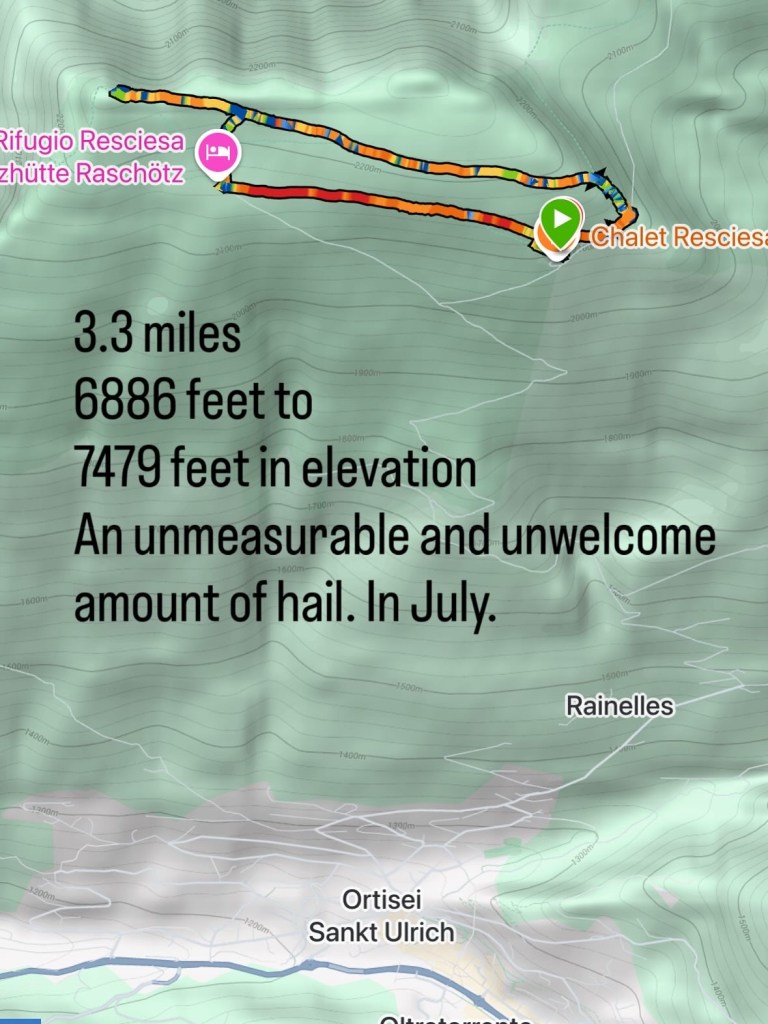
Absolutely insane, but also hilariously unexpected, as clearly articulated in this video on the cliff:
South Tyrol
From Ortisei we veered a little northwest to Plose Mountain in the South Tyrol and our epic stay at a hotel that our safari friends recommended to us:
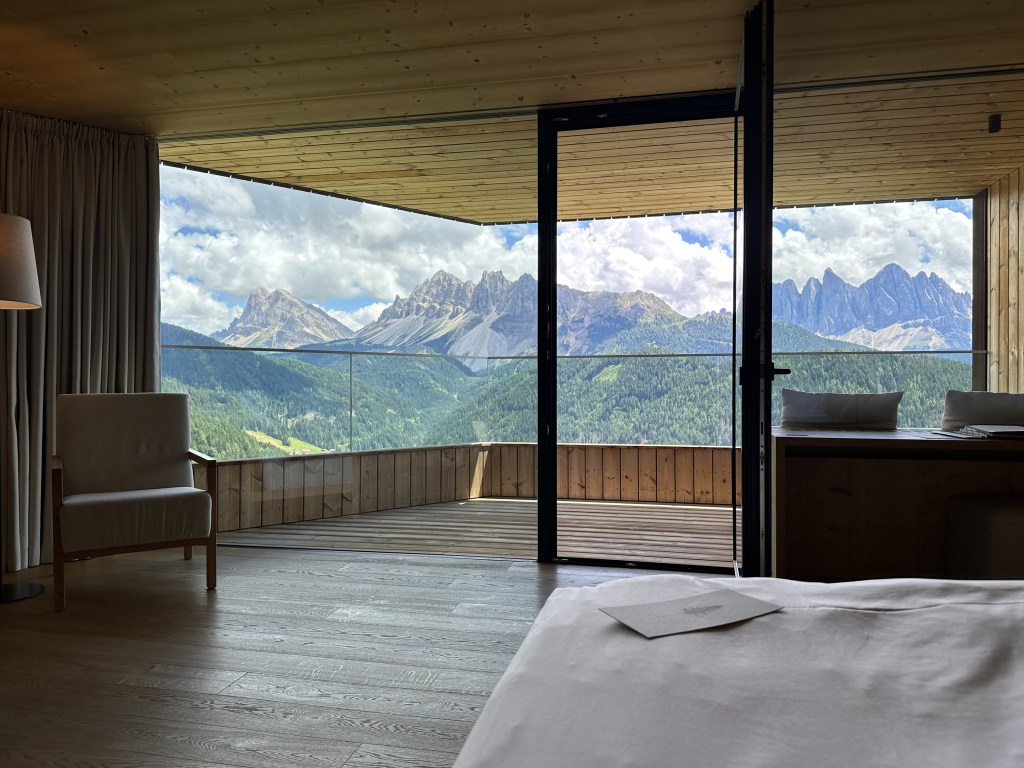
Third favorite hike of the trip – Plose Mountain, Part Uno (or maybe Part Eins, considering that in the Italian South Tyrol, they’re still all German-speaking Austrians in a region that was transferred from the Austro-Hungarian Empire to Italy after WW I).


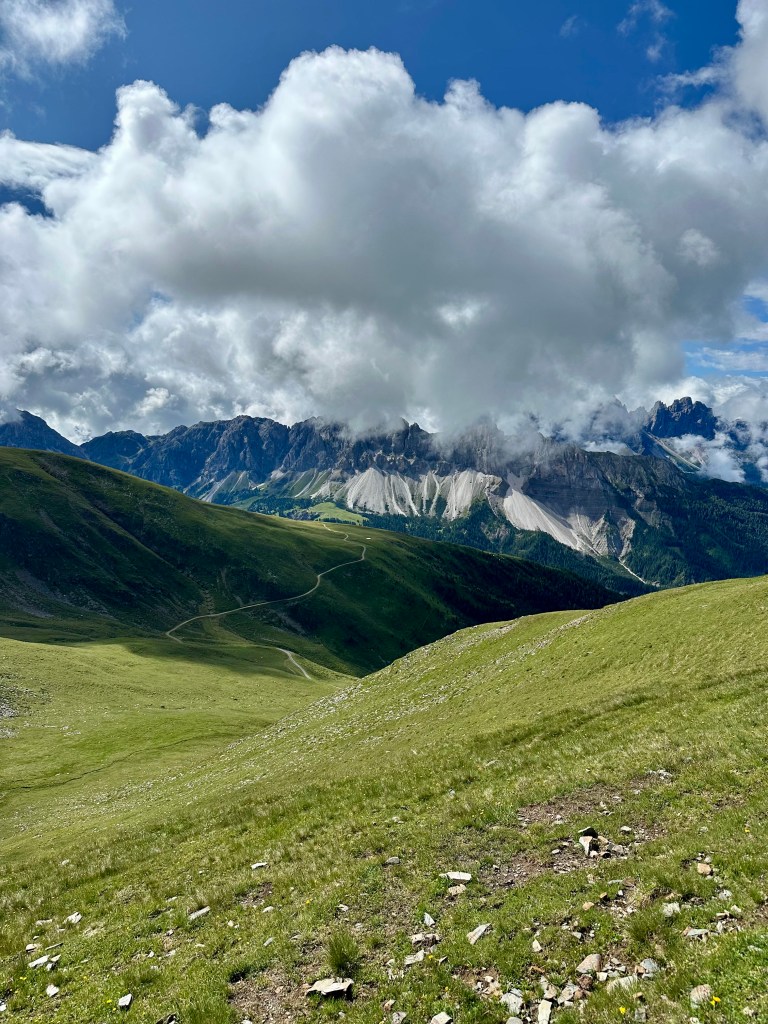
The next day, back up we went – Plose Mountain Part Due / Part Zvei, where we climbed to the peak itself, after hitting the other two peaks nearby on the first hike. Second favorite hike of the trip, even though it hailed on us at the end of the trek – AGAIN!


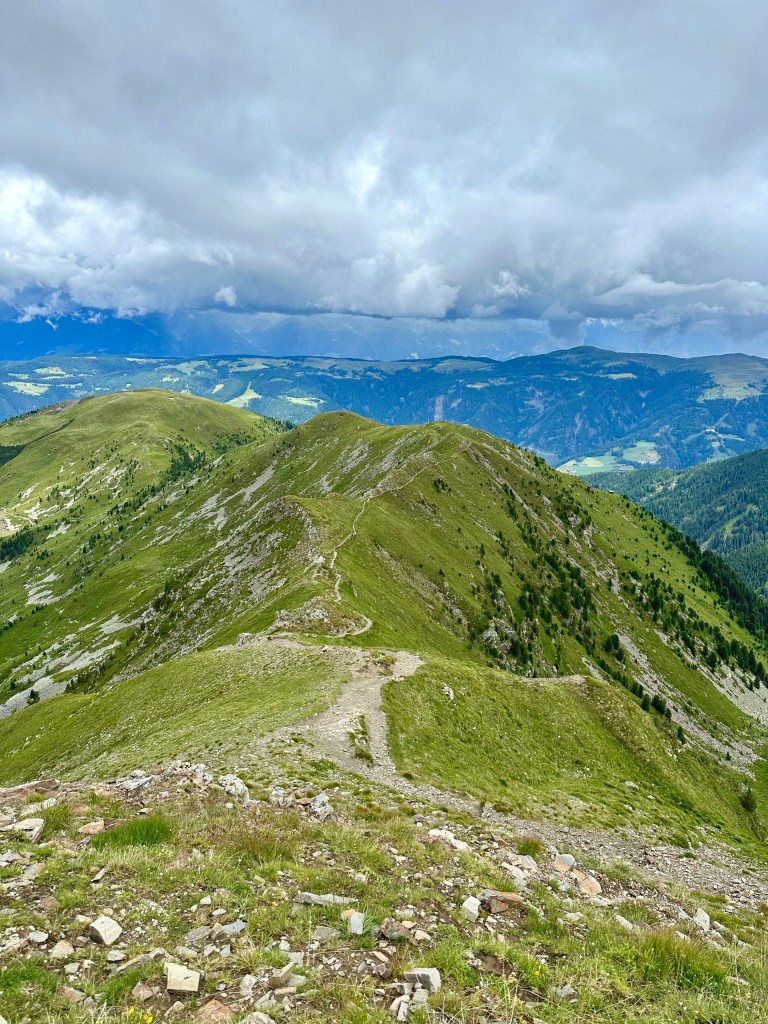
It was also 42 degrees at the top – lowest temperature of the trip.

Then, a quick stopover for a night in South Tyrol’s capital of Bolzano.
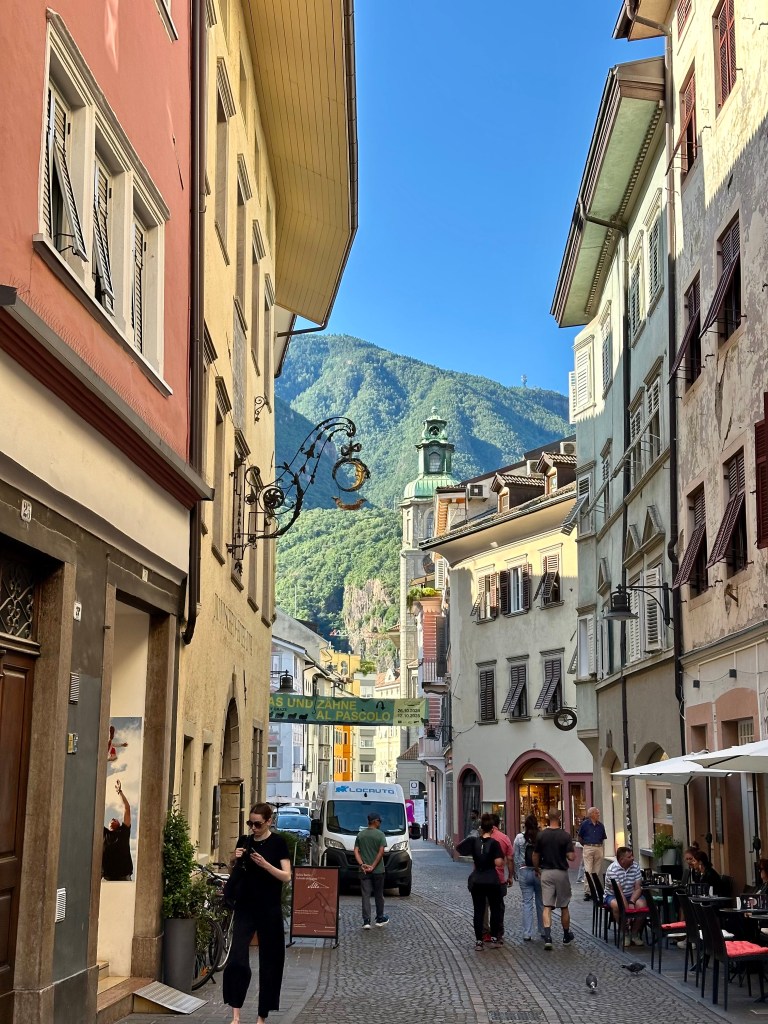
Another cool perch at our place perched 4035 feet above the town of Merano:

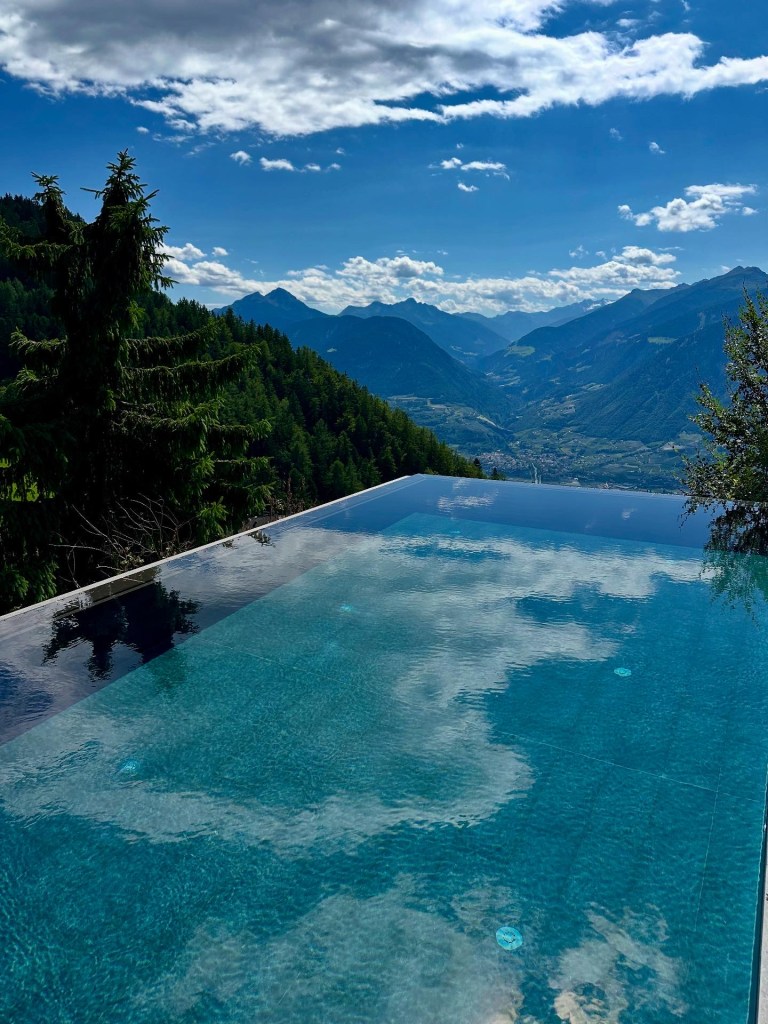
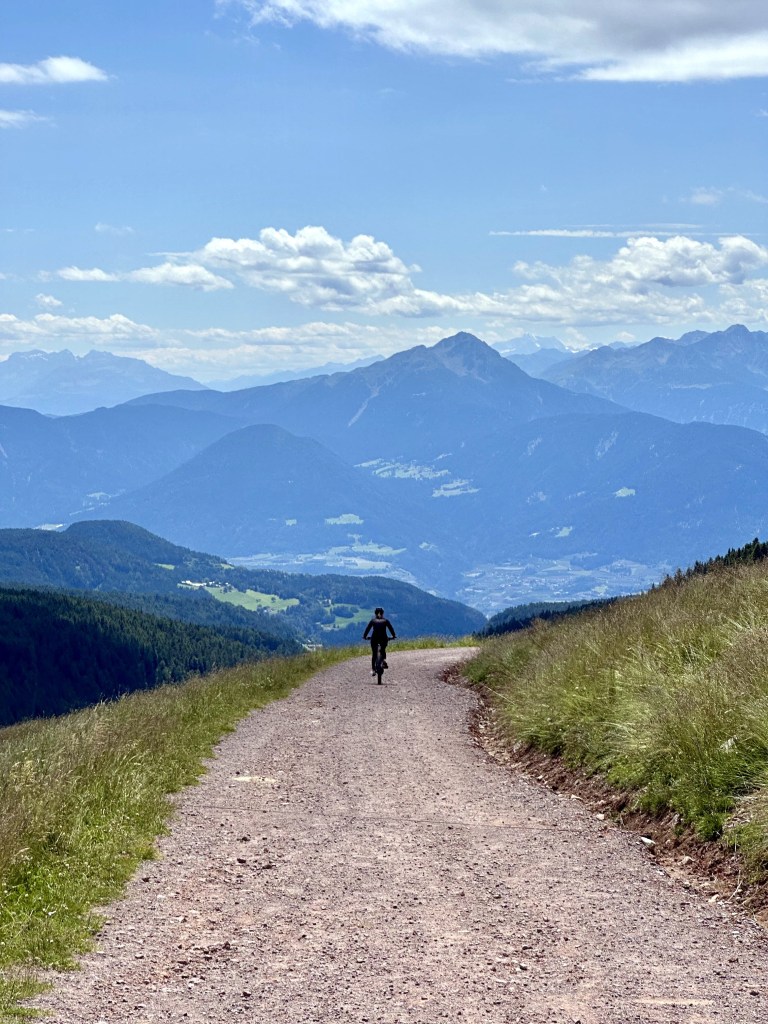
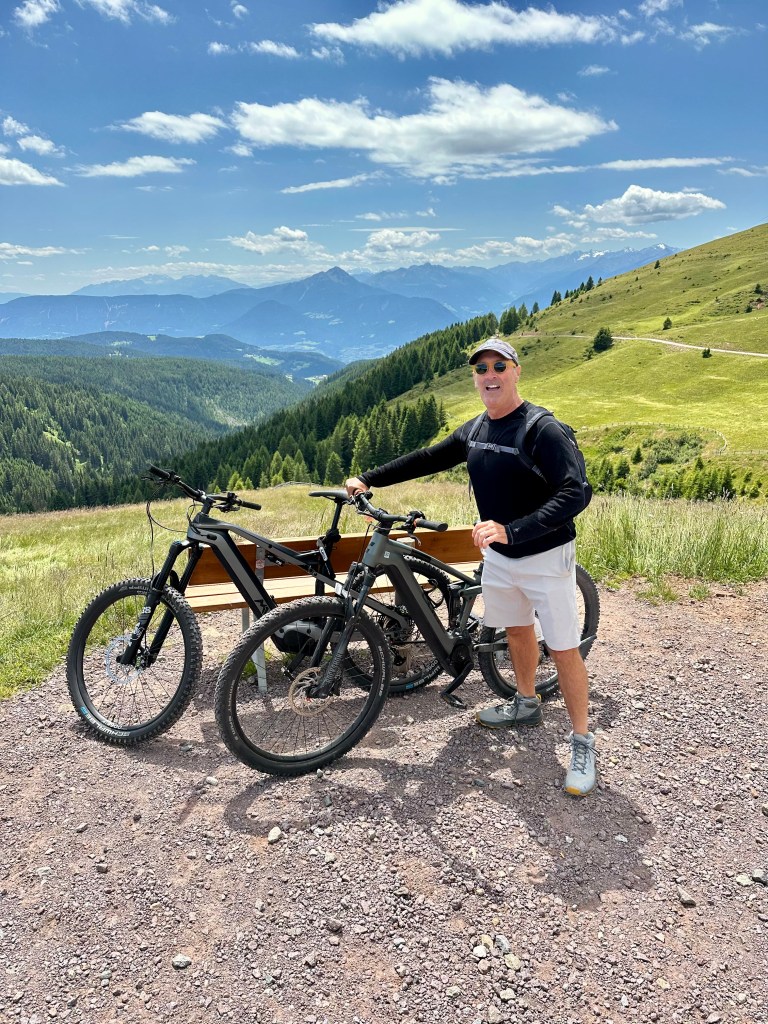
Foregoing our hiking routine, at MiraMonti, we rented bikes to ride up and around the nearby Merano 2000 mountain.
Romantic Road in Bavaria
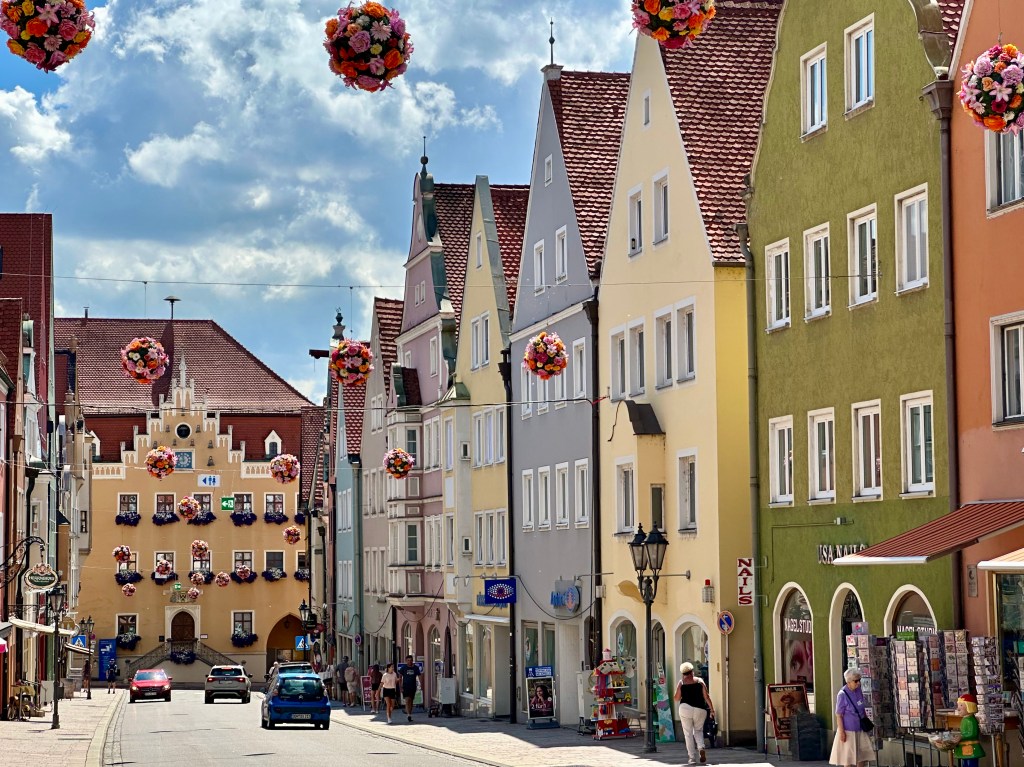
We spent the last few days of the trip on the Romantic Road, visiting the string of medieval walled towns just over the border in Germany where the clock has stopped some time in the 15th century.


Although not officially on the Romantische Straße, we stopped for a night to revisit Garmisch-Partenkirchen (and to do a bunch of laundry in the AirBnB, since we’d only been in hotels since Rovinj).
The charming Bavarian town we remembered as Garmisch from our earlier trip turned out, in fact, to be Partenkirchen, which was way more interesting.
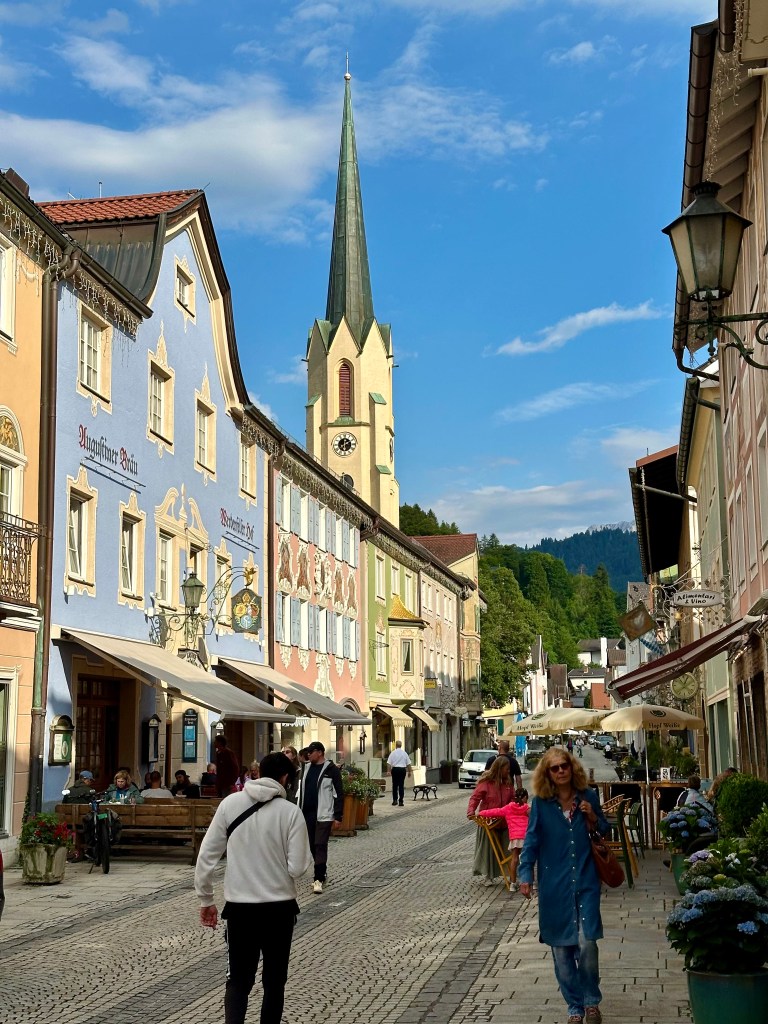
Met some cool locals over lunch and, appropriately, ordered our first schnitzel on this leg of the trip.

Then, on to Donauwörth,

Harburg Castle,


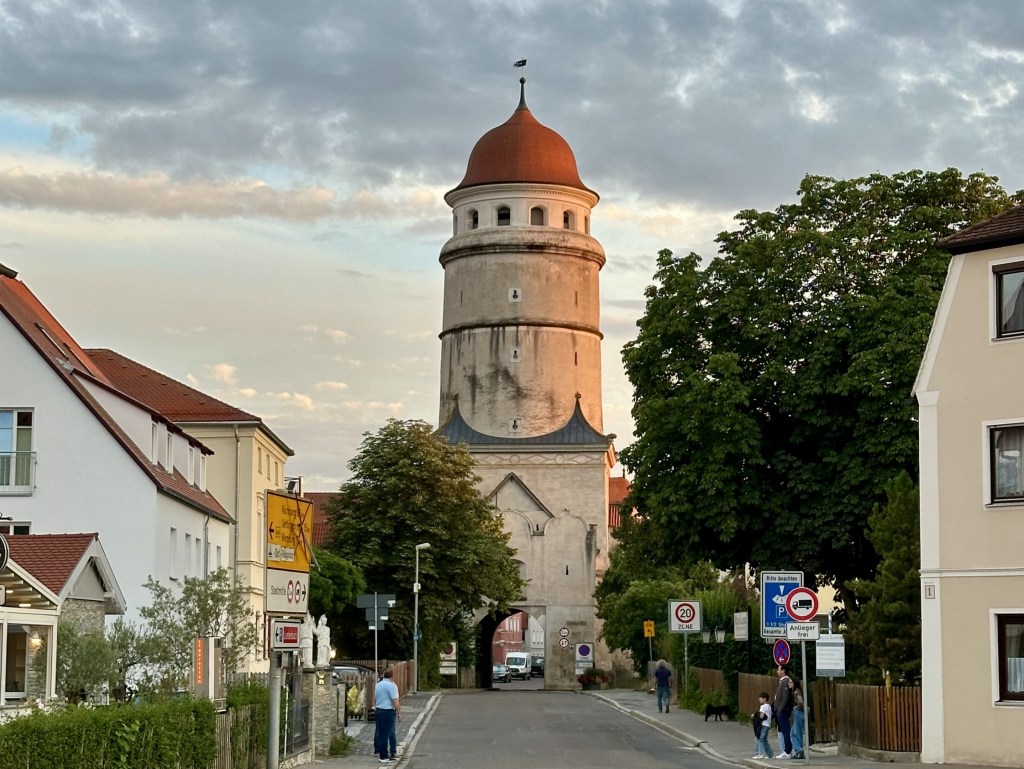
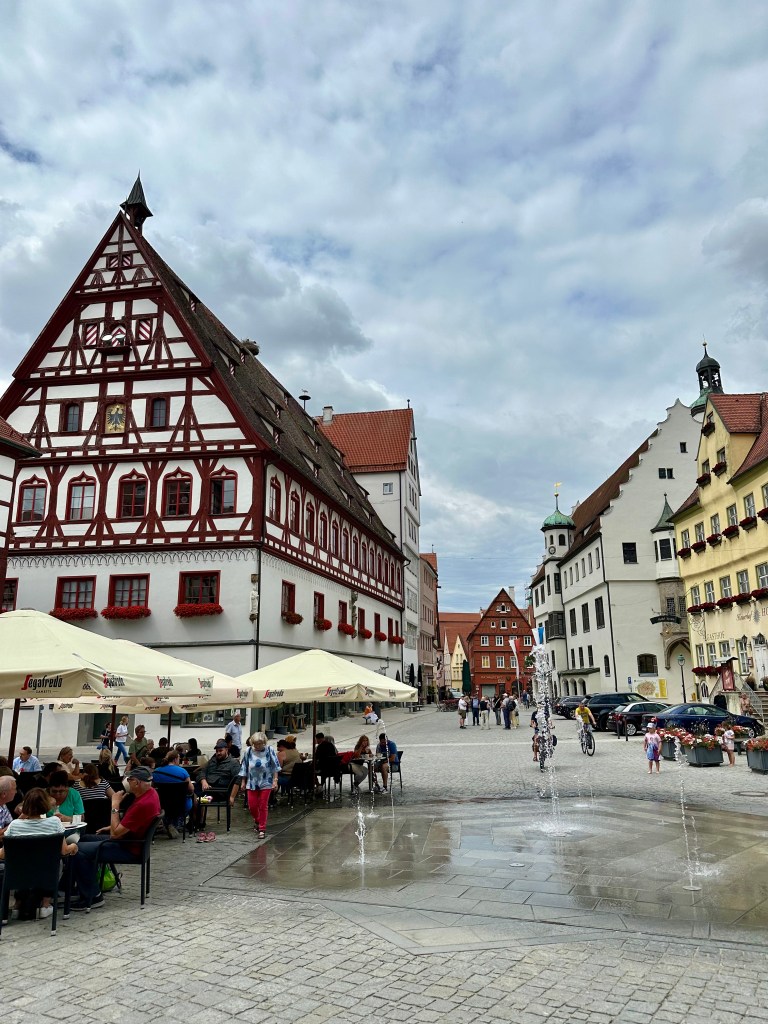
Nördlingen with its entirely intact medieval walls and tors,
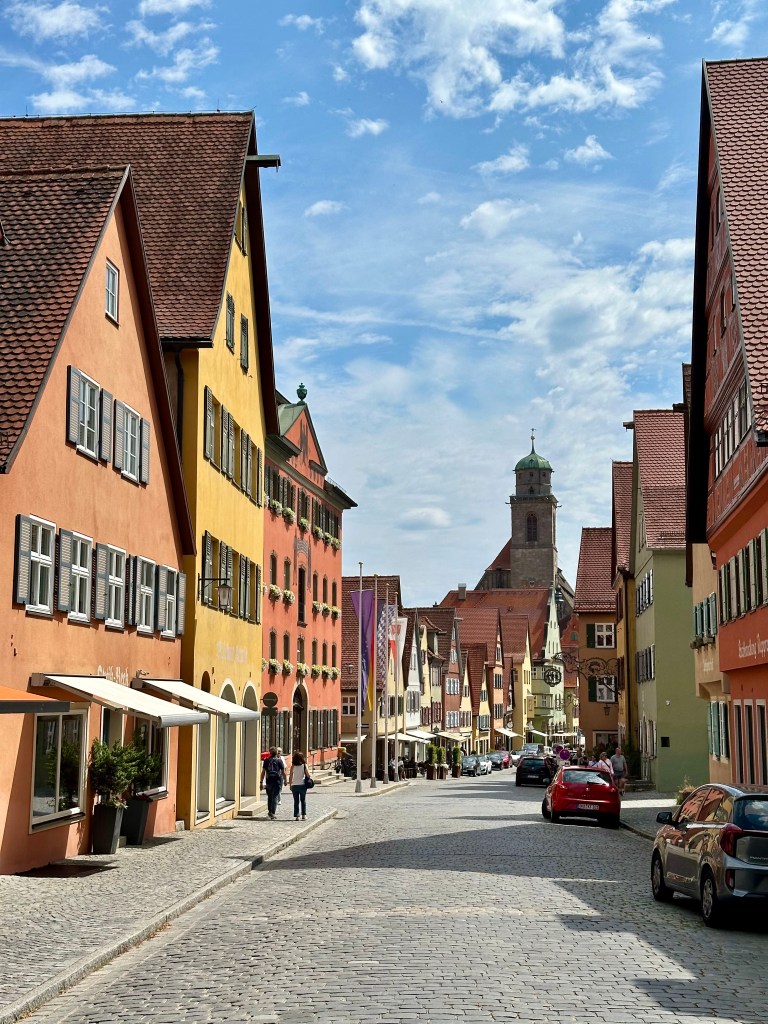
Dinkelsbühl, which we found to be both the most charming and least touristy of them all,

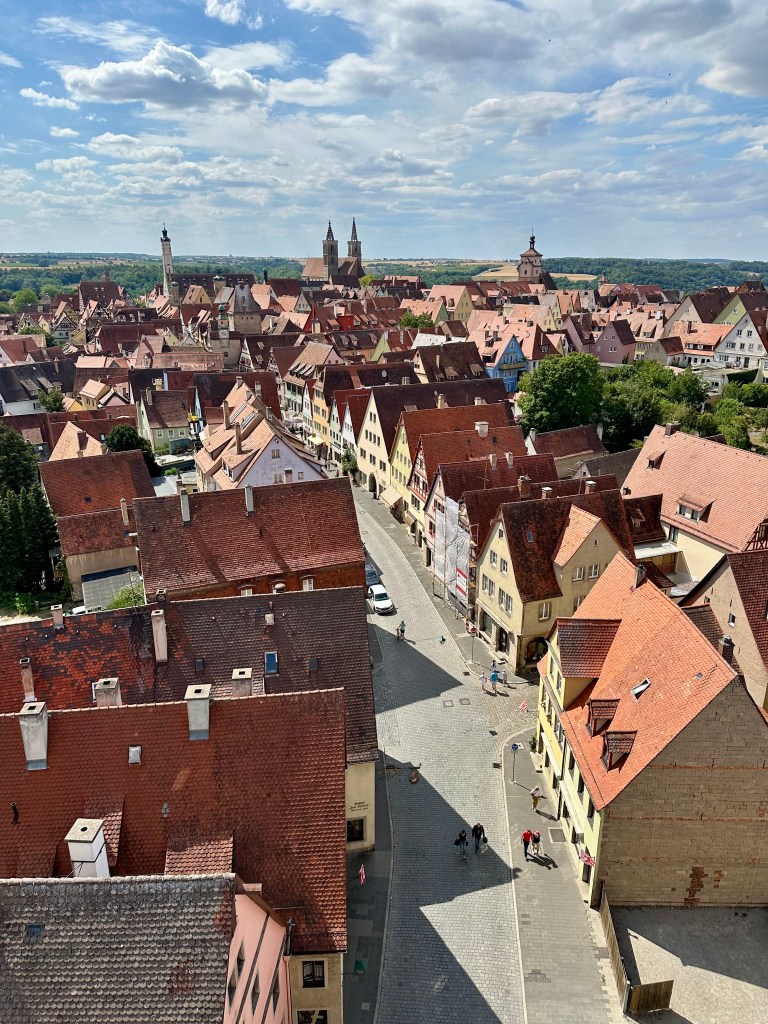
And, of course, the crown jewel of the Romantische Straße, Rothenburg ob der Tauber:

We ended our Romantic Road journey in Würtzburg, which was thoroughly underwhelming. Luckily, one of us has cousins in Germany and luckily one of the cousins has friends in the nearby charming village of Eibelstadt and luckily Eibelstadt was hosting a wine festival that evening. Relatives and wine and friends delightfully solved the Würtzburg problem.

We drove 3 freakin’ hours to Munich the next day to hang out, spend the night, and fly the following morning out of MUC when we should have just headed an hour the other direction from Würtzburg and flown out of FRA. But considering that that was the only major misstep of the trip (there was a minor one in the Dolomites that we’ll cover in a future post), the overall trip was fantastic. Really great pace, in terms of time spent in each location and time on the road between locations.
All told, our latest road trip entailed the following:
- 6 weeks
- 4 countries
- 1900 miles
- 19 stopping points
- 7 Croatian islands
- 7 iconic Dolomites / South Tyrol hikes
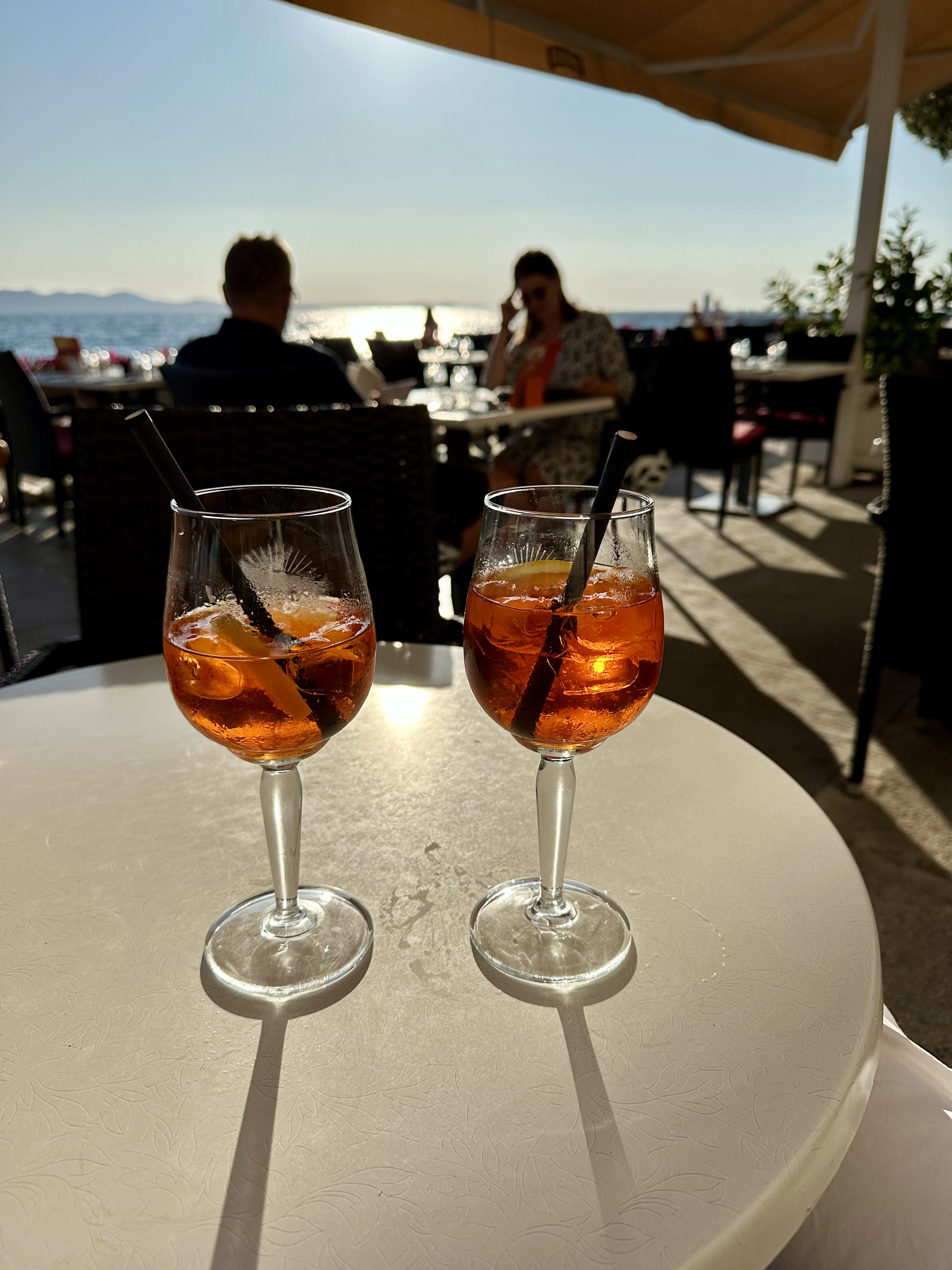
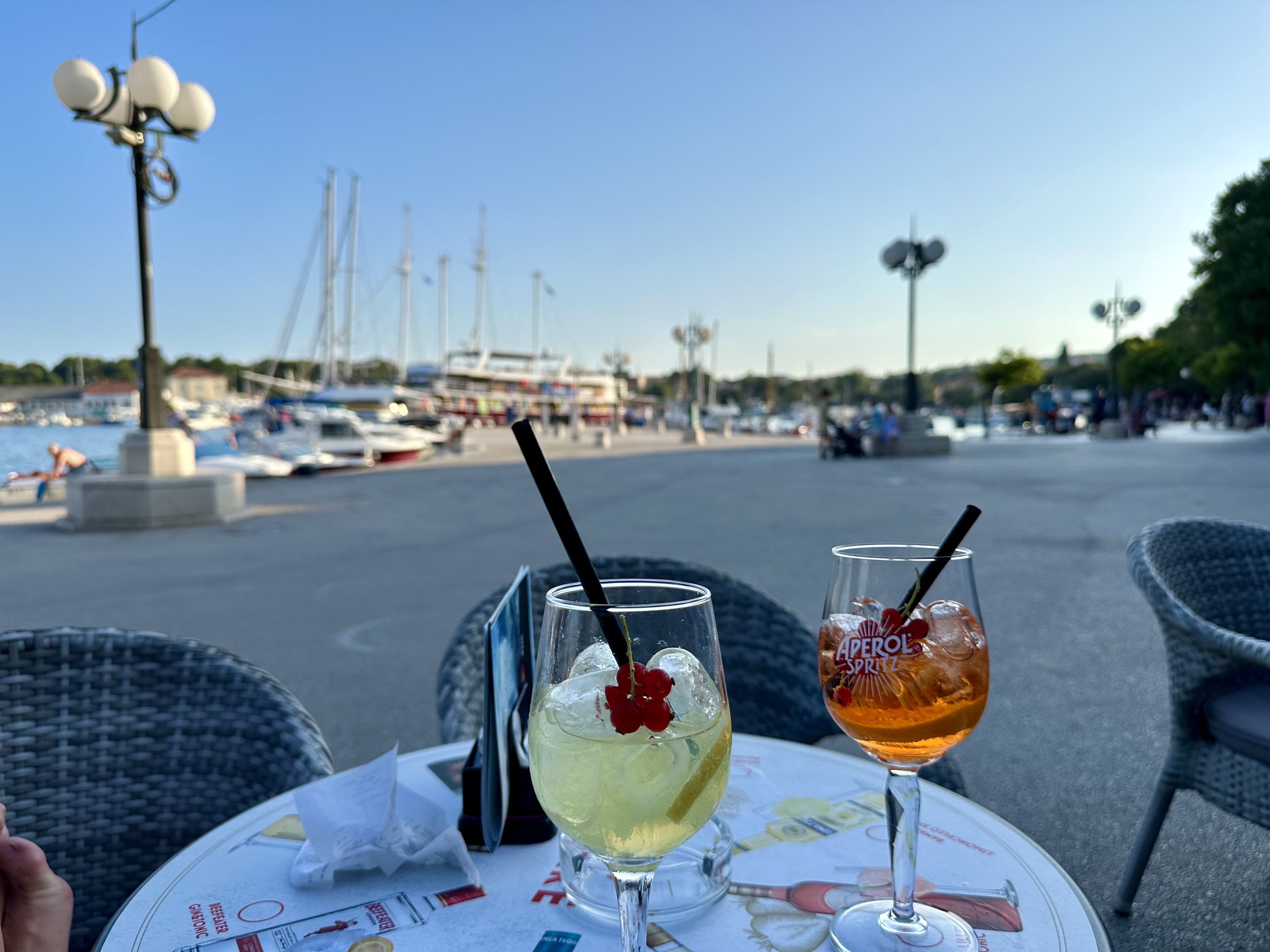
Oh, and a shit ton of Aperol spritzes. . .






On to the next adventure!
 WolfeStreetTravel