Italy
Protected: Cinque Terre and Back to Tuscany: Siena
Protected: Cinque Terre and Back to Tuscany: Monteriggioni
Protected: 2017
The Smallest 5 for the Big 5-O
One of us turns 50 this year. In recognition of the milestone, we’re hitting all 5 of Europe’s “microstates” in a single road trip.
What prompted a birthday trip through Europe’s microstates? An inexplicable fixation with them since our first trip to Europe in 2002, which included a leg by train from Barcelona, Spain, to Avignon, France. When we planned the trip and looked at the train route, we noticed something to the west on the map – a country we didn’t know existed was positioned between France and Spain.
A entire freakin’ country – Andorra – lurking between France and Spain.
One of us (the one with the birthday, to be clear) has been fascinated ever since, and even tried to add a side trip to Andorra to our bike trip in Catalonia in 2009. (This was overruled in favor of Cadaques, which, we think you’ll agree, was a pretty good idea when you check out that post.)
Nonetheless, the impetus to visit the microstates persisted, and the 50th birthday milestone provided a great opportunity to finally see them.
There are some tiny regions in Europe and elsewhere, but not all can be considered microstates. For example, Gibraltar, at the southwest tip of Spain, is tiny, but it’s not independent – it’s a British Overseas Territory. Luxembourg, on the other hand, is independent, but not tiny (it covers 1000 square miles). By contrast, the microstates are truly micro – most cover less than 25 square miles and none of them exceed an area of 200 square miles.
So, other than being incredibly small, what defines a microstate?
- Independence
- Diplomatic recognition
- Control of territory
- Permanent population
- Government
Based on these characteristics, the following sovereign countries within continental Europe qualify and will be part of the trip:
- The Principality of Andorra (finally!)
- The Principality of Liechtenstein
- The Principality of Monaco
- The Most Serene Republic of San Marino
- The State of Vatican City

Because none of the microstates, other than Vatican City, have rail stations (particularly Andorra and Liechtenstein – Nice and Rimini are somewhat close to Monaco and San Marino), we had to forego train travel, which otherwise is the best way to get around Europe. Instead, we’re renting a car and making this a road trip.
In our planning, we had a choice:
- Drive directly from one microstate to another, resulting in a couple of long days of driving, but providing a couple of rest days with no driving, or
- Add interim destinations between some of the microstates, so that we’re never driving more than 3 or 4 hours, but we would be driving every day
We chose Option 2:
The map above depicts the following itinerary:
- Take a redeye to Rome
- Day 1: Vatican City
- Day 2: Drive to San Marino
- Day 3: Drive to Bergamo, Italy
- Day 4: Drive to Liechtenstein
- Day 5: Drive to Lake Lugano, Switzerland
- Day 6: Drive to Monaco
- Day 7: Drive to Carcassonne, France (another place we’ve wanted to visit – last stronghold of the Cathars!)
- Day 8: Drive to Andorra
- Day 9: Drive to Barcelona
- Day 10: Fly back
We’ll spend every afternoon and night in the destination town / country to check things out before heading off the next morning to the next target.
Today, we’re part of the way through the tip, in Vaduz, Liechtenstein. We’ll post highlights of the trip when we get back!
European Microstate Road Trip: Overview
Our epic 9-country road trip designed to hit all 5 European microstates came to an end on Sunday. Despite some initial trepidation, it turned out to be fantastic!
This was one of our best trips, in fact, despite encountering this choice little nugget on 2 of the tiny 5 from a Cadogan guide book that we used several years ago on a previous trip:
“It’s a sleazy little paradise, [Microstate X]. . . Today, the [inhabitants] have found a way to exploit every single possibility open to a grasping, sweaty-palmed pipsqueak principality. They’ve turned their lovely corner of the [region] into a single, garish supermarket. It’s a worthy competitor for Europe’s other Ruritanian craphole, [Microstate Y], which, if you’ve never been, is the first country in the world to be entirely paved over with factory outlet car parks.”
Yow! We’ll reveal which of the pipsqueak nations the Cadogan guide was referencing in subsequent posts, but we were infatuated with the tiny countries and undeterred! We persisted and planned and executed a pretty ambitious itinerary to hit all 5 microstates in a single trip.
Information on continental Europe’s 5 tiniest nations – and the characteristics that define a microstate – was previously posted here. A repost of the map with the location of each is below:
Location of the continental Europe’s five microstates
The trip was great adventure, overall – both based on the tiny countries and some of the outstanding start, stop, or stopover locations in Italy, Switzerland, France, and Spain that we included in the trip to keep driving distances practical. Our experiences in the five microstates spanned the spectrum:
- Two exceeded our fairly modest expectations (biased in part by the pithy and brutal opinion proffered by the Cadogan guide) and we really enjoyed our visit to both
- One was precisely as expected
- Two were definitely not as awesome as we thought they would be – one was simply not as magnificent as we had envisioned, while the other turned out to be every bit just an outrageously expensive Disney world
These reactions will be assigned to the appropriate country in future posts, but some highlights of the tiny five are below, presented in the order in which we encountered the little buggers.
No. 1 of 5: The State of Vatican City:

Hallway of maps in the Vatican Museum
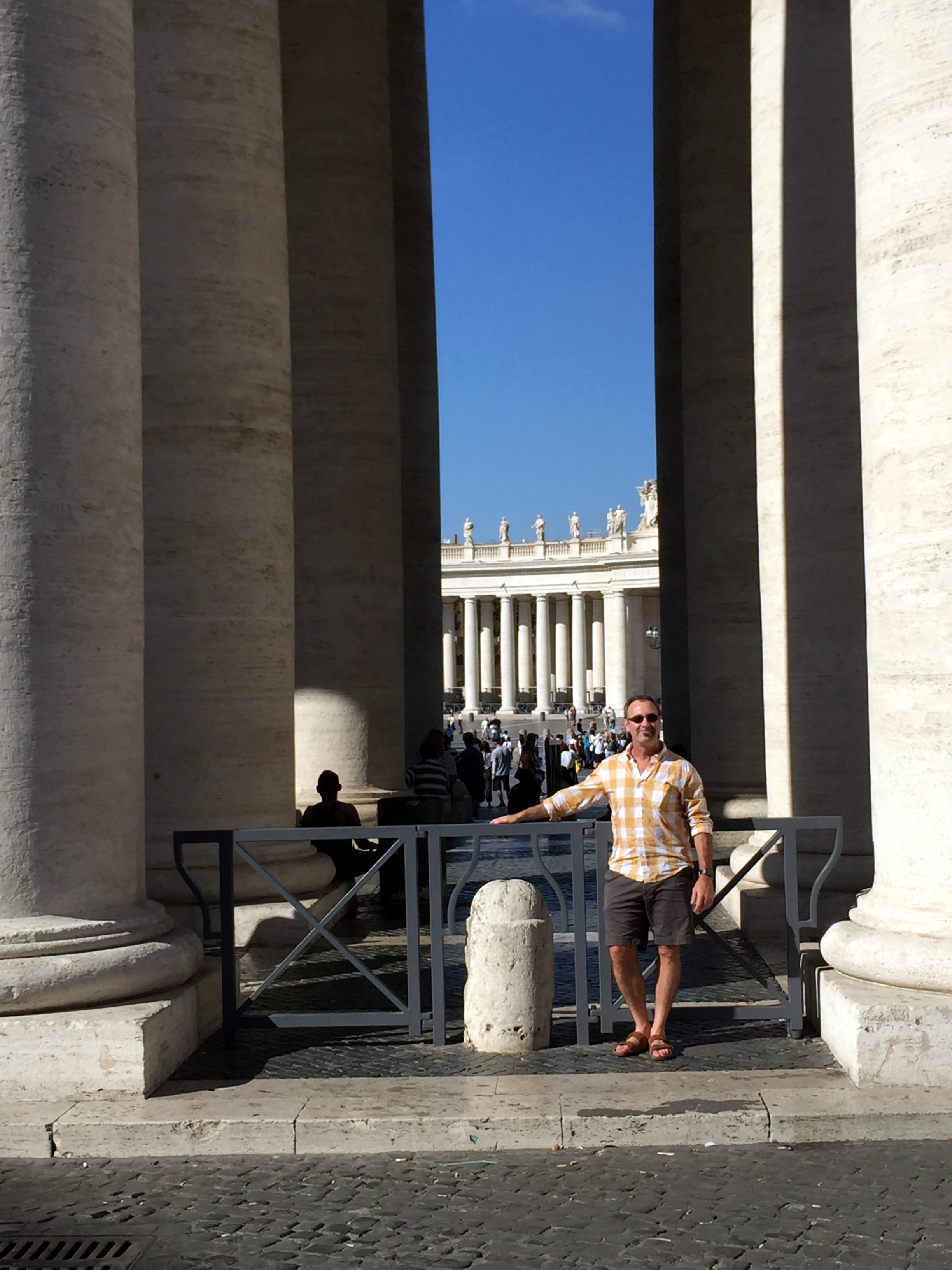
At the border between Vatican City and Rome – No. 1 complete
No. 2 of 5 – The Most Serene Republic of San Marino:

Guaita (1st Castle) on San Marino’s Mount Titano

San Marino’s town hall at sunset

View from Cesta (2nd Castle) to Guaita (1st Castle) on Mount Titano in San Marino – Microstate No. 2 complete
No. 3 of 5 and location for the Big 5-0 milestone – the Principality of Liechtenstein:

Vaduz castle from afar

and up close – No. 3 complete
4 of 5 – Principality of Monaco:

Monte Carlo casino our evening in Monaco

Above the port of Monte Carlo – No. 4 complete
And finally, No. 5 of 5 and the microstate that started it all – the Principality of Andorra:

11th-century Sant Joan de Caselles church with Lombard-style tower in Andorra

Casa de la Vall in Andorra la Vella – headquarters of the General Council of Andorra; No. 5 of 5 complete!
Before we left the US, we were a little concerned that the trip could turn out to be an arduous box-checking exercise involving too much driving and not enough time to enjoy each destination, based on the itinerary we designed:
- Take a redeye to Rome
- Day 1: Vatican City (1 of 5 . . .)
- Day 2: Drive to San Marino (2 of 5 . . .)
- Day 3: Drive to Bergamo, Italy
- Day 4: Drive to Liechtenstein (3 of 5 . . .)
- Day 5: Drive to Lake Lugano, Switzerland
- Day 6: Drive to Monaco (4 of 5 . . .)
- Day 7: Drive to Carcassonne, France
- Day 8: Drive to Andorra (5 of 5!)
- Day 9: Drive to Barcelona
- Day 10: Fly back
Instead, our daily cadence ended up providing a good balance – we’d drive for a few hours each morning in our rockin’ diesel Skoda family truckster . . .

Our trusty Skoda after navigating the narrow alleyways of Bergamo on Day 3
. . . then arrive at our destination in the early afternoon to explore things, typically log some downtime in the evening at the hotel pool, then grab dinner.

Sweet pool in Carcassonne, our stopover between Monaco and Andorra
Although the trip focused on the microstates, some of the stopovers proved to be just as rewarding, including staying in a hotel that overlooked Lake Lugano in Switzerland on August 1, without realizing beforehand that this was the Swiss National Holiday – spectacular!

Fireworks over Lake Lugano to celebrate the Swiss National Holiday
We’ll post highlights of each of the five micronations plus the very cool stopover locations during the next few weeks.
Oh, and the book read as we started the trip?


Of course.
Microstates! The State of Vatican City
So, we’re finally getting around to publishing posts from the “Tiniest 5 for the Big 5-0” road trip last year. We have an inordinately high level of interest in the microstates, which, although ridiculous, was nonetheless explained in our initial post on the trip planning.
Last July’s Magical Microstate Tour began with what we’re sure is the most visited tiny territory of them all – Vatican City, located within the city of Rome:
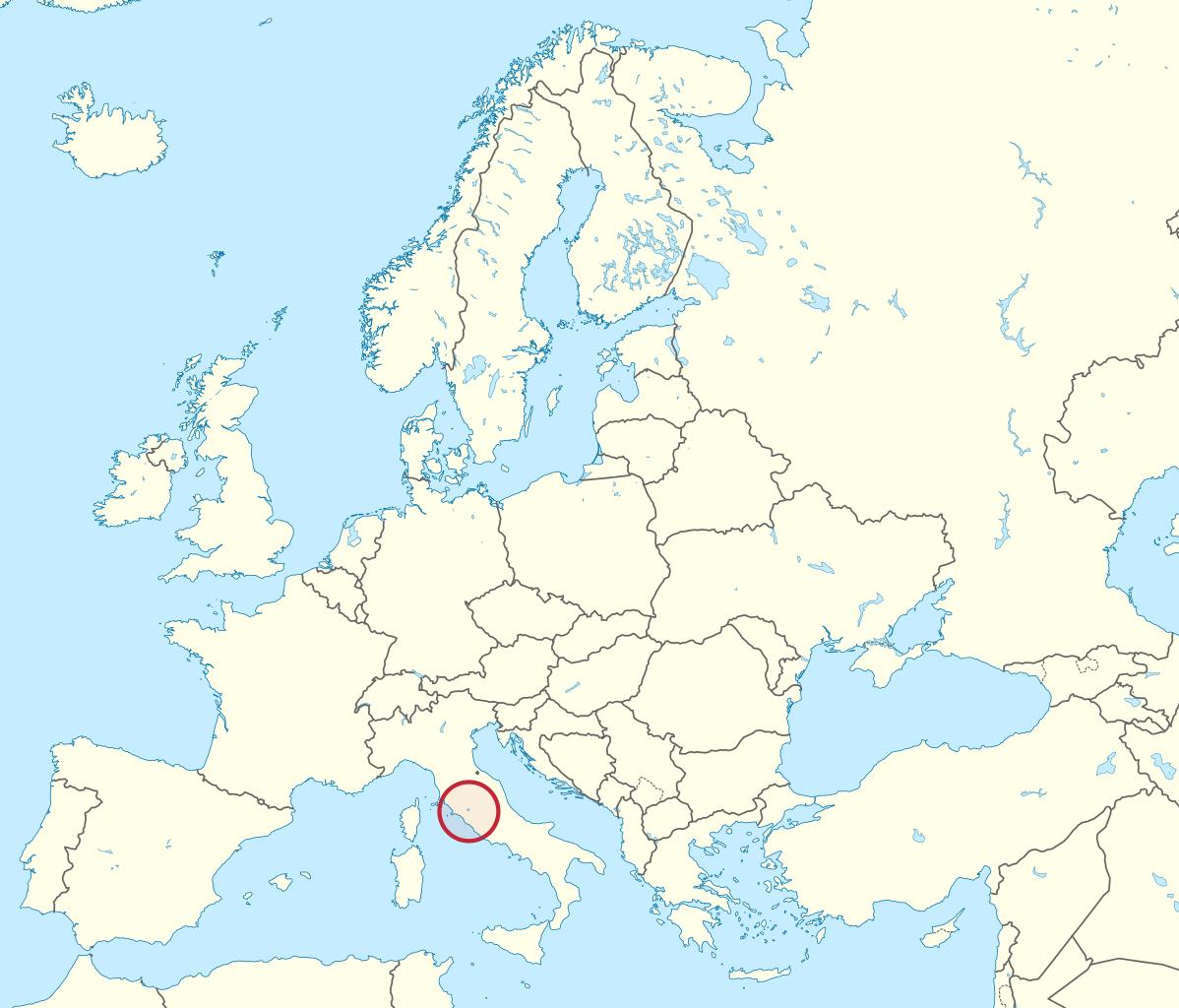
For what it’s worth, we weren’t particularly excited about Vatican City because it’s the least exotic and most known of the microstates. Our expectations in this regard were pretty much met – interesting, but certainly not fascinating.
State Synopsis
History: Starting in the 700s and continuing until the 19th century, the pope controlled a hell of a lot more than the postage stamp that Vatican City currently occupies. Although the popes began collecting properties before the 8th century, the millennium-long history of the Papal States really began with the Donation of Pepin. In the 750s, the Lombards had overrun the last remnants of the Roman Empire in Italy around Ravenna, and were demanding the submission of Rome and tribute from the Papacy. Pope Stephen II sent envoys to Pepin the Short, King of the Franks (as well as father of Charlemagne and founder of the Carolingian Empire) requesting his support in resisting the Lombards. In return for an official coronation by Pope Stephen, Pepin and his Frankish army forced the Lombard king to cede their recent Italian conquests. Pepin then conferred upon the pope these territories in 756:
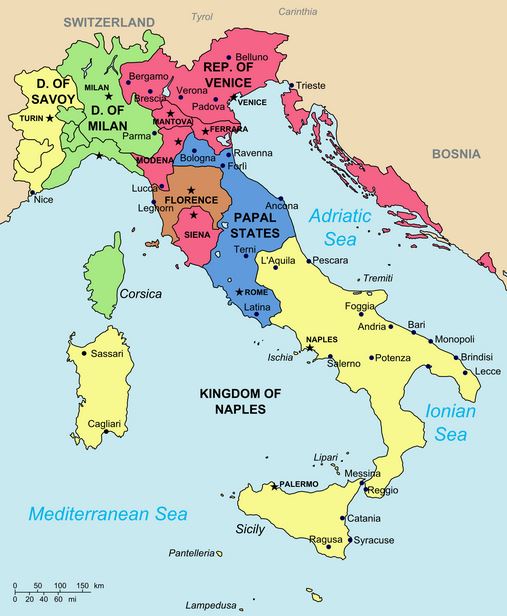
The Papal States in the early 1800s, prior to Italian unification.
For more than a millennium, the Papal States occupied this chunk of Italy – waxing and waning over time, but always substantial. However, during Italian unification efforts in the 19th century, the Papal States were annexed and integrated into the secular state of Italy, leaving only the Holy See within the Vatican walls. The popes did not recognize the Italian king’s right to rule in Rome, and they refused to leave the Vatican compound in resistance of any move to integrate Vatican City.
Why it still exists: The impasse was resolved in 1929, when the Lateran Treaty between the Holy See and the Kingdom of Italy was signed by Benito Mussolini, on behalf of King Victor Emmanuel III, and by Cardinal Secretary of State Pietro Gasparri for Pope Pius XI. The treaty, which became effective on June 7,1929, established the independent State of Vatican City and reaffirmed the special status of Catholicism in Italy.
Absolute size: 0.17 square miles
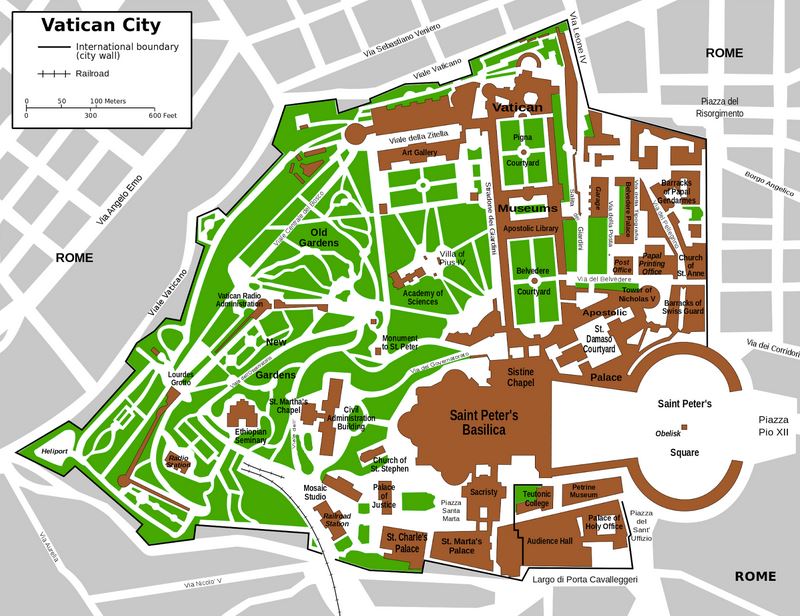
Relative size: Vatican City is the smallest of the five European microstates and is smaller than the City of Alexandria, at 15 square miles. Moreover, “Vatican City is the smallest state in the world by both area and population. However, formally it is not sovereign, with sovereignty being held by the Holy See.”*
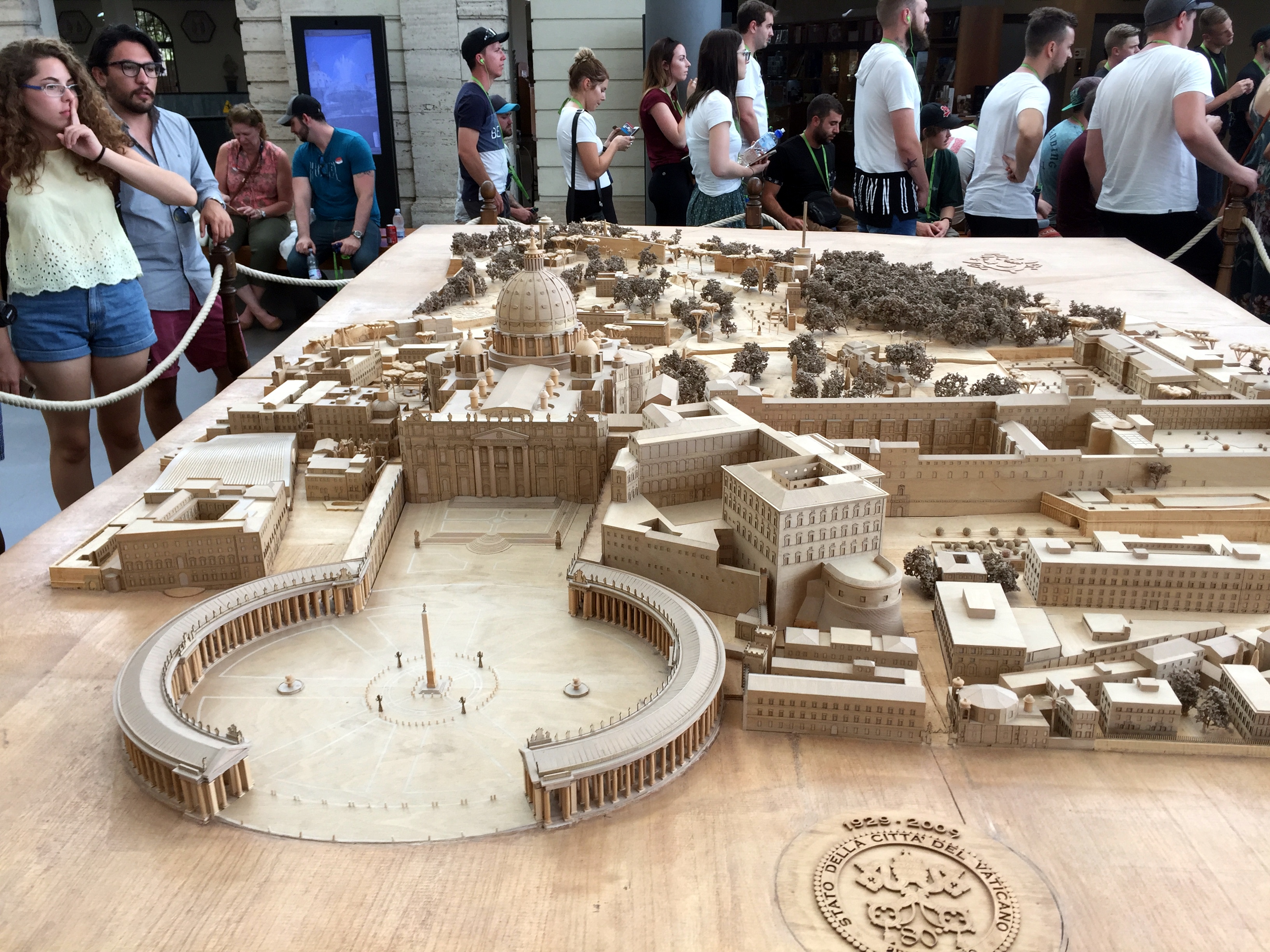
Scale model of Vatican City near the entry point:
Population: 600
Capital: Yeah, it’s Vatican City, so there you go.
Government: Vatican City is an absolute elective monarchy ruled by the pope. The location we visited officially is both the State of Vatican City and The Holy See. (The Holy See is the central government of the Catholic Church, while Vatican City is the independent state where the Holy See operates). The Holy See is a non-hereditary monarchy. (Speaking of which, Absolute Monarchs: A History of the Papacy, read in part during the road trip, is a wildly entertaining overview of the politics and personalities of the papacy, particularly in the early middle ages when the pope were pawns of powerful families or corrupt themselves. We’ll let Wikipedia summarize the relationship between Vatican City and the Holy See: The Holy See is the ecclesiastical jurisdiction of the Catholic Church in Rome, the episcopal see of the Pope, and an independent sovereign entity. As an independent sovereign entity, holding the Vatican City enclave in Rome as sovereign territory, it maintains diplomatic relations with other states.
Note that we would be remiss in not recognizing that the Popes did not always lead from their enclave in Rome – seven Popes (or anti-Popes, depending on with whom you were aligned) ruled from Avignon in the 14th century (which happens to have been the start and finish of our first bike trip in Europe . . .).
Tiny nation trivia: “At several times during the Vatican’s history, popes escaped through a secret passageway. In 1277, a half-mile-long elevated covered passageway, the Passetto di Borgo, was constructed to link the Vatican with the fortified Castel Sant’Angelo on the banks of the Tiber River. It served as an escape route for popes, most notably in 1527 when it likely saved the life of Pope Clement VII during the sack of Rome. As the forces of Holy Roman Emperor Charles V rampaged through the city and murdered priests and nuns, the Swiss Guard held back the enemy long enough to allow Clement to safely reach the Castel Sant’Angelo, although 147 of the pope’s forces lost their lives in the battle.”
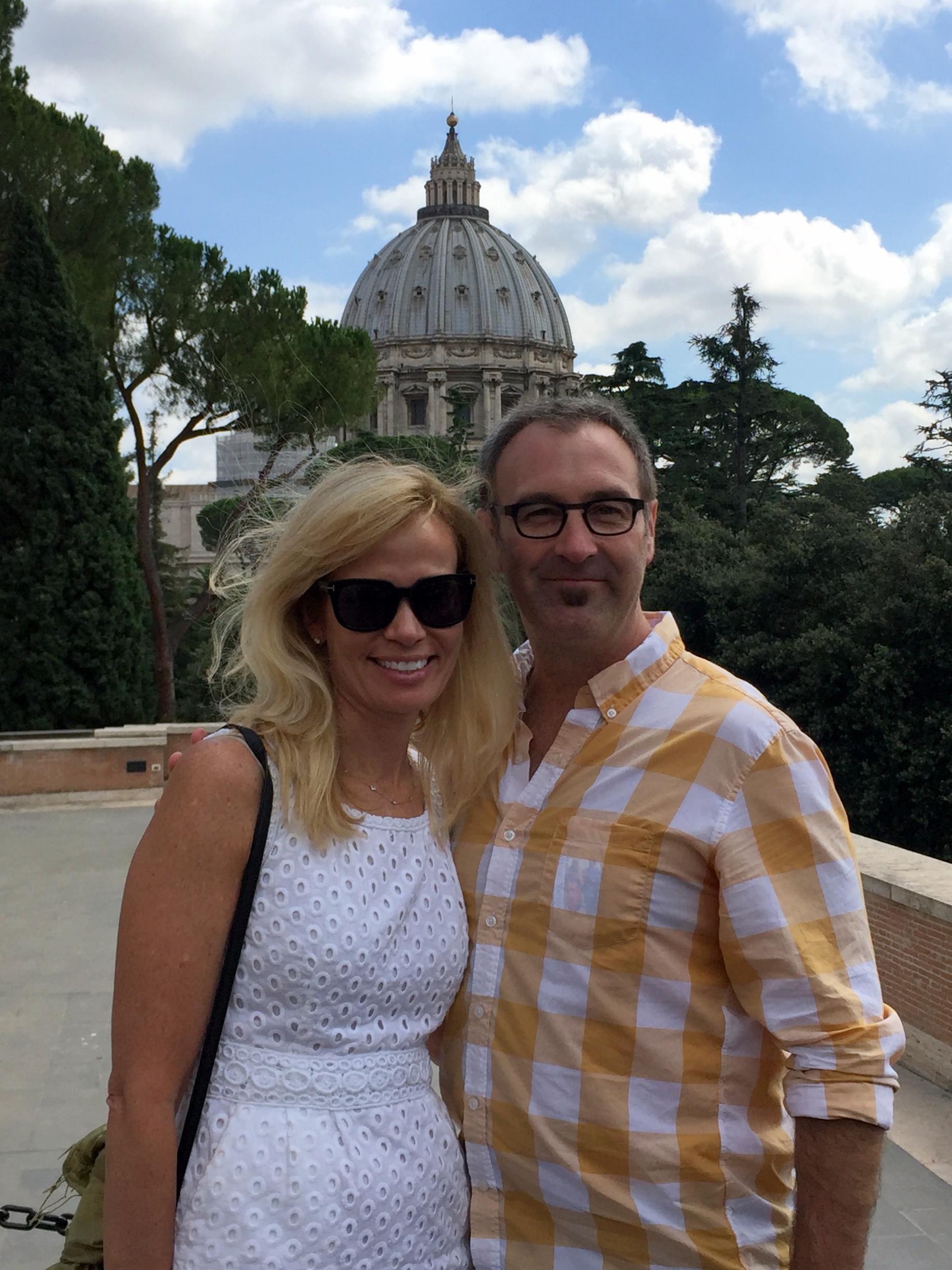
In the Vatican Gardens with St. Peter’s in the background:
Vatican stuff (most of the information comes from the Vatican Museum’s website:


Sarcophagus of St Helena:
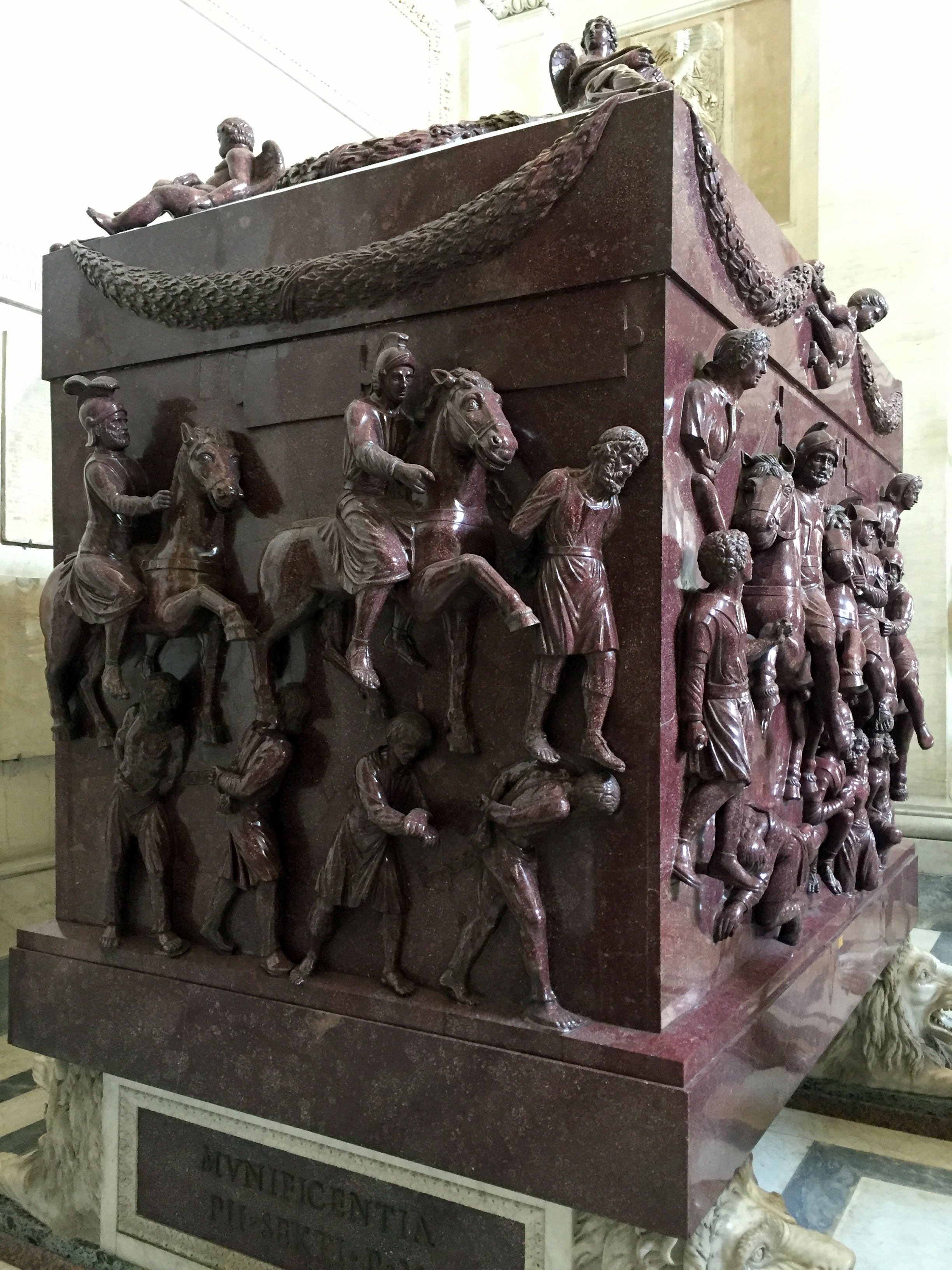
“This monumental red porphyry sarcophagus is believed to have held the remains of Helena, mother of Constantine the Great, who died around 335 A.D. The coffin is carved with military scenes with Roman soldiers on horseback and barbarian prisoners. This very military decoration, not really suitable for a female burial, has led scholars to suppose that the sarcophagus was originally made for a male member of the Imperial family, such as Helena’s husband, Constantius Chlorus or, more probably, Constantine himself.”
Gallery of Maps with works commissioned by Pope Gregory XIII in the late 16th century. Very cool snapshots in time, with respect to the relative size and importance of Renaissance cities to one another, as well as the extent of urbanization in Europe and awareness of non-European locales.


On to the Sistine Chapel, which we really did not expect to be as small and rectangular as it is. Lisa arranged for a private tour for us, and our tour guide (who was really good) took us aside before we entered the chapel to provide us with a detailed lesson on the history of the chapel and of the individual artworks. You’re supposed to be reverent and quiet while in the chapel, so there’s no speaking. Our guide used her iPad to provide insight into the individual panels.
The whole “reverent and quiet” rule would be ignored by the packed assembly of tourists, so every 2 minutes or so, one of the guards would intone in a booming voice: “SILENCIO!” Everyone would then become quiet again. Until the rule was ignored after a bit, prompting another outburst from the guards. This resulted in a sinusoidal pattern of noise – very quiet immediately after the dire warning, then a swiftly rising crescendo of noise, peaking until the guard bellowed yet another “SILENCIO!” Then quiet, then noisy, then “SILENCIO!” then repeat. Good stuff.
We were prohibited from taking pictures as well (although we tried surreptitiously, with abysmal results . . .):
In lieu of purloined pics from us, you can take a virtual tour here, on the Vatican Museum’s website. (Note that this virtual tour will not convey the signature, sinusoidal sound effect described above . . .).
St. Peter’s Basilica


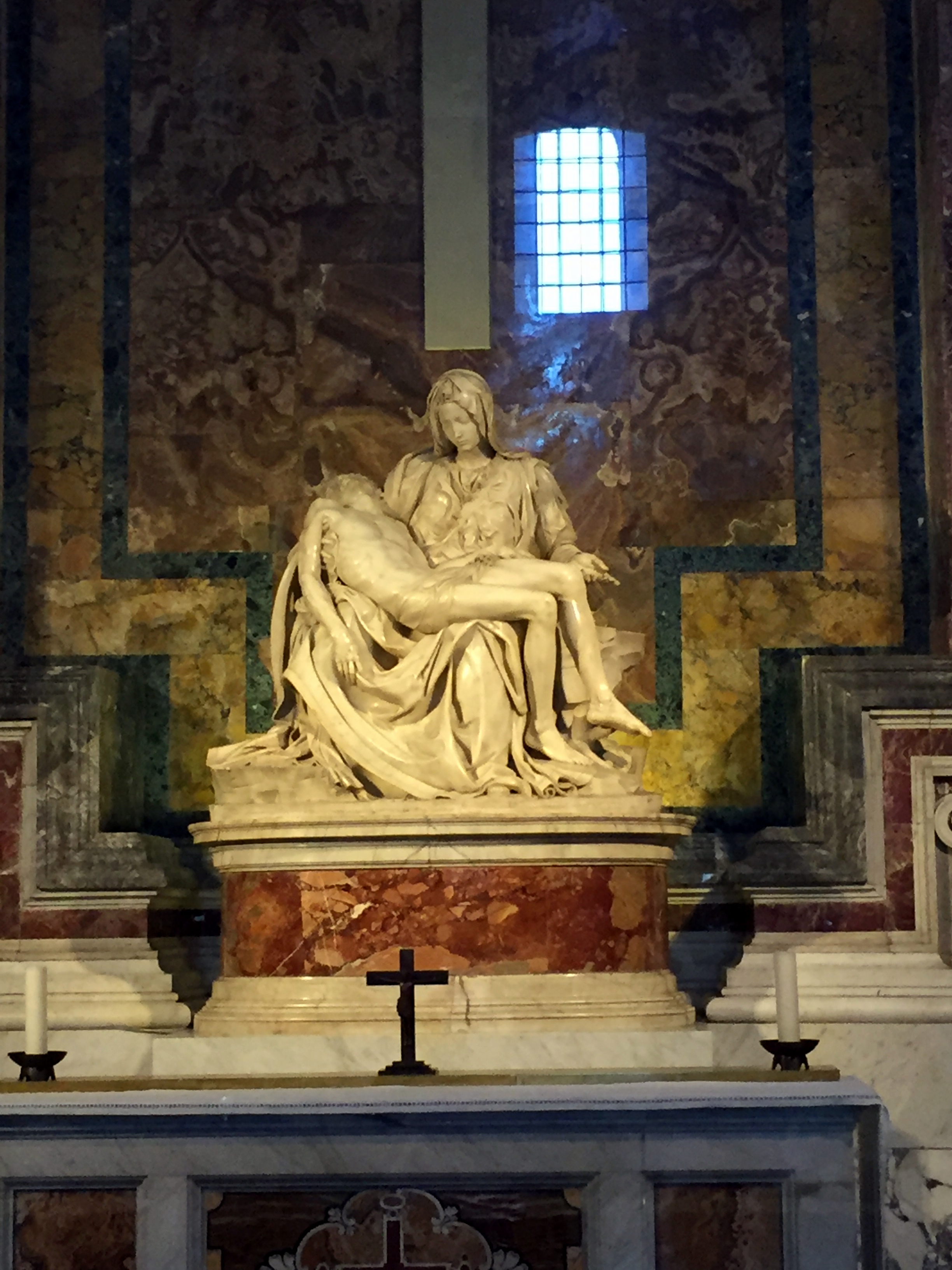
Michelangelo’s Pietà – now behind glass. In 1972 “a mentally disturbed geologist, the Hungarian-born Australian Laszlo Toth walked into the chapel and attacked the sculpture with a geologist’s hammer while shouting “I am Jesus Christ; I have risen from the dead!” With fifteen blows he removed Mary’s arm at the elbow, knocked off a chunk of her nose, and chipped one of her eyelids. Onlookers took many of the pieces of marble that flew off. Later, some pieces were returned, but many were not, including Mary’s nose, which had to be reconstructed from a block cut out of her back.”
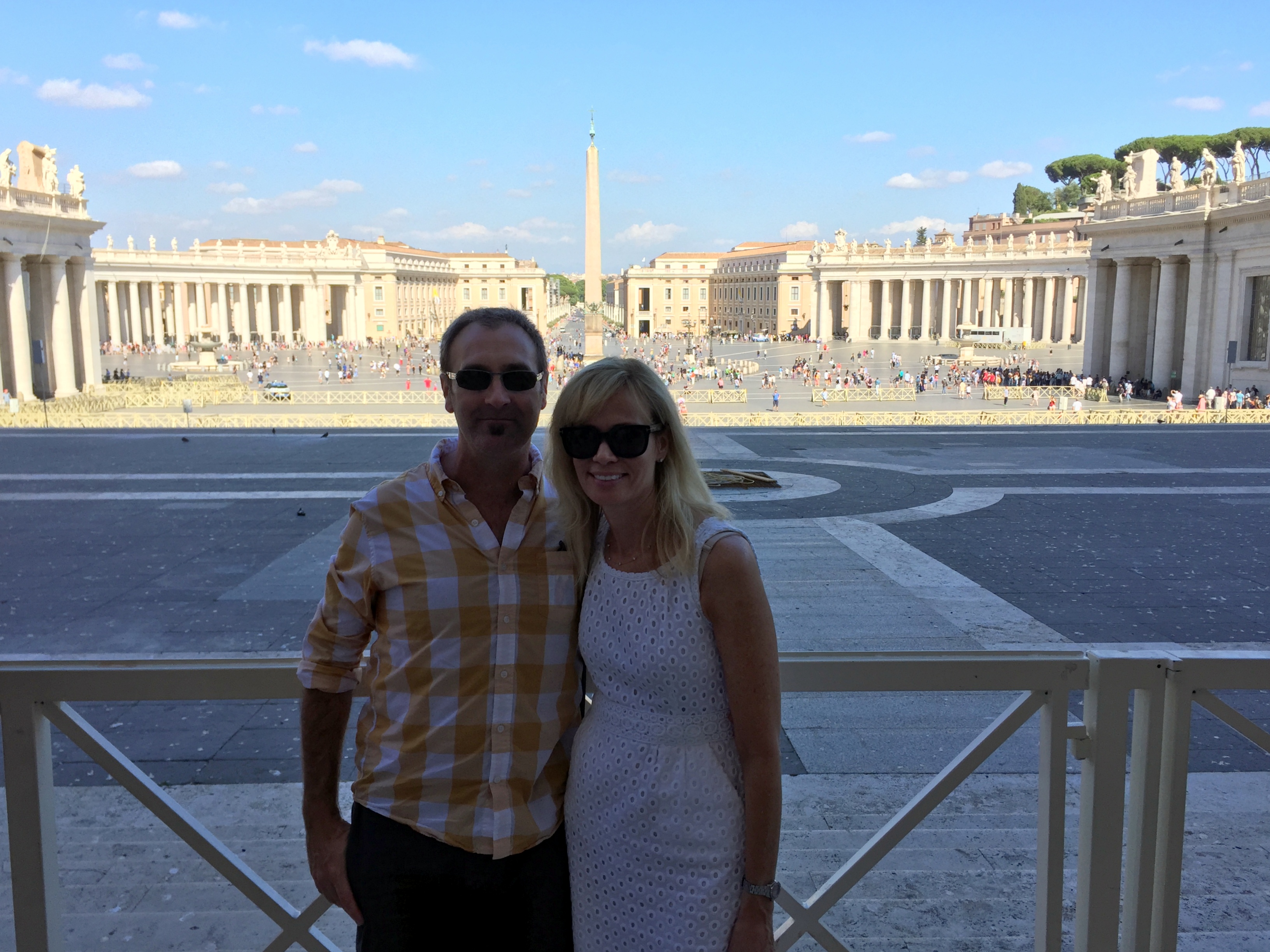
Back outside, in St. Peter’s Square
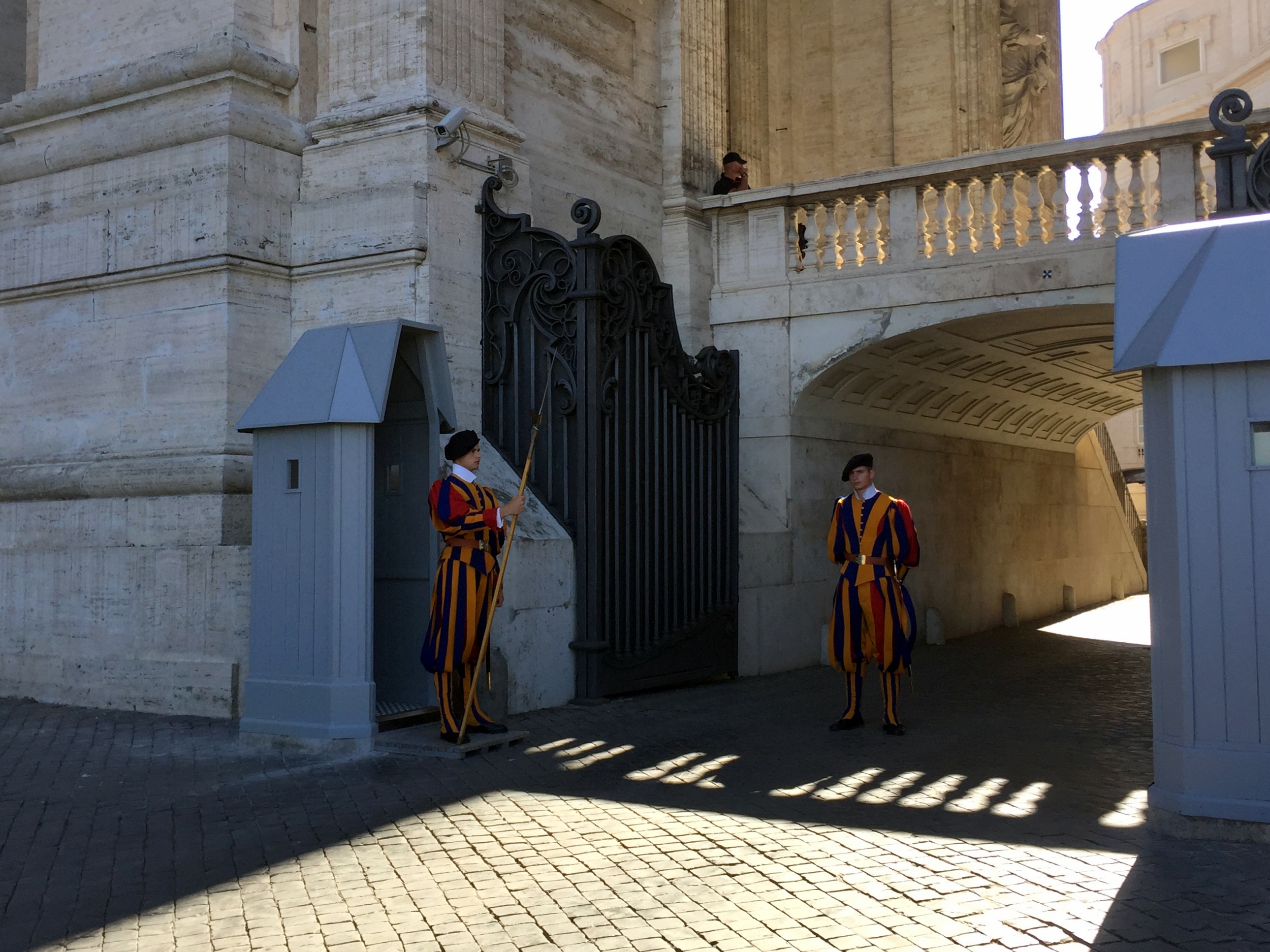
“The Swiss Guard, recognizable by its armor and colorful Renaissance-era uniforms, has been protecting the pontiff since 1506. That’s when Pope Julius II, following in the footsteps of many European courts of the time, hired one of the Swiss mercenary forces for his personal protection. The Swiss Guard’s role in Vatican City is strictly to protect the safety of the pope. Although the world’s smallest standing army appears to be strictly ceremonial, its soldiers are extensively trained and highly skilled marksmen. And, yes, the force is entirely comprised of Swiss citizens.”
“Roman Emperor Caligula built a small circus in his mother’s gardens at the base of Vatican Hill where charioteers trained and where Nero is thought to have martyred the Christians. To crown the center of the amphitheater, Caligula had his forces transport from Egypt a pylon that had originally stood in Heliopolis. The obelisk, made of a single piece of red granite weighing more than 350 tons, was erected for an Egyptian pharaoh more than 3,000 years ago. In 1586 it was moved to its present location in St. Peter’s Square, where it does double duty as a giant sundial.”
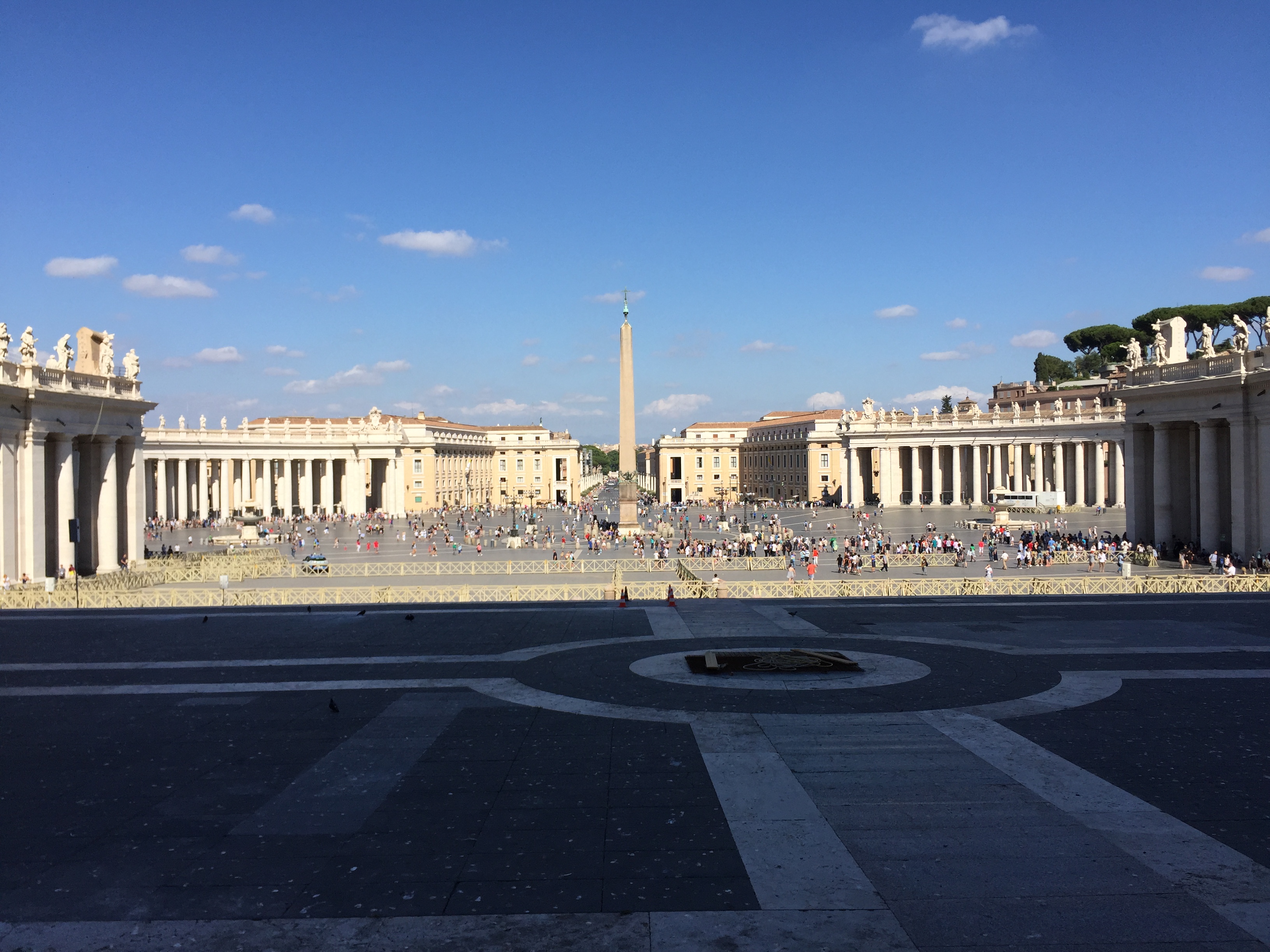
Microstate 1 of 5 complete!
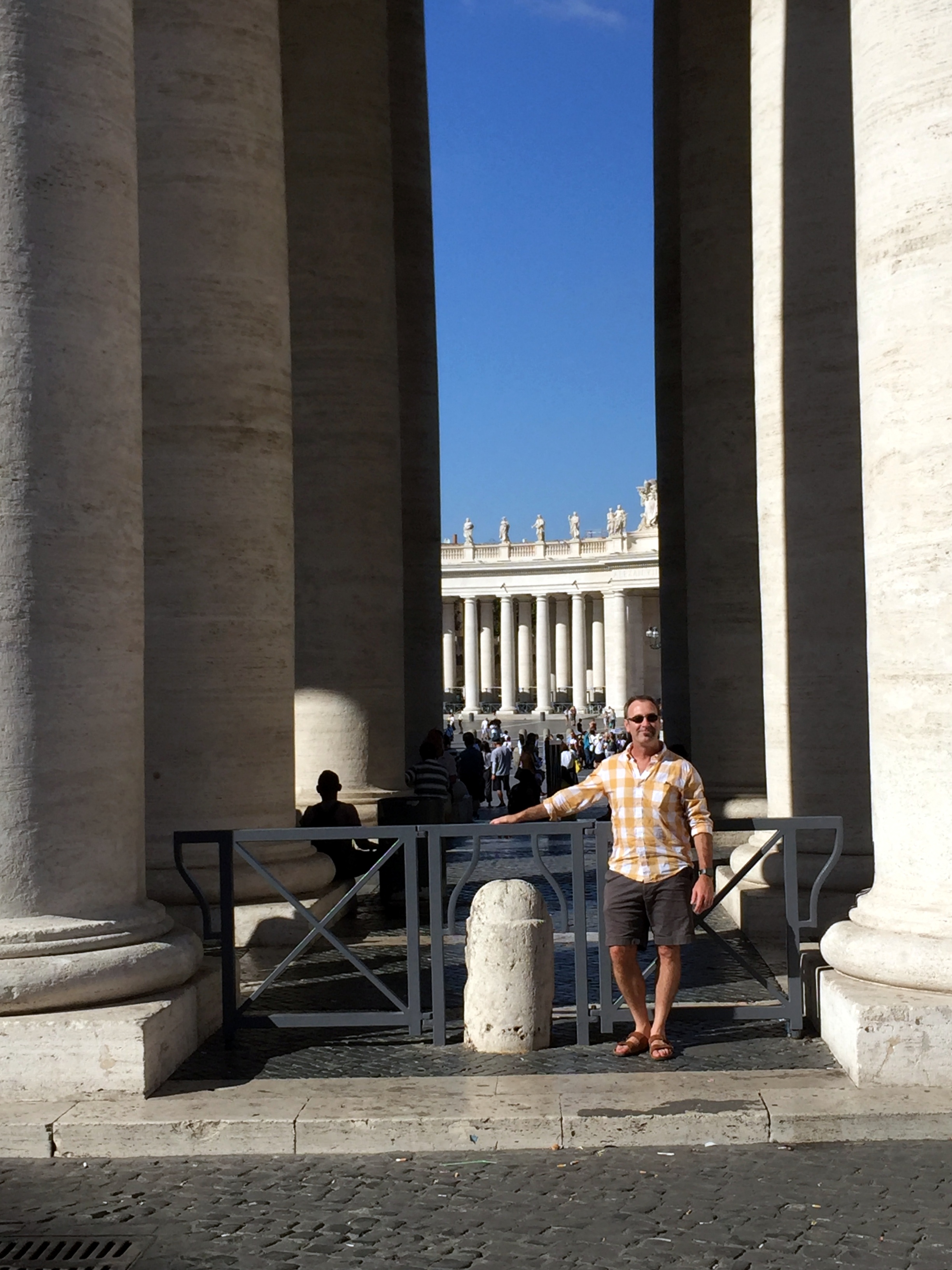
At the border (literally) of Vatican City
The Castel Sant’Angelo noted in the trivia above, spotted on the way back through Rome from Vatican City (the structure began as the Mausoleum of Hadrian):

Around Rome, mostly retracing steps taken during our brief visit before biking in Tuscany back in 2004.


Unbelievably cool retreat on the rooftop of our villa hotel to chill out for a bit late in the day:


End of the day on the way to dinner in Rome:
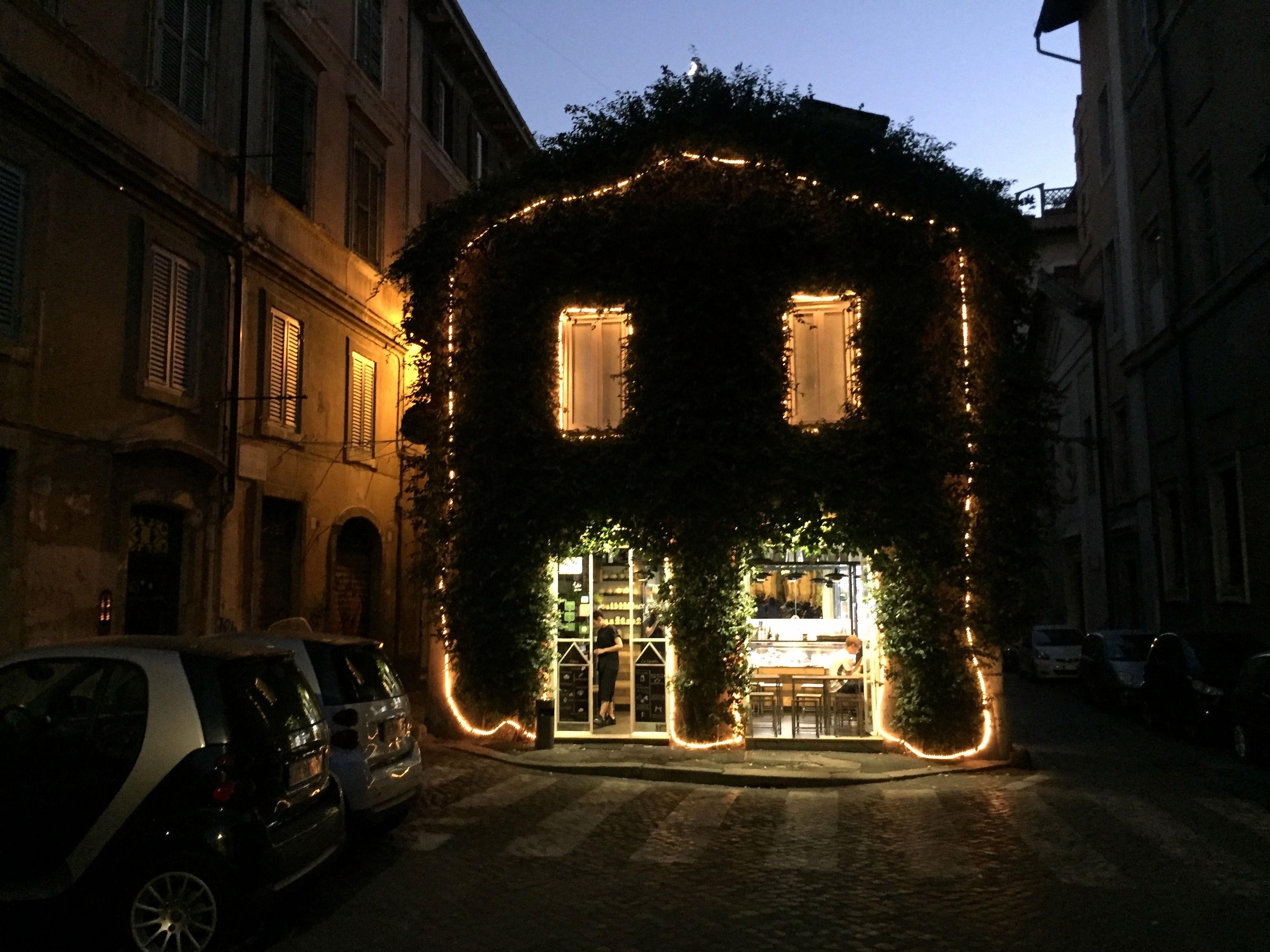
Bergamo, Italy
After San Marino, the next target on our micronation road trip was the country of Leichtenstein. However, driving there directly would take almost 8 hours, so we picked an appealing half way point to stop over on the way – Bergamo, Italy:

Driving through the more modern outskirts of town toward the fortified Città Alta (Upper Town), where we’d spend our time:

Bergamo’s main square – Piazza Vecchia, located precisely where the old Roman forum once existed.

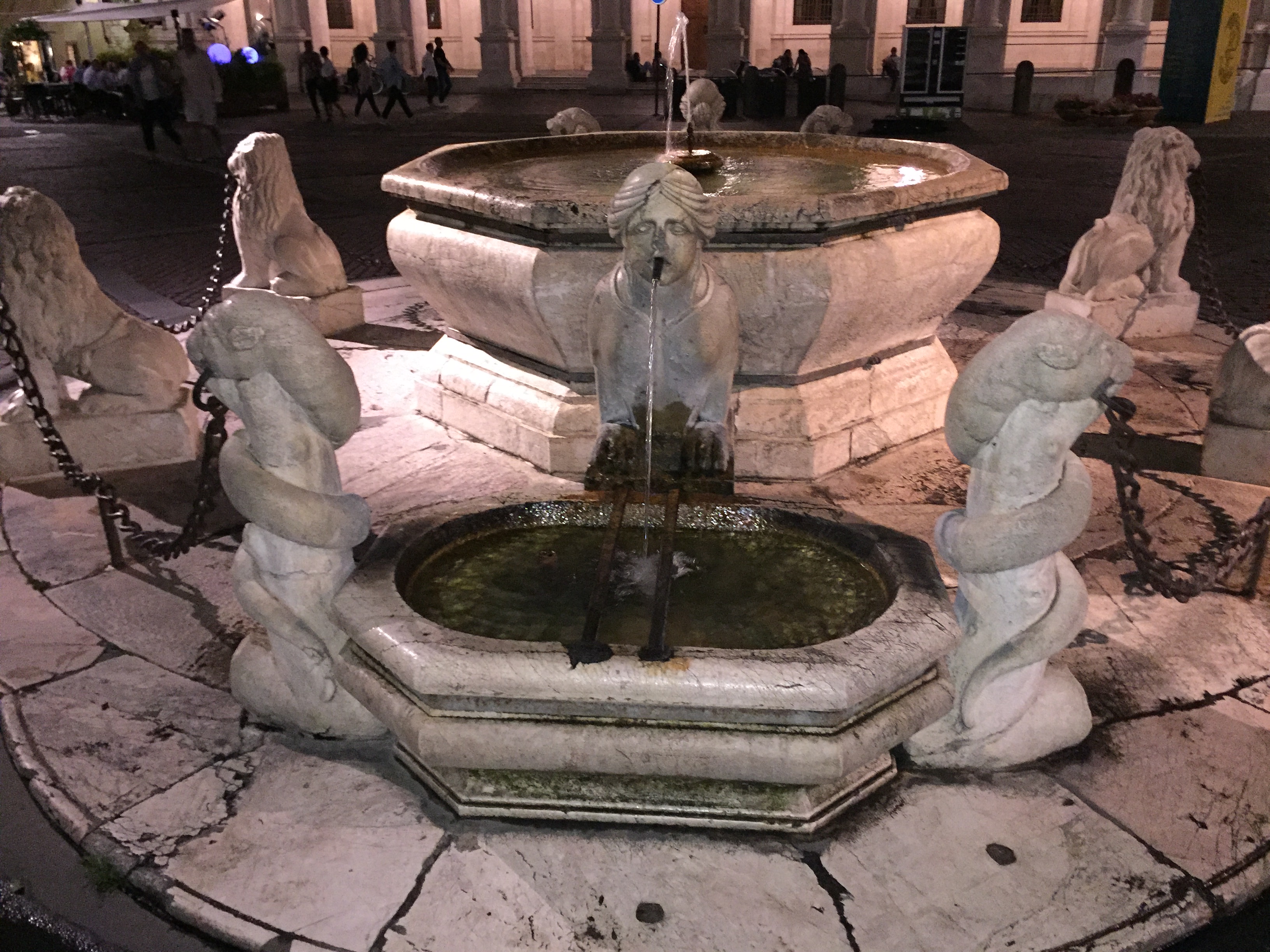
The piazza’s 1780 Contarini fountain, where you can still refill your water bottles with potable water flowing from the sphynx’s mouths:


On one side of the piazza lies the Venetion-styled Palazzo Nuovo (New Palace), which served as Bergamo’s Town Hall until 1873:

On the other lies the Palazzo della Ragione, the oldest municipal seat in Lombardy, with the Venetion lion still over the door from when Bergamo was part of the independent Venetion empire:

Just beyond is the Basilica di Santa Maria Maggiore, built starting in 1137 in fulfillment of a promise by the townspeople to dedicate a church to Mary if she helped them avoid the plague in the early years of the 1100s:


Down the street lies the Torre Dell’Orologio (Clock Tower) that serves as the gateway into town through the town’s citadel, dating to 1355:

A climb up from town in the opposite direction brought us to Rocca of Bergamo (the Fortress of Bergamo):
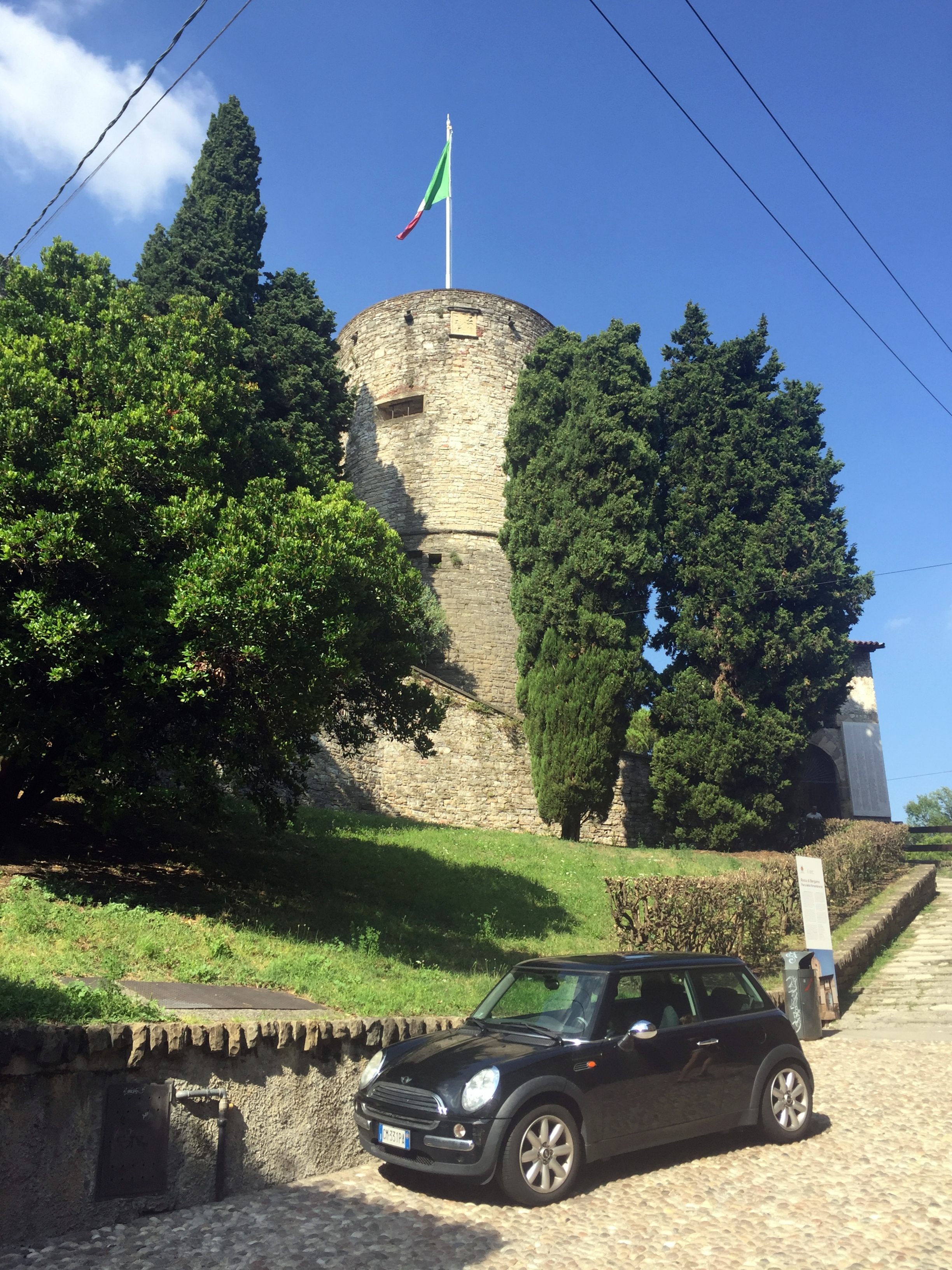
On one side of the fortress are great views of the medieval skyline of Bergamo’s Città Alta:
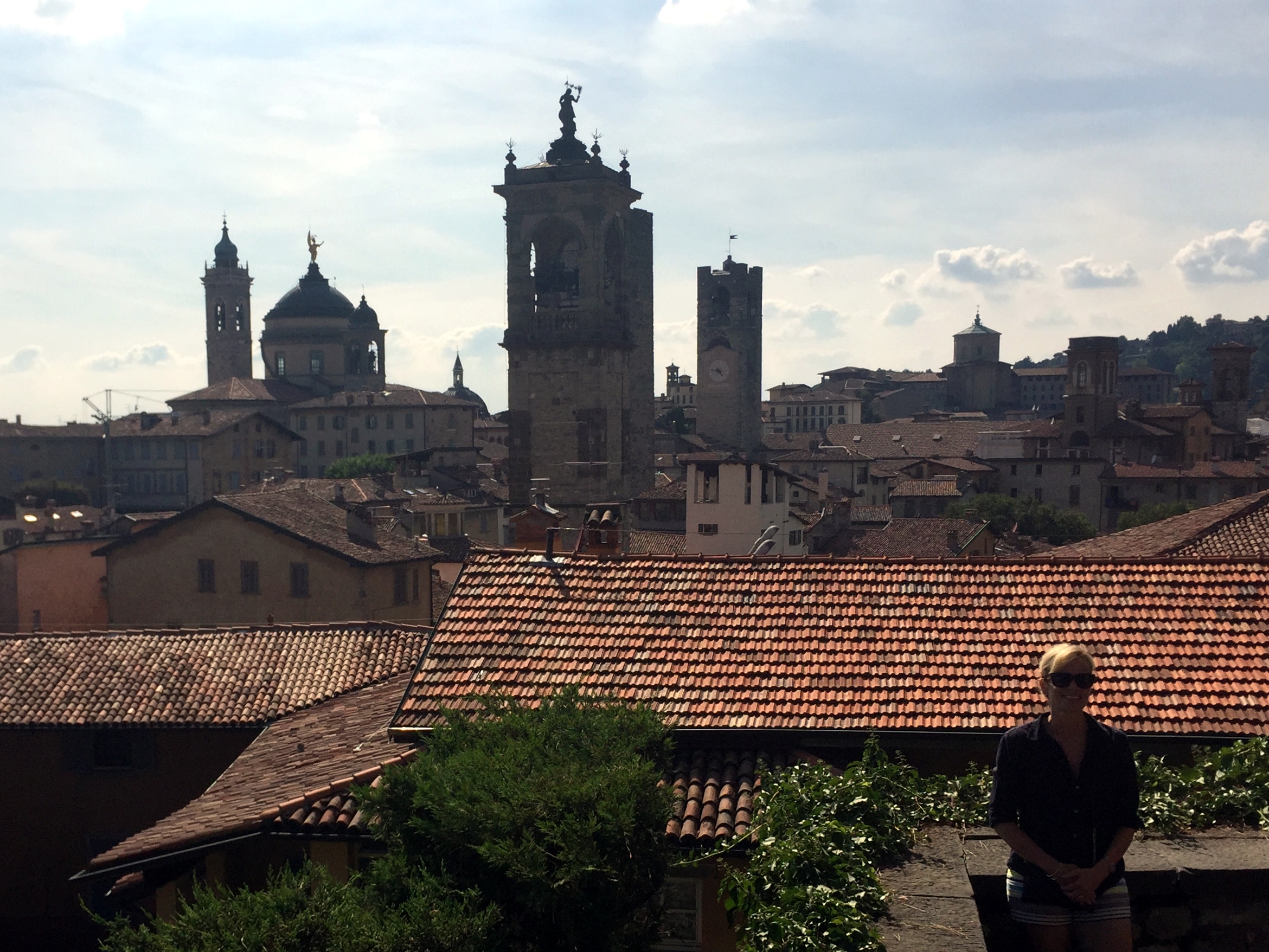
On the other are views to the valley below, as captured by this mighty cool panorama:

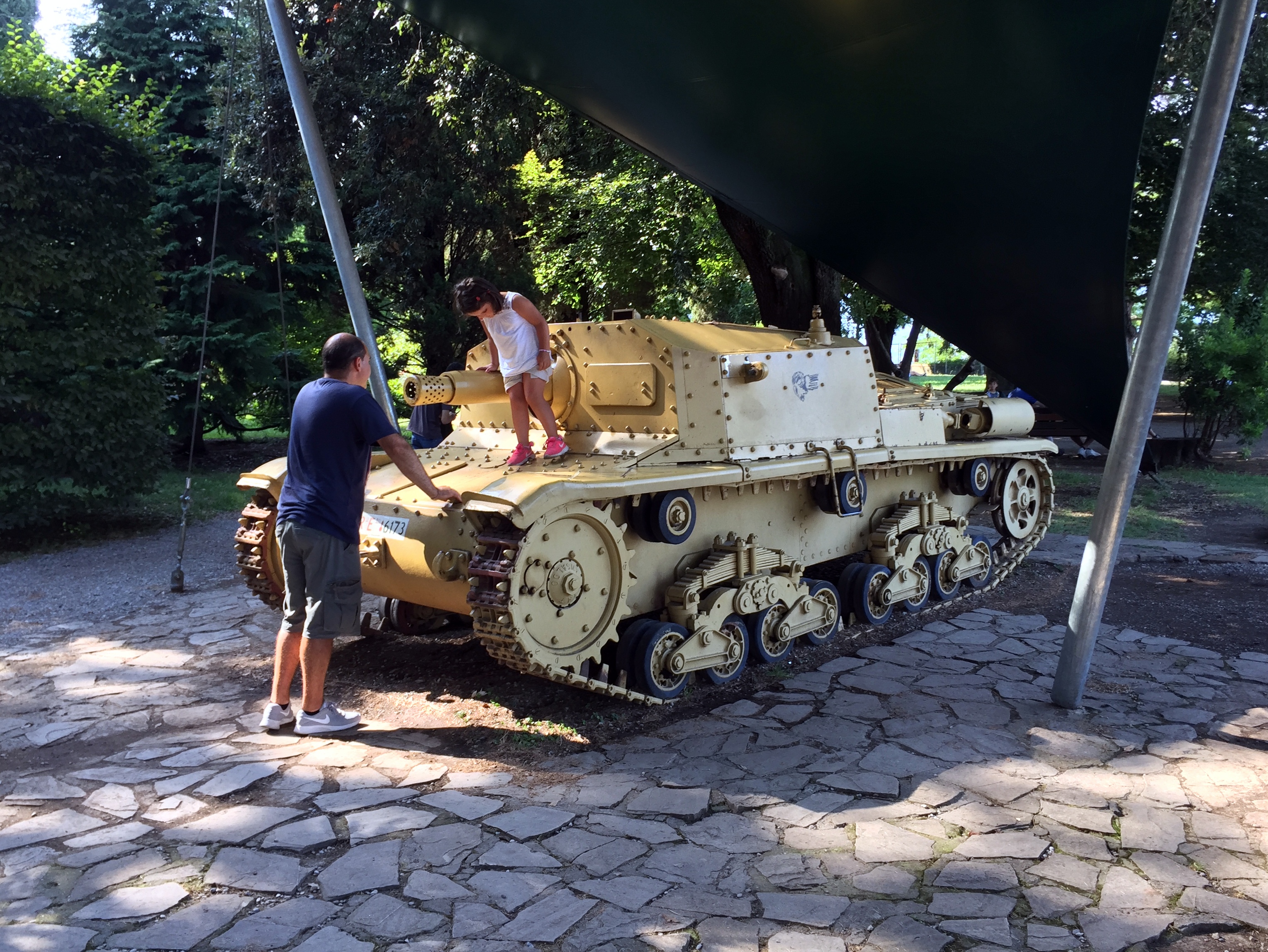
The grounds of the fortress now serves as a site for Italian war memorials:


We’re not sure which elements of this image is more incongruous: a little girl and an Italian tank . . . or simply an Italian tank:
Our cool design hotel, abutting the Gombito Tower, built in 1200 as a symbol of power of one of the feuding families in town (a la San Gimignano, experienced during our bike trip through Tuscany). It once controlled access to Piazza Vecchia from the roads leading into Città Alta from the valleys below:

Right next to the hotel (near a nice location for an afternoon cigar) lies Bergamo’s last Lavatoio Medievale, a communal wash house built in 1881 to combat sanitation problems that led to a cholera epidemic in the late 1800s. It’s a pretty cool structure with a decorative cast iron roof, and continues to serve as a communal gathering location for locals based on activities during our visit:

We had dinner outside that evening at a restaurant on Piazza Vecchio and ended up in an extended conversation with the owner, who was interested in hearing about our micronation trip and had some good stories about Bergamo, Lombardy, and San Marino.

The mildly creepy Contarini fountain that evening:
View over to the Camponone bell tower at Piazza Vecchio the next morning from our room . . .

before hitting the road for the drive into the Swiss alps and on to Leichtenstein in the family truckster – our killer diesel Skoda, shown here on the streets of Bergamo:
Olive ‘Em Are Not the Same: New York Times Compares Oils from Tuscany and Puglia
One of the stories in the New York Times this past Sunday focused on Italian olive oils, comparing those from Tuscany (“delicate, like a pinot noir”) to those from Puglia (“like a big cabernet, it’s much heartier”). We’ve biked in both Tuscany and Puglia, and there’s no competition.
Puglia reigns supreme in the olive category. The ancient olive trees that produce these heartier olive oils are such an omnipresent part of the landscape and so defined our bike trip in the heel of Italy’s boot that they earned their own post.
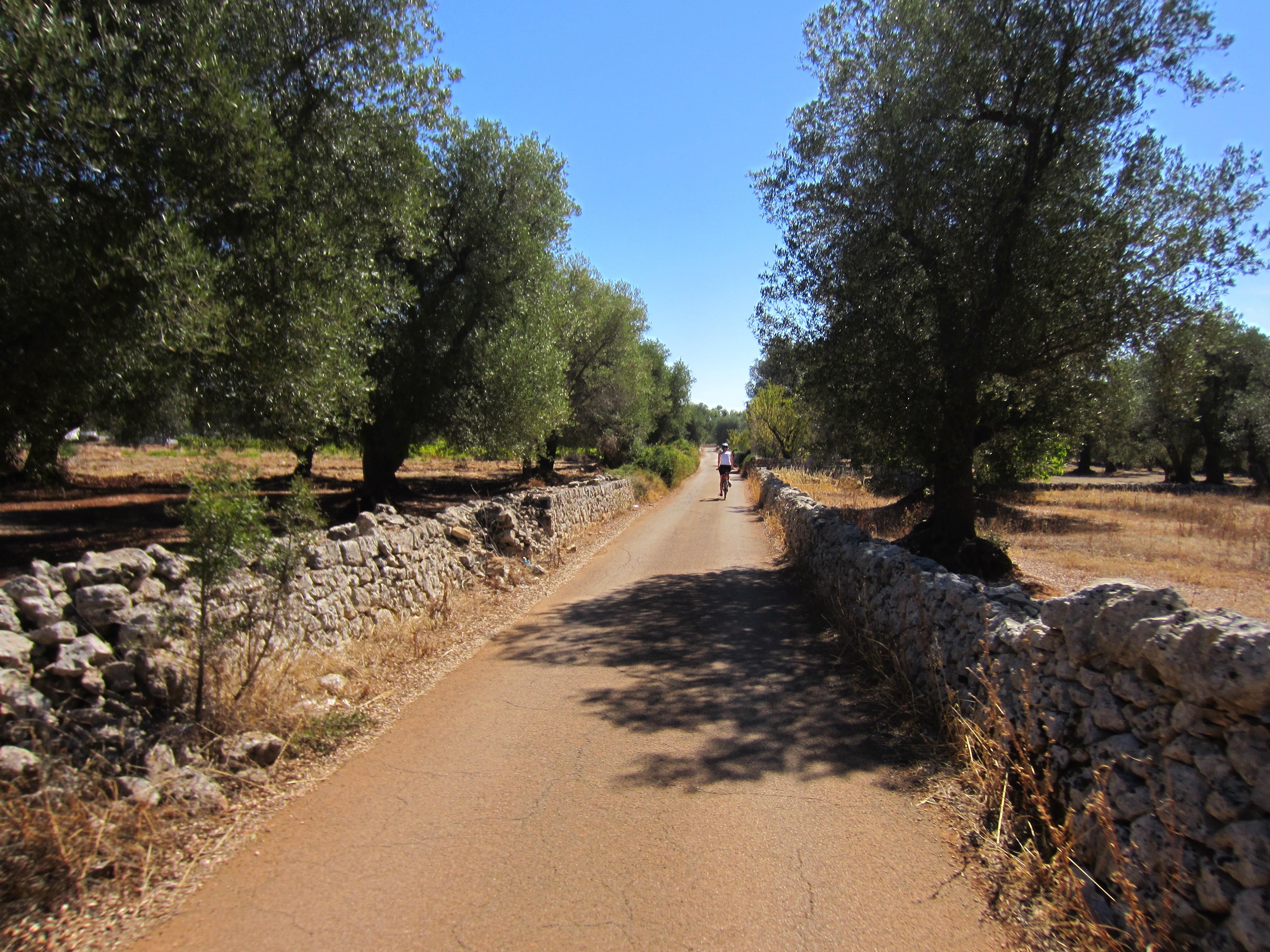
Ubiquitous olive groves in Puglia

Some of the really old olive trees that were common across Puglia
The New York Times article is well worth a read. The author’s characterization of Puglia and comparison to Tuscany, in both olives and landscapes, is below. Here, the article is dead on, in our view; elsewhere, not so much. The story also includes a caveat that olive oils from other countries are increasingly smuggled into Puglia and passed off fraudulently as extra virgin Italian olive oil.
“’In Italy, we say, the bread of one day, the oil of one month, the wine of one year,” said Paolo Rossi, the property manager, establishing parameters for freshness and essentially articulating my entire Italian summer diet. “Olive trees are a generous plant. Here in Tuscany, one tree can produce one liter. In Puglia, one tree can produce 30 liters. If you go to Puglia, you will see trees so big you need three people to hug them. You won’t believe your eyes.’
The next morning, it was time. We set off to not believe our eyes.
Driving south, the hillsides of Tuscany gave way to craggy mountains, then lush countryside, until finally, after hours in the car, we entered a low, flat plateau that ran along the coast of the Adriatic; dry and rocky, and vaguely prehistoric. Puglia is stark, beautiful, almost North African. The air is dry and salty and the earth is rough and stony and burned red with clay under an unforgiving blue sky. And everywhere, in every direction, at every turn: olive trees. It was like the gods had chosen to carpet the entire heel of Italy with a shaggy, olive green rug.
Puglia produces almost 40 percent of the olive oil in Italy. There are some 60,000,000 olive trees here, and millions of them are so old they are protected by the government. With water on three sides, it’s the perfect place to bring in olive oil from outside Italy, process or bottle it in Puglia and pass off fake stuff for the real thing, as the region allows easy access to the Italian market.
This is a real problem, and a reason to go to the source.”
The article ends with reliable sources of genuine Italian olive oil that we’ll be looking for the next time we buy (using the second list, of course, featuring robust Puglian olives).
The article later gushes over both the town of Ostuni and the village of Ceglie Messapica in Puglia. We’ve been to both and certainly agree with the Times’ assessment of Ostuni. We were entranced by the White City (“Città Bianca”):

La Città Bianca


Ostuni’s cathedral

Bishop’s Palace Bridge in the cathedral’s piazza
The Times’ characterization of a charming Ceglie Messapica, though? Either the journalist was drinking olive oil that had inadvertently fermented or we went to different places. We thought it was a bland “nothingburger” of a town, according to the pics in our 2013 post:

A stopover in the nothingburger town of Ceglie Messapica

Inside the old 11th-century fortress – nothing to see here

Other than a mildly creepy set of guys holding a crest from some long-ago ruling family

The streets of Ceglie Messapica – they aim to bore.
Maybe the residents of Ceglie Messapica historically have just focused all of their efforts outside the town . . . in the olive groves.
