The charming town of Taormina was to be the final stop on the Sicily leg of our prolonged foray. (Map and overview of the full foray is posted here.) If you’re following along, we have only three legs left after Sicily.
Perched high above the Ionian Sea, Taormina was founded by the Sicels and later became an important Greek settlement after refugees from the nearby colony of Naxos just south of Taormina’s current location relocated there in the 4th century BC (stay tuned later this year for a post covering travel to Naxos the Greek island, which is upcoming). The town flourished under Greek and then Roman rule, leaving behind its most famous monument, the spectacular Ancient Theatre of Taormina (which we’ll get to in the next post), whose stage frames views of both the sea and Mount Etna. Through the Byzantine, Arab, Norman, and Spanish periods, Taormina retained its strategic hilltop position and developed into one of Sicily’s most historically layered and visually dramatic towns.
Taormina’s 12th-century Porta Messina on the north end of town (where you would enter the town if you were coming from Messina to the north in the olden days; or from the gondola at sea level now):
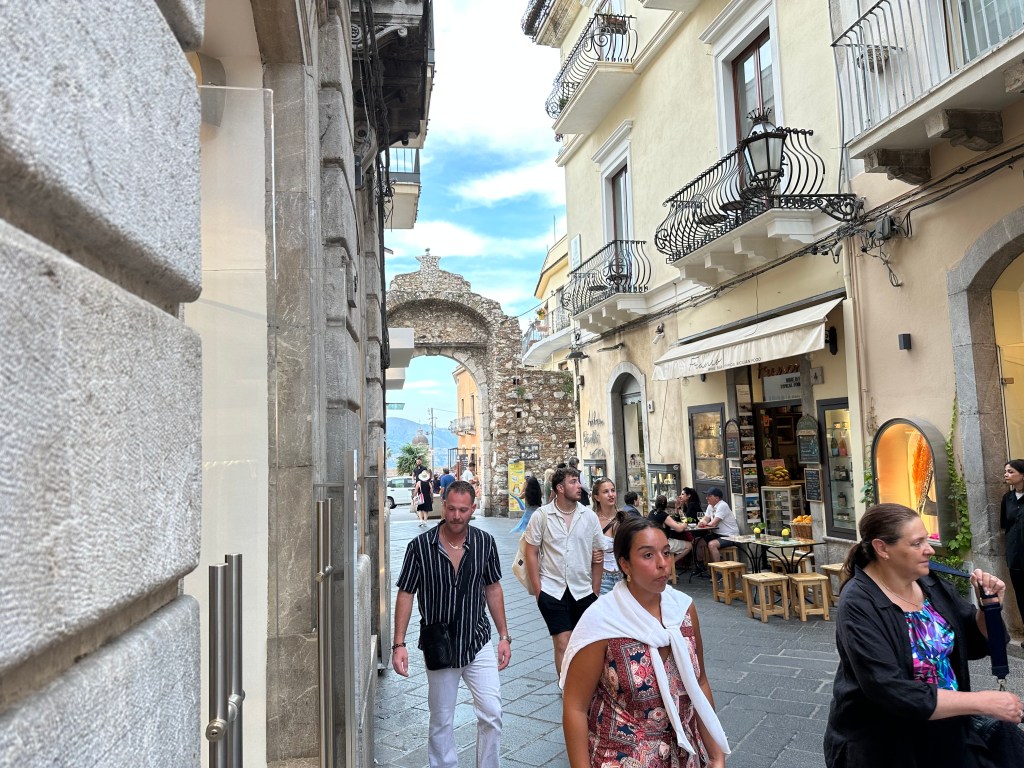
And on the other end of town, the 15th-century Aragonese Porta Catania (replete with the Spaniards’ coat of arms), facing south to Catania (where we’d fly out of in several days):
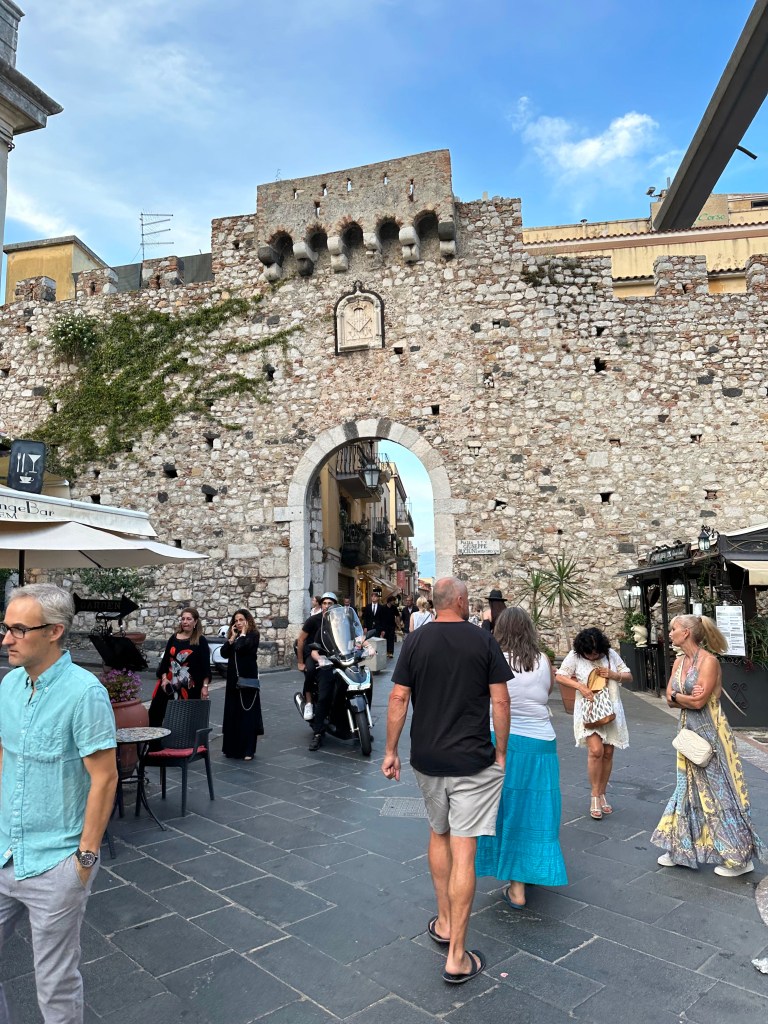
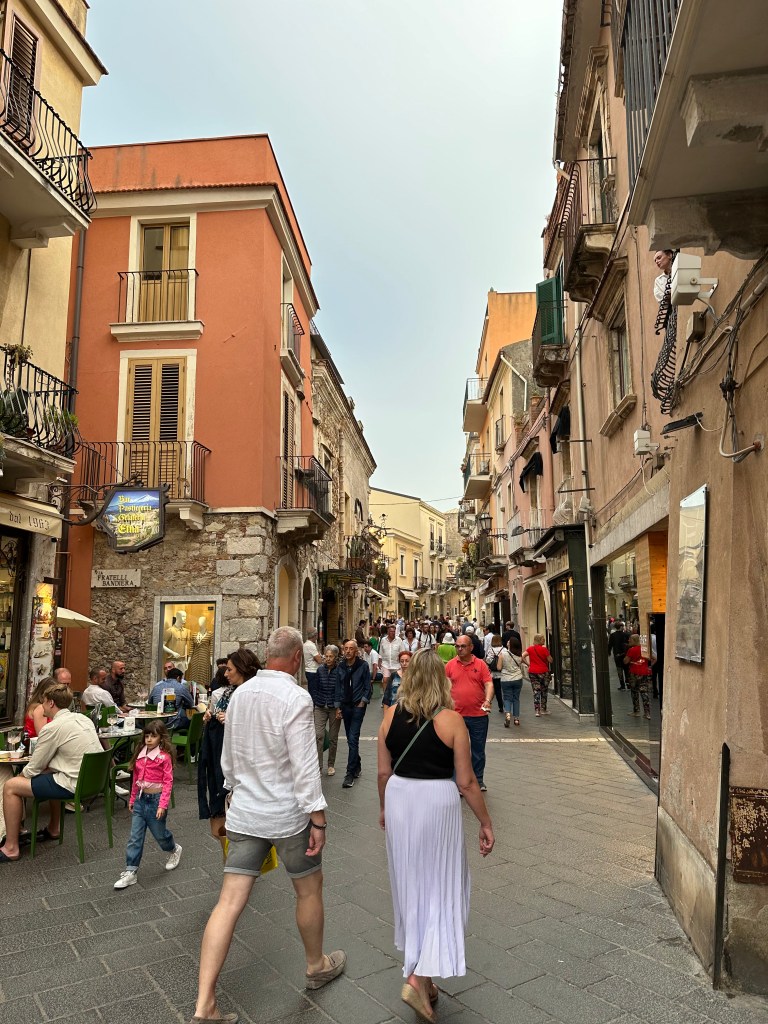
And snaking between the two? Corso Umberto, Taormina’s main street.
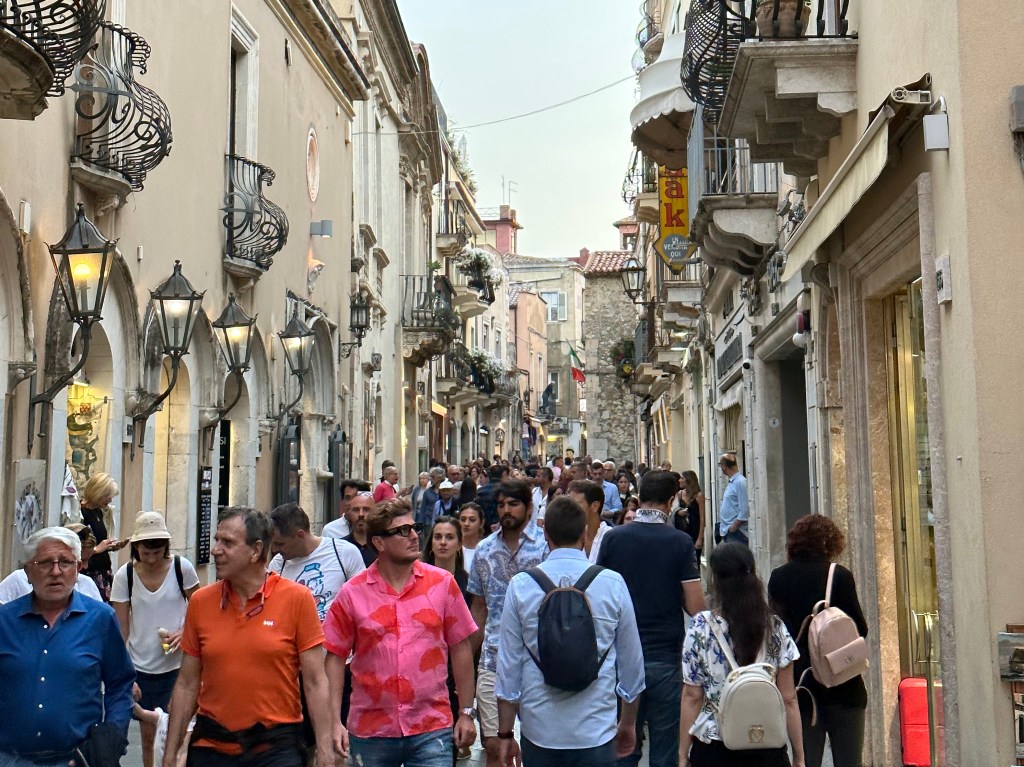
Like the one-road Baroque town of Noto visited a week or so earlier, Taormina indeed is replete with streets, but there’s only one main drag and singular main event.
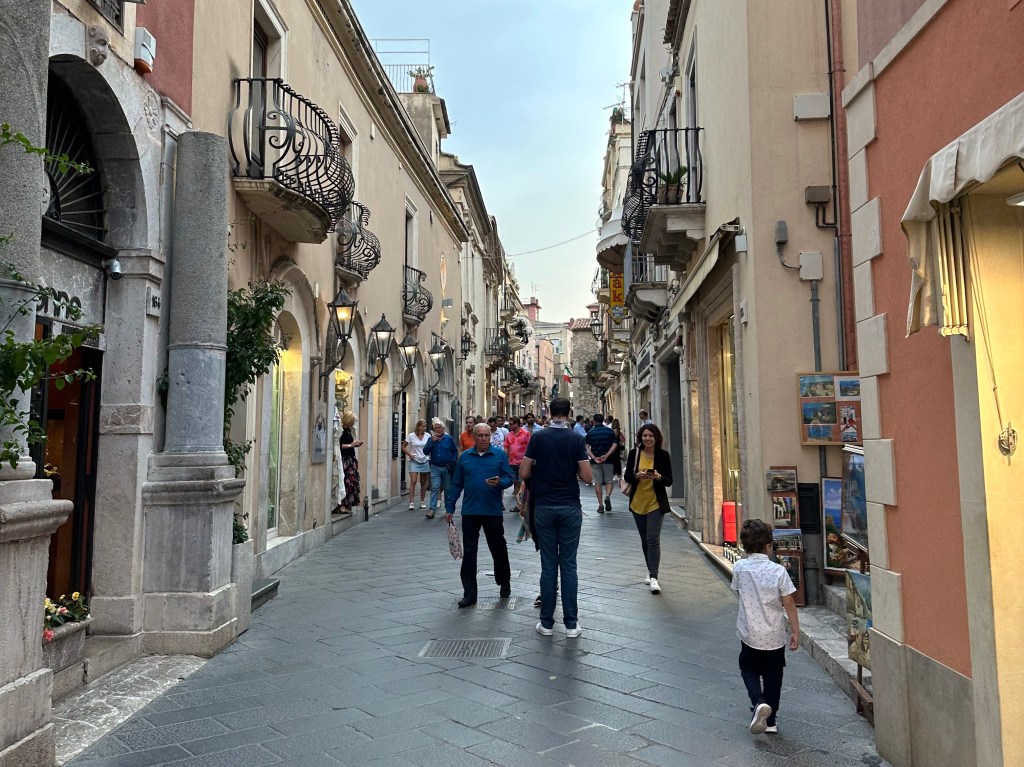
But what a fantastic main drag it is – way more restaurants, bars, and shops than Noto and incredibly appealing. Beginning in the 19th century, Taormina became a celebrated stop on the European Grand Tour, attracting artists, writers, aristocrats, and intellectuals drawn by its scenery, mild climate, and classical ruins. Today it remains one of the Mediterranean’s most stylish destinations, combining luxury hotels, elegant boutiques, refined dining, and breathtaking views in a setting that feels both sophisticated and timeless.
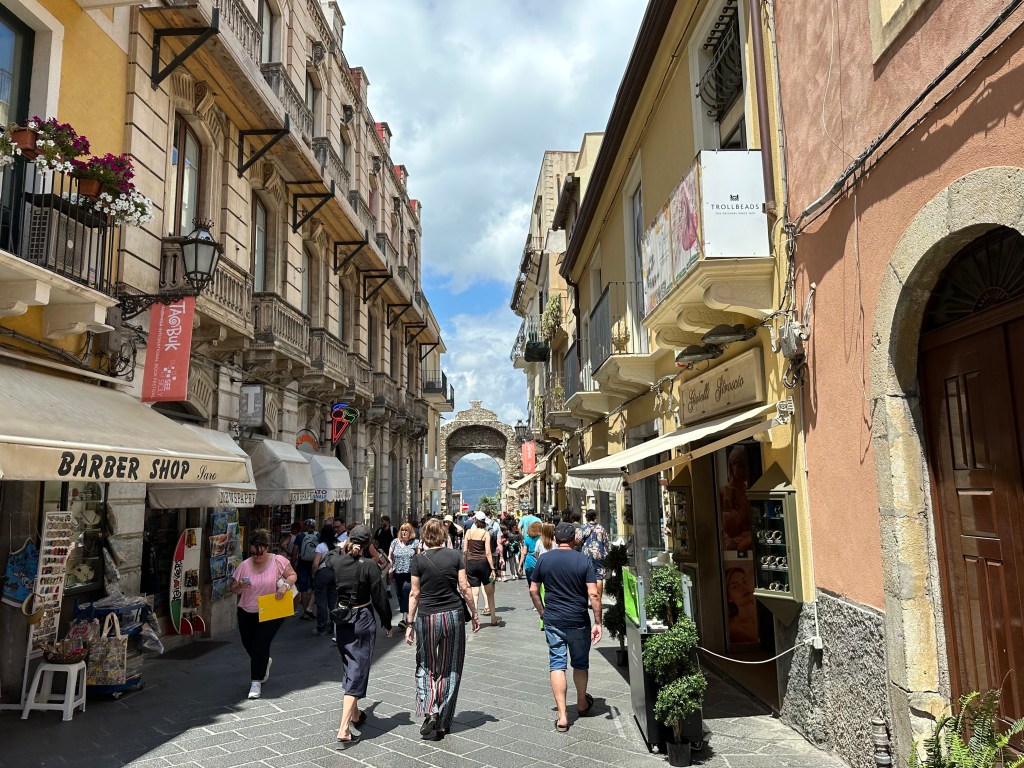
The corso appears packed here, but everything’s flowing and there was never any sense that we had embroiled ourselves in an overtaxed Positano-type situation.
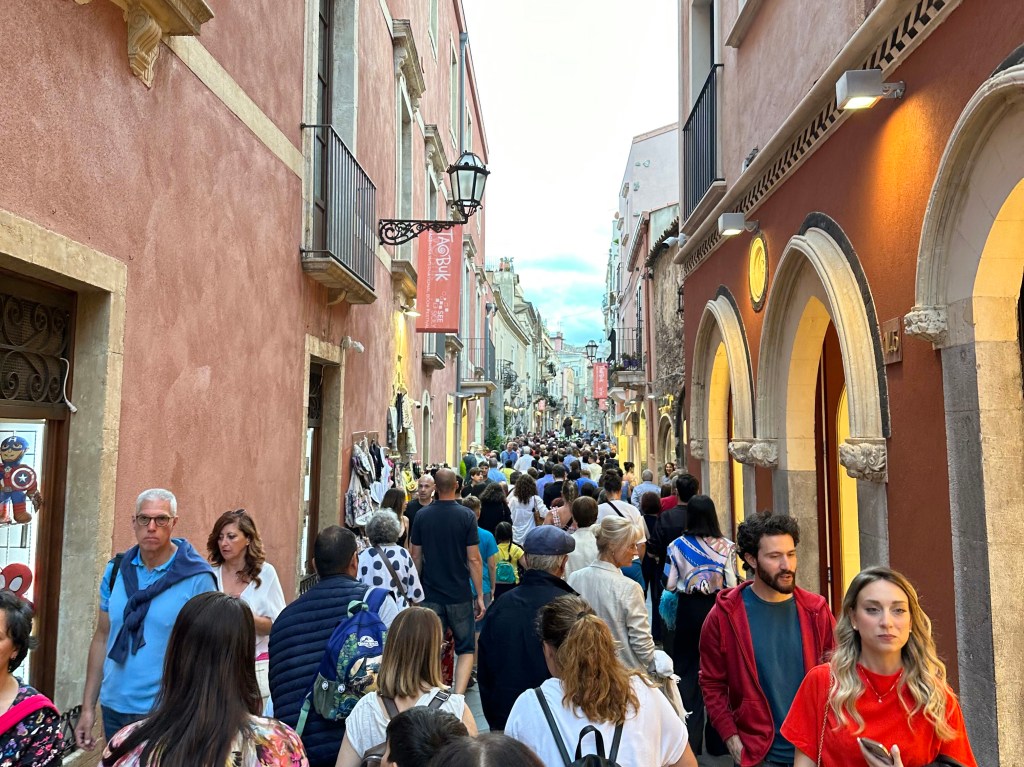
Plus, the occasional religious festival procession winding its way down the corso – in this case, celebrating the Feast of Saint Anthony of Padua (that’s him on the litter); we think maybe they’re taking the lazy way out of this by proceeding with a litter on wheels instead on shoulders, like in Godfather II and Godfather III:
And around the midway point on Corso Umberto lies Piazza IX Aprile and Porta di Mezzo – the midway tower:
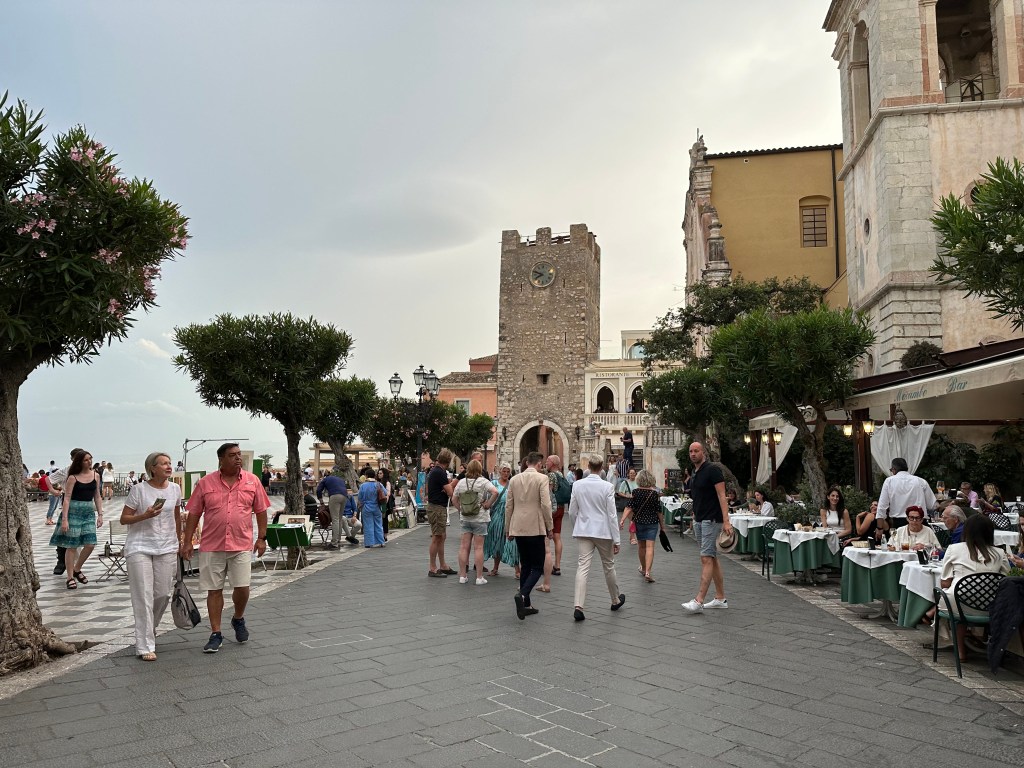
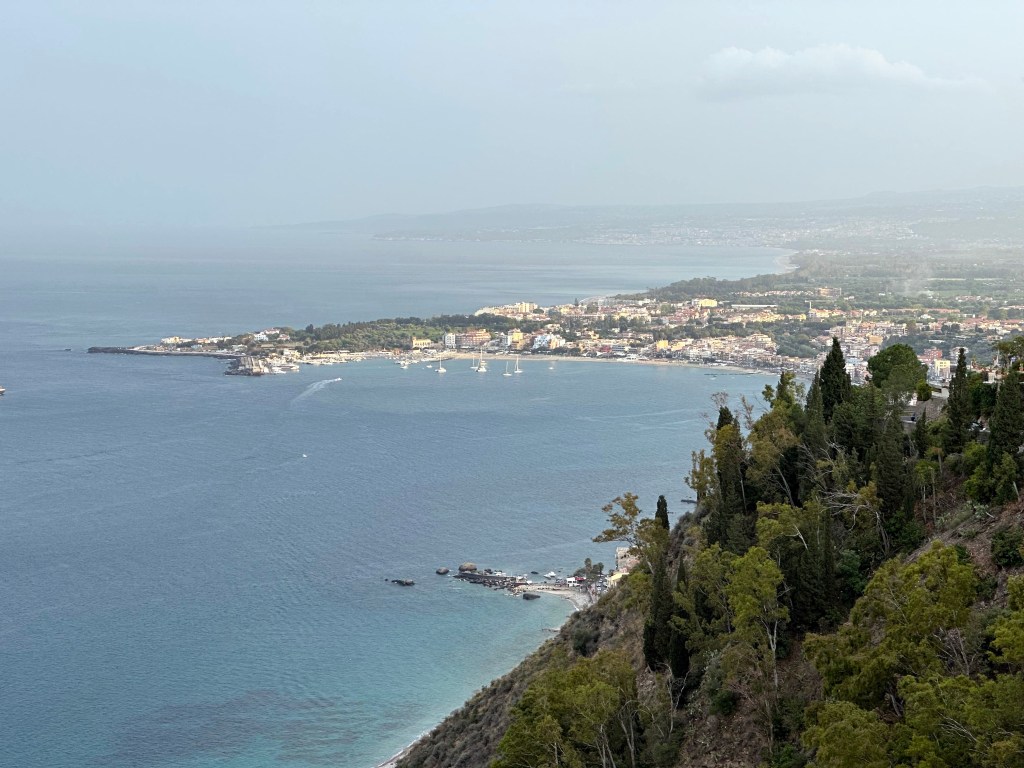
Because Taormina is perched on a cliff, Piazza IX Aprile offers a great belvedere with views of the coast below:
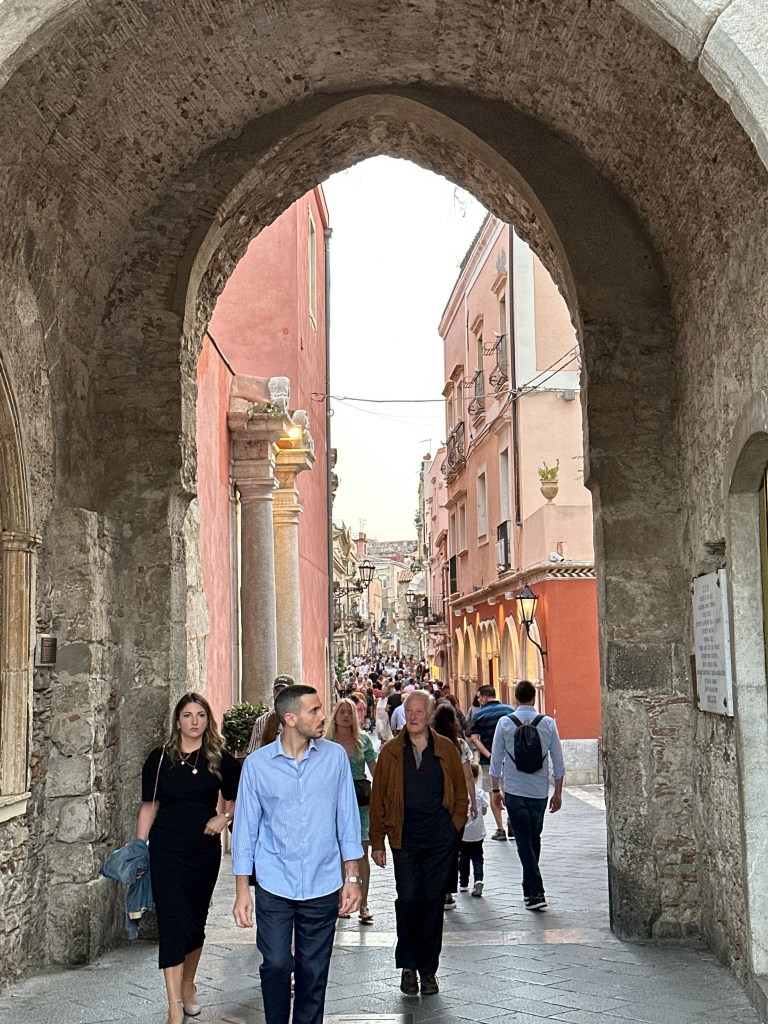
View into the corso under the clock tower:
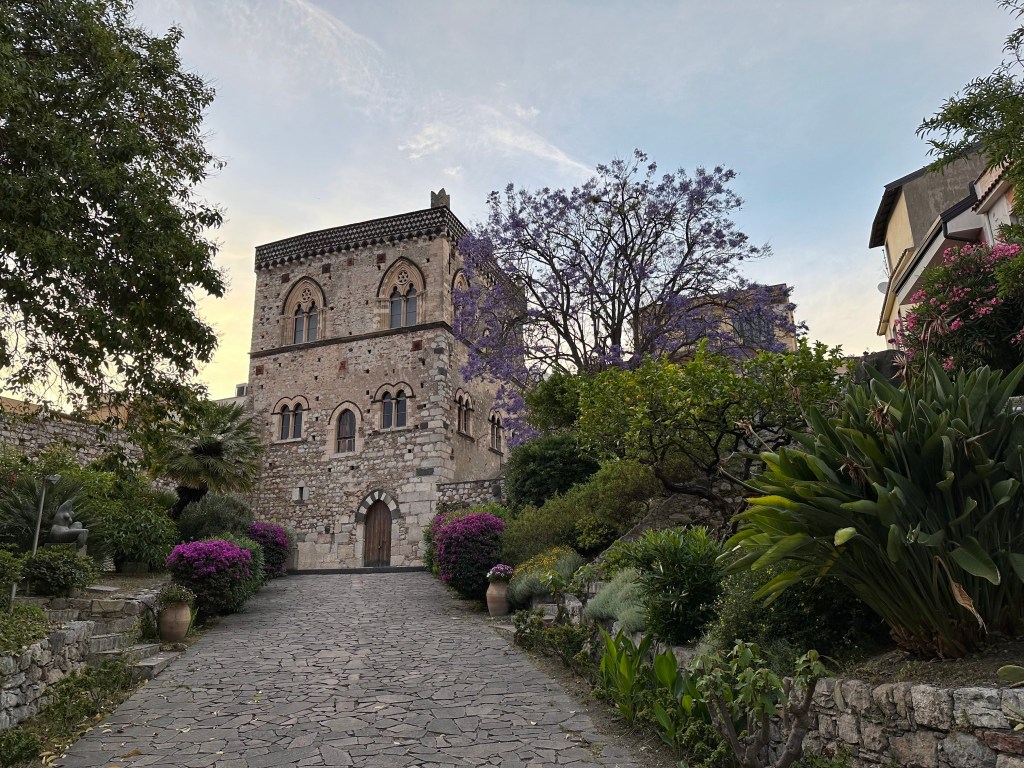
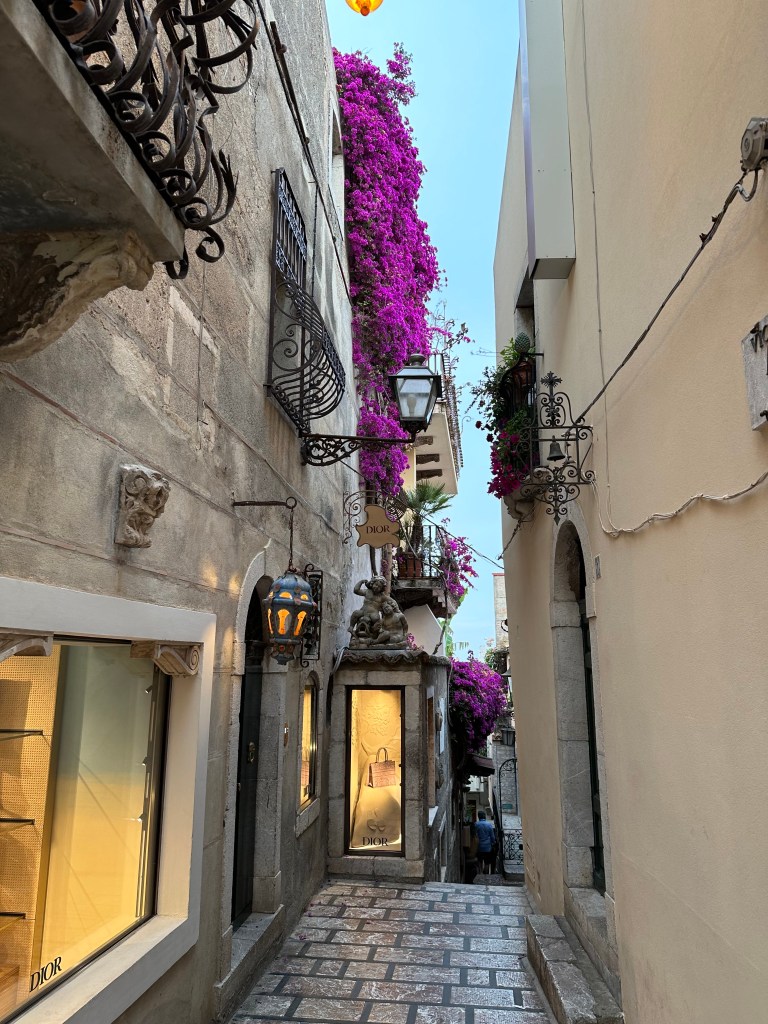
Medieval palazzo off the corso, with a vibrant jacaranda tree in bloom, to boot.
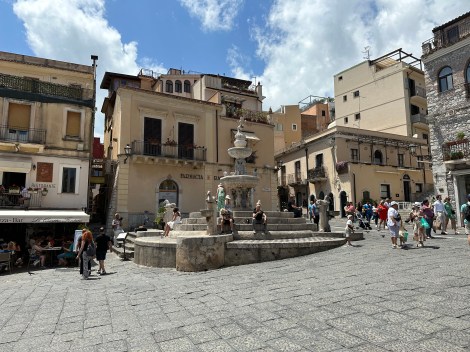
Taormina’s second square (second to Piazza IX Aprile, of course): the Piazza Duomo:
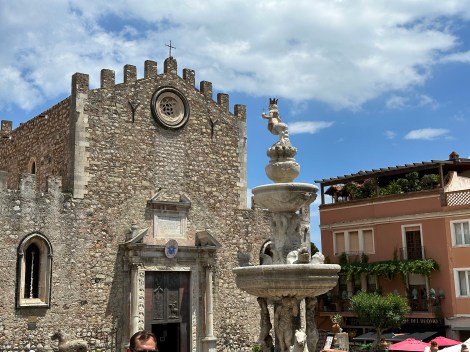
There’s the duomo. And, uh, there’s the Quatro Fontanes (Four Fountains):
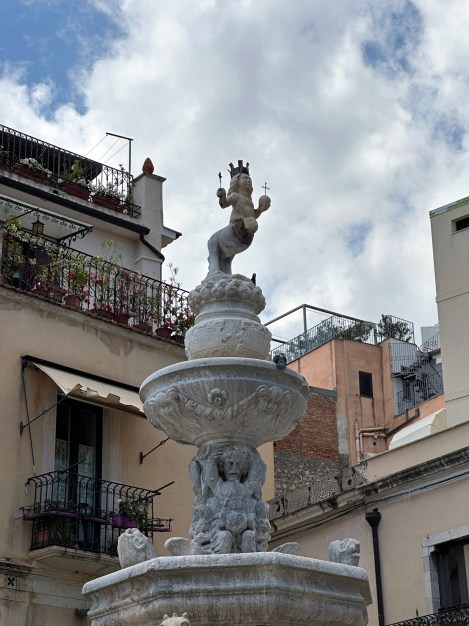
Topped by a female centaur – apparently the historic emblem of Taormina. She wears a crown and holds a scepter in one hand and a globe surmounted by a cross in the other—symbols of civic authority and power. Regardless, super weird.
Heading to the duomo, the Cathedral of Saint Nicholas of Bari, the popular bishop-saint whose cult spread widely throughout southern Italy and Sicily.
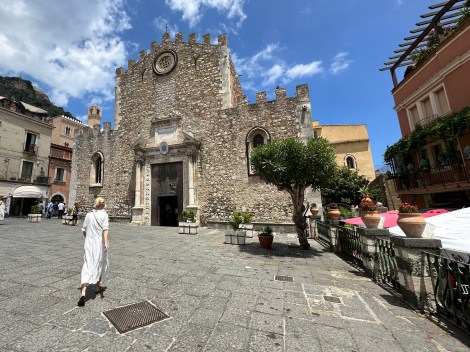
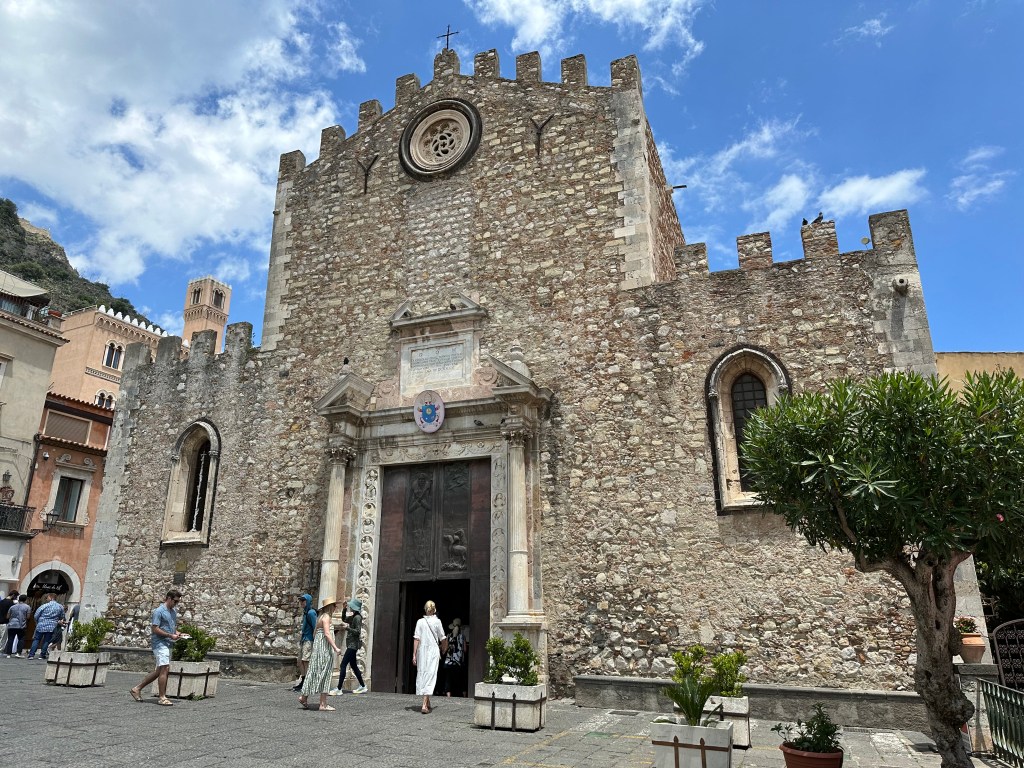
The duomo looks more like a castle than a church. Built from massive stone blocks and topped with battlements, it was designed as an ecclesia munita—a fortified church capable of providing refuge during periods of instability. This defensive appearance earned it the nickname “Cathedral Fortress” and reflects the turbulent medieval history of Sicily.
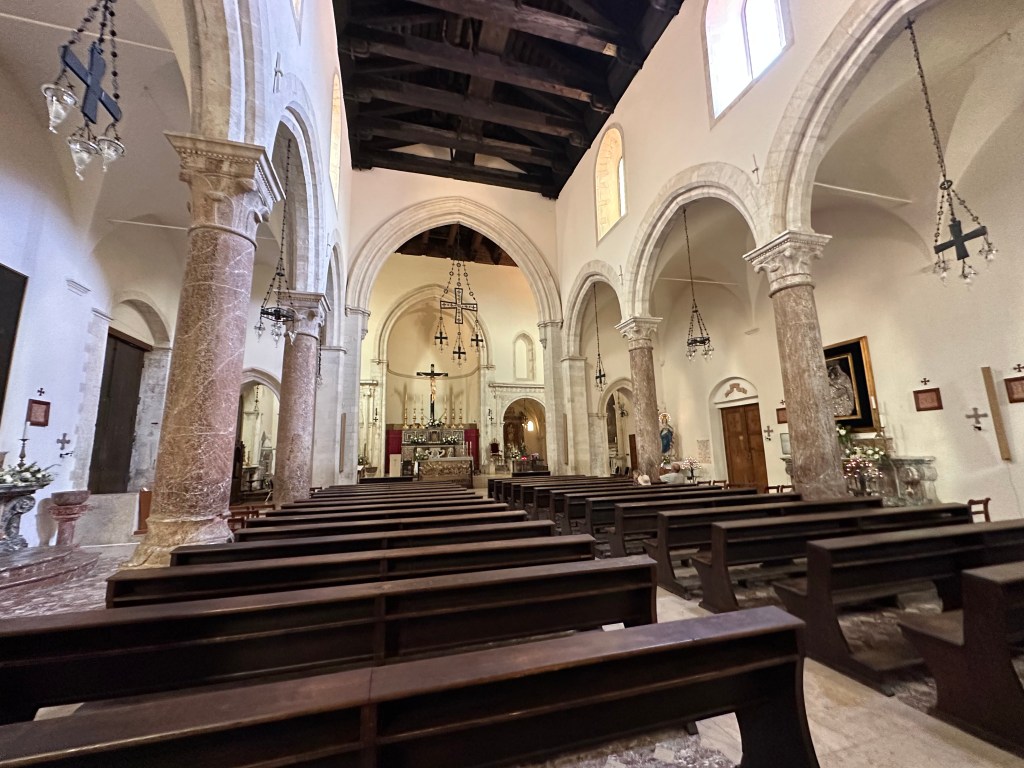
But the interior of the 13th- and 14th-century duomo looks pretty standard.
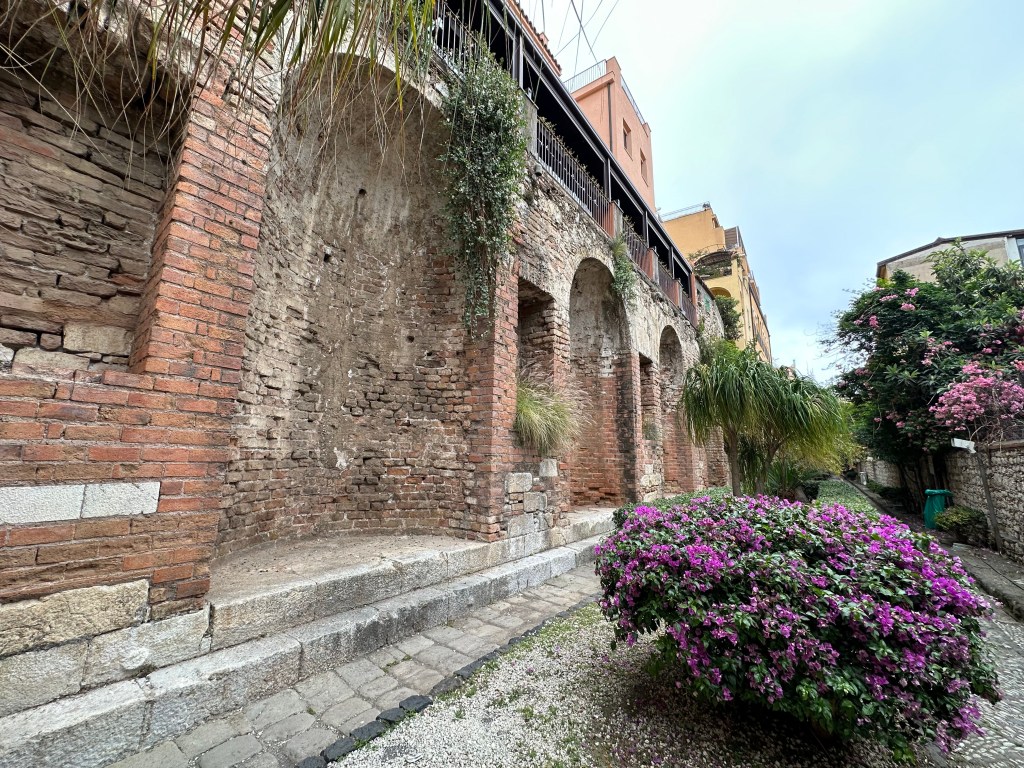
Down (and to the left) we encounter the 2nd-century AD Roman “Naumachie,” a long brick wall punctuated with niches, likely to house statues. Buried and unknown for a millenia and a half, the moniker was incorrectly (just like in Agrigento) applied by a Dutch scholar in the 18th century, who figured – and why not? – that the structure hosted naval battles.
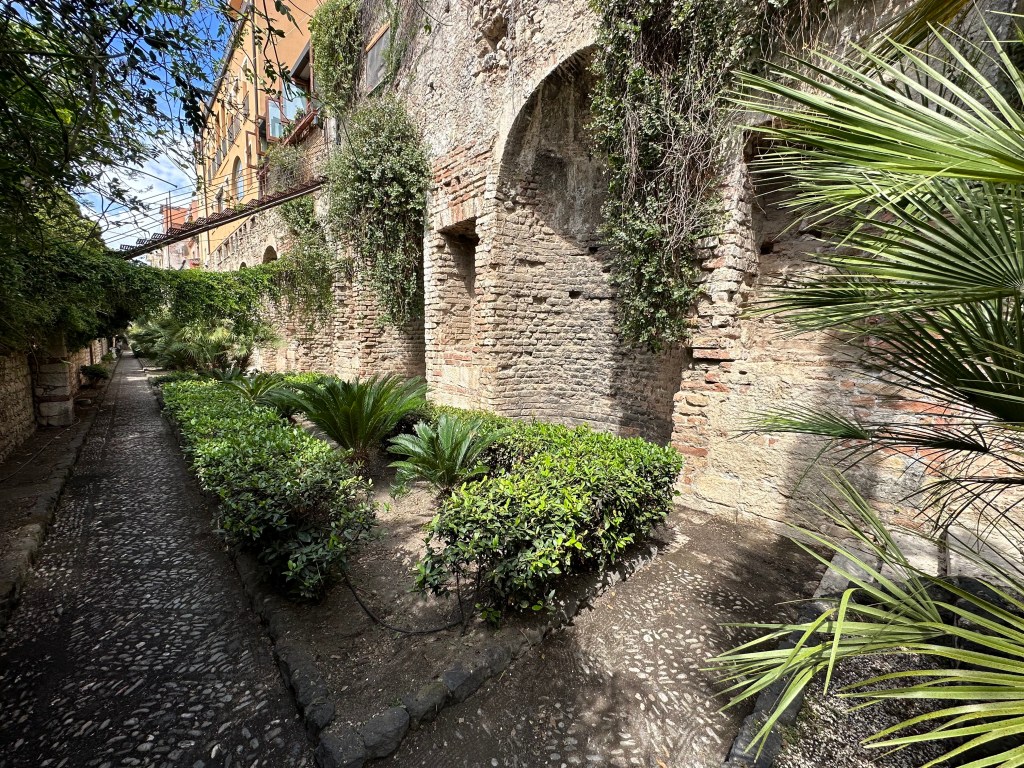
The massive wall did function as the barriers of a reservoir to supply a gymnasium or massive municipal fountain complex.
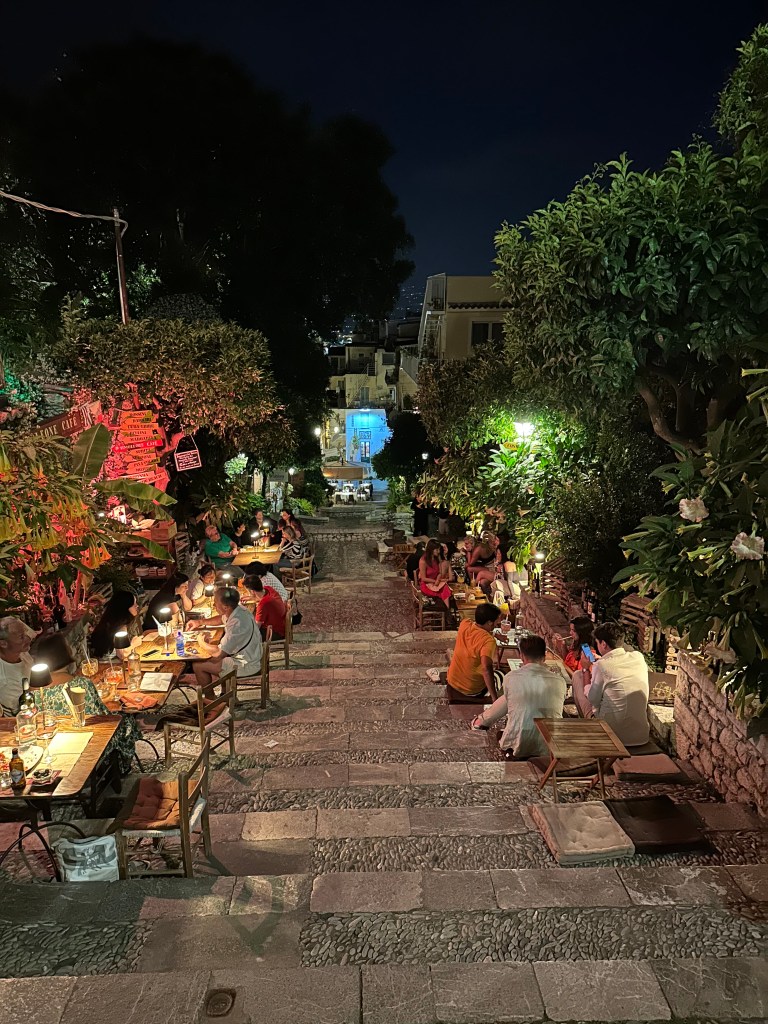
But enough history; aperitivo hour is approaching with the setting sun and we needed to locate a decent perch.
This will do.
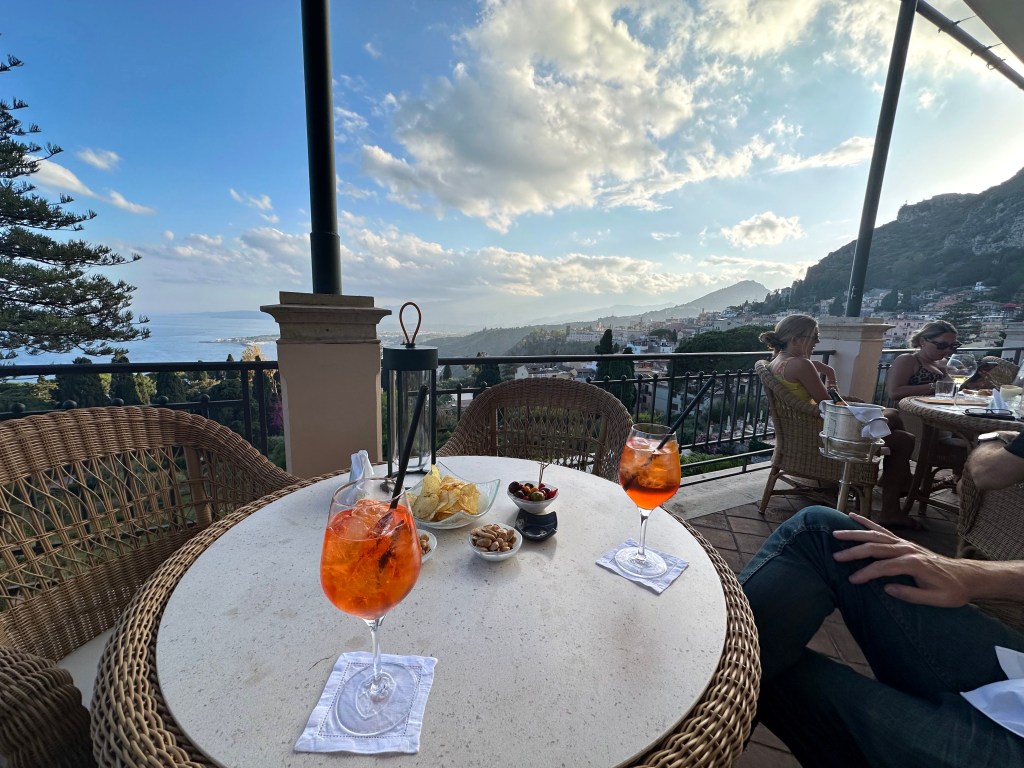
With a great view over the coast and also a glimpse of what once was a 14th-century Dominican monastery. . .
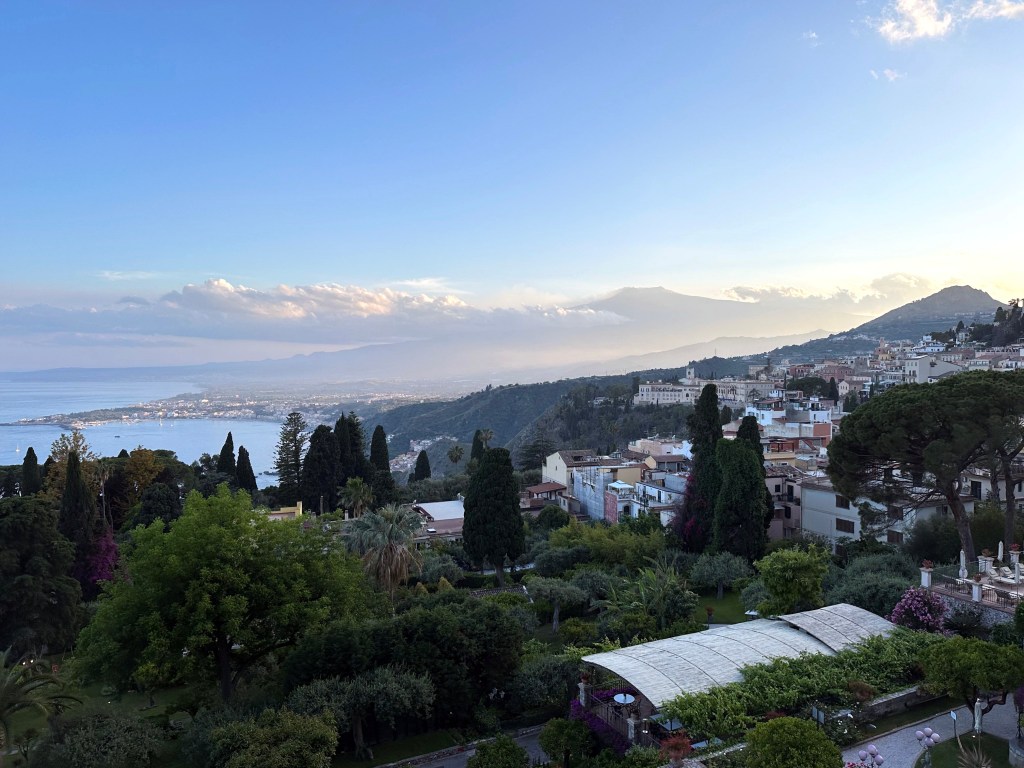
But now houses the Four Seasons and the setting for Season 2 of White Lotus (they were closed to outside visitors due to a private event when we were there, otherwise we would have checked it out).
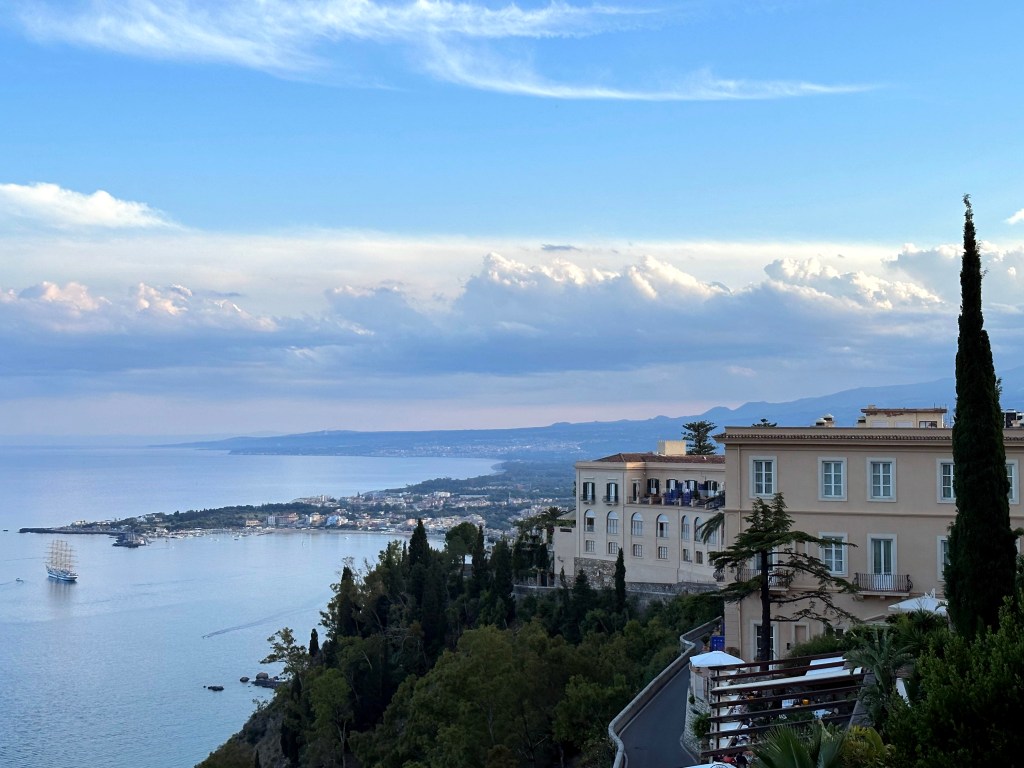
Pretty great town.
To actually reach town (through Porta Messina), we had to walk about 2 blocks from our AirBnB to catch the gondola at this station, since Taormina is high up on a cliff, visible at the top of the pic:
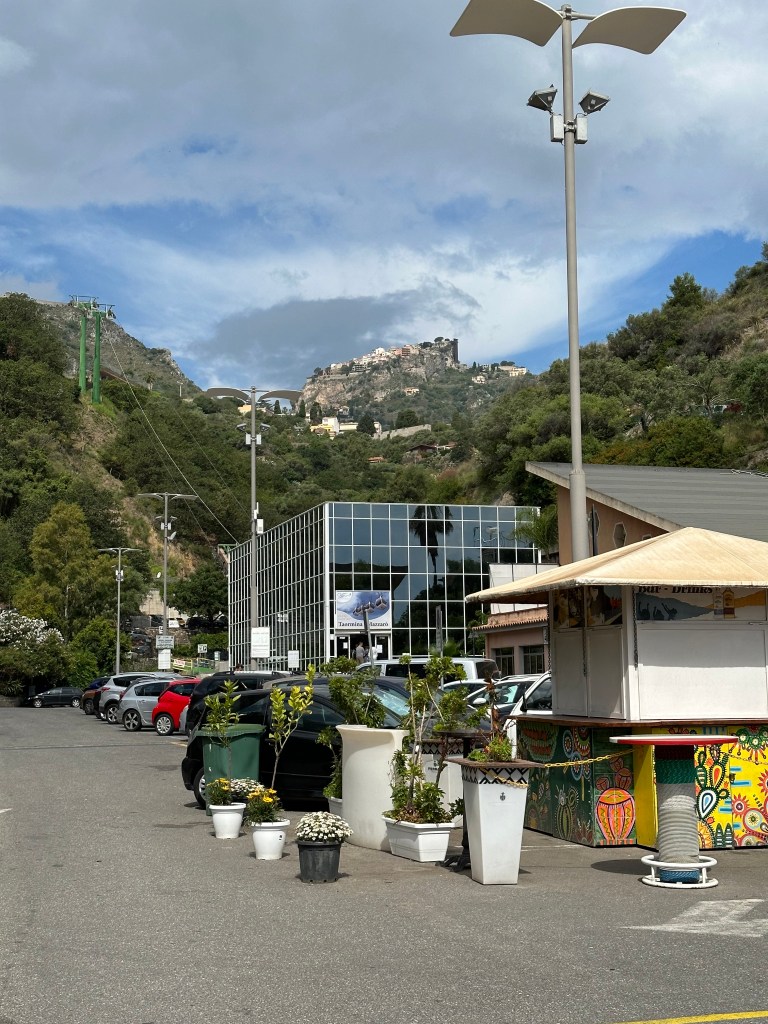
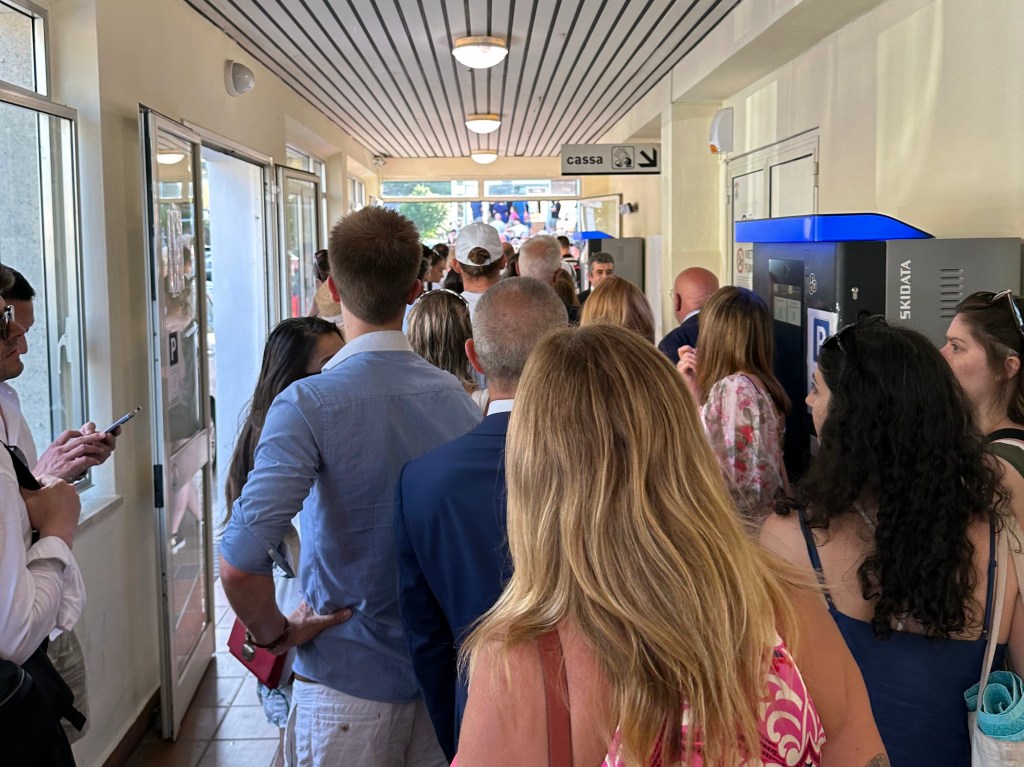
You grab your tickets while in line, and head on up; we never had to wait more than a few minutes – pretty efficient system.
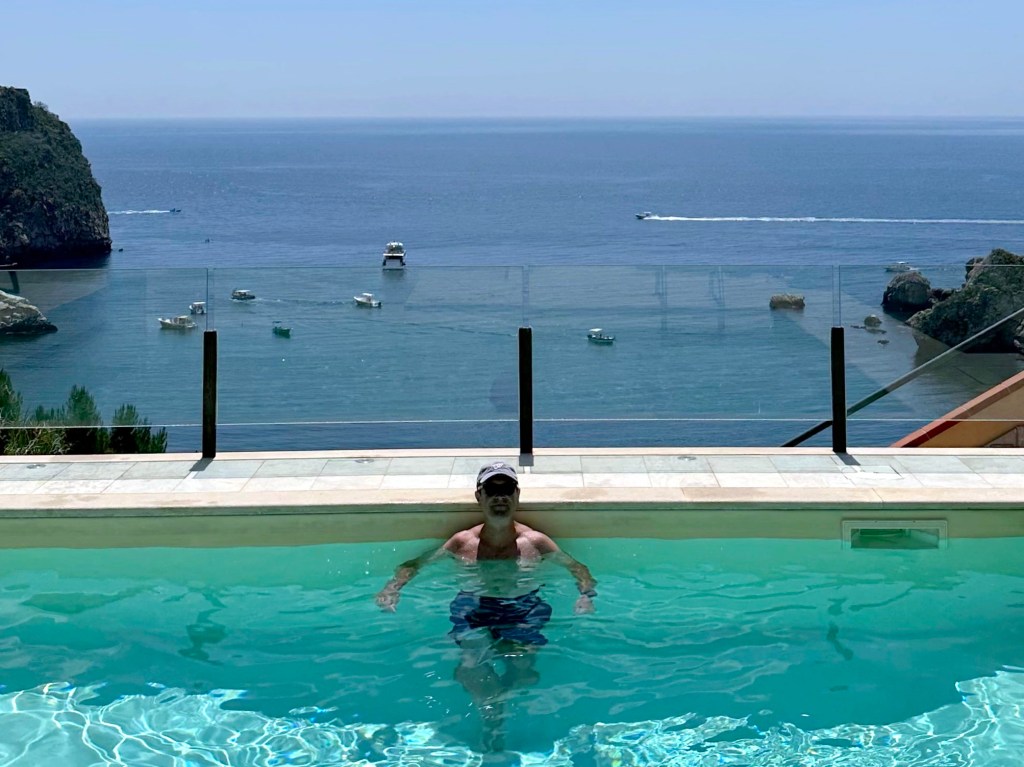
Why would we stay a gondola ride from town instead of nestled within centro storico? Because this:
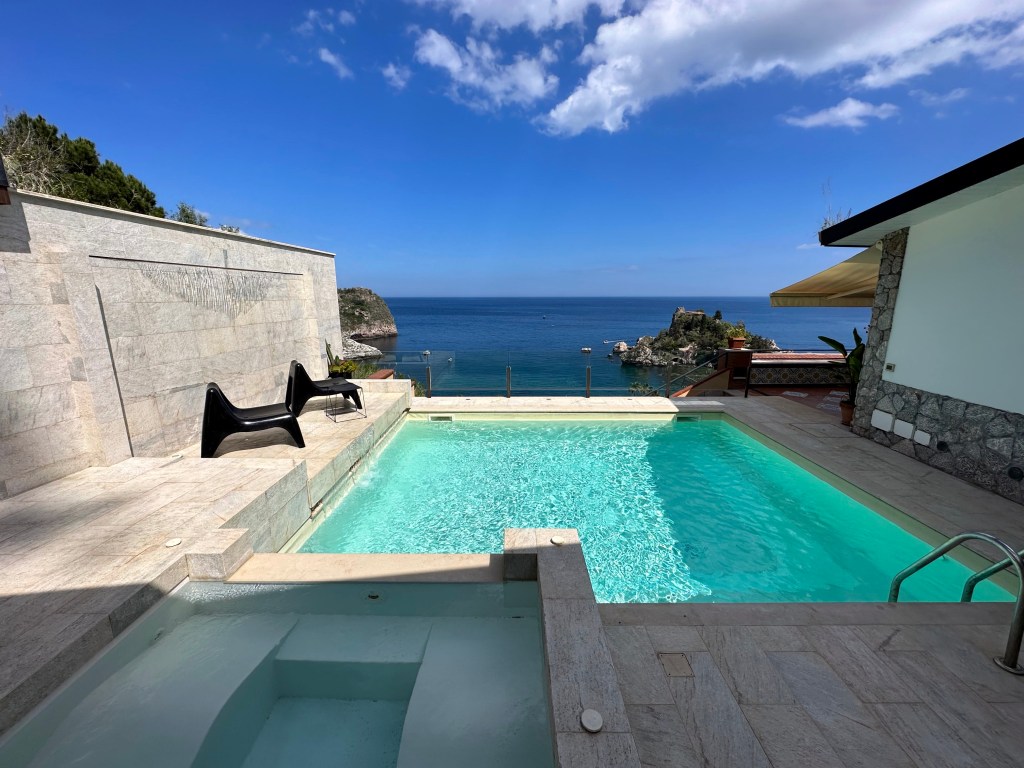
Pretty great setting in the Sicilian heat.
Because we were fixated on lodging with pools, we snagged this thing probably 6 months before we headed off for our prolonged foray.
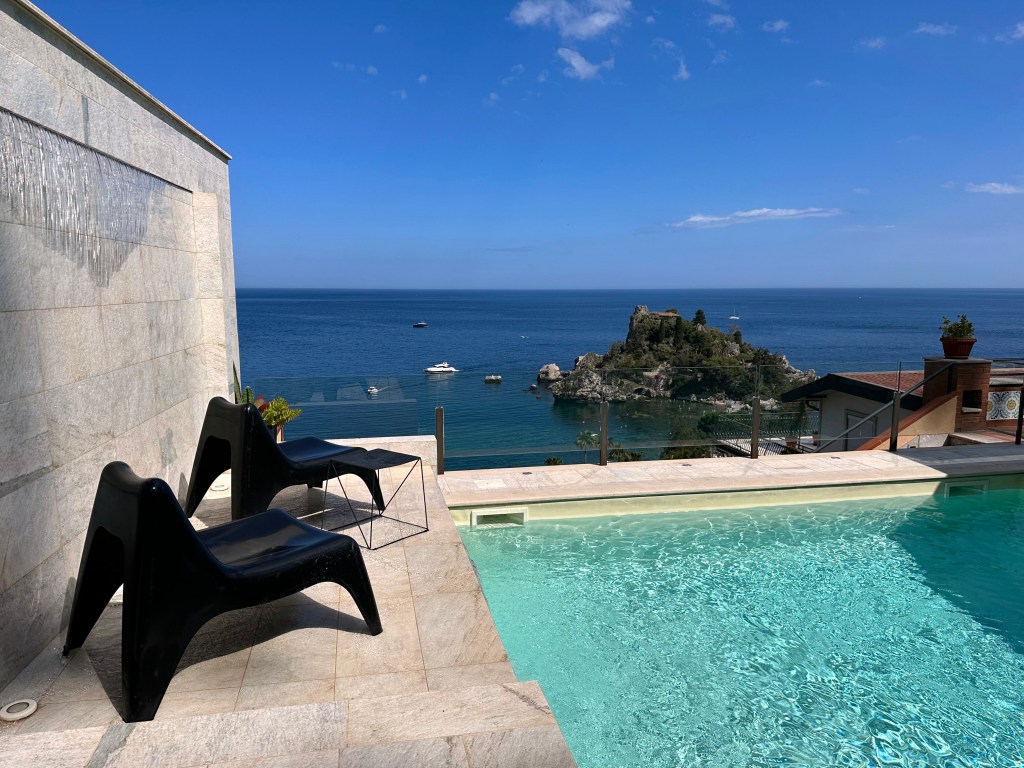
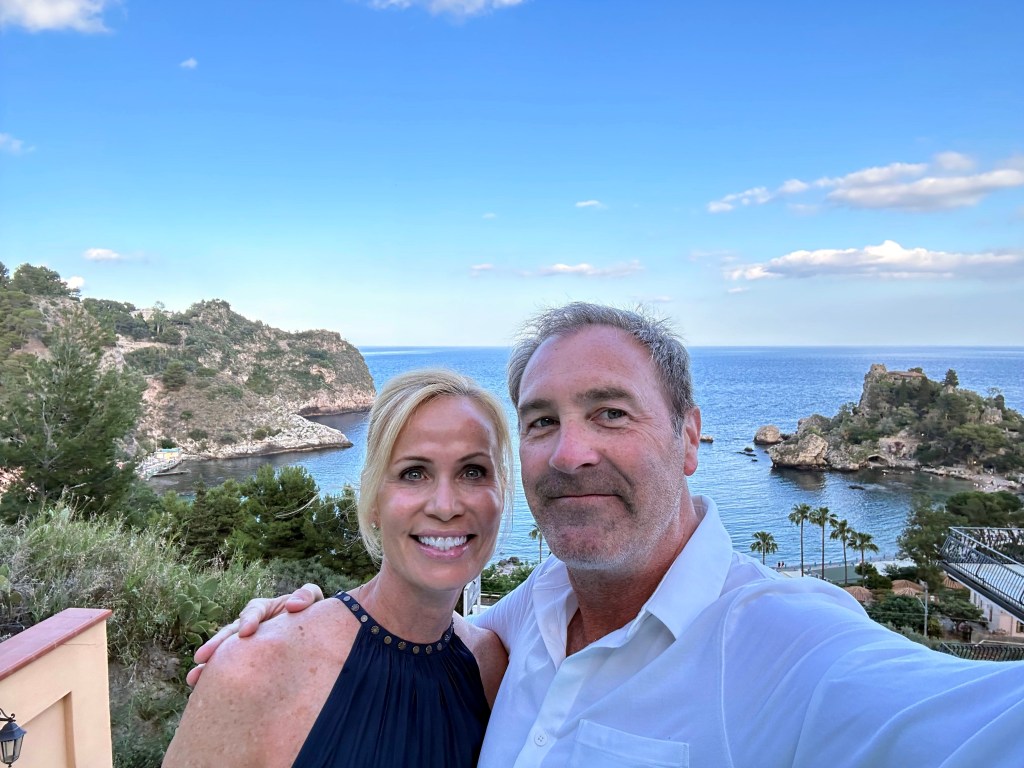
Great view of Isola Bella – Beautiful Island. King Ferdinand I of the Two Sicilies donated the island to the town of Taormina in 1806. In 1890, Florence Trevelyan purchased it, built a small retreat, and transformed the island into a botanical sanctuary filled with tropical and subtropical species that thrived in Sicily’s climate. The Sicilian government acquired the island in 1990, and it later became a protected nature reserve. And unofficial symbol of Taormina.
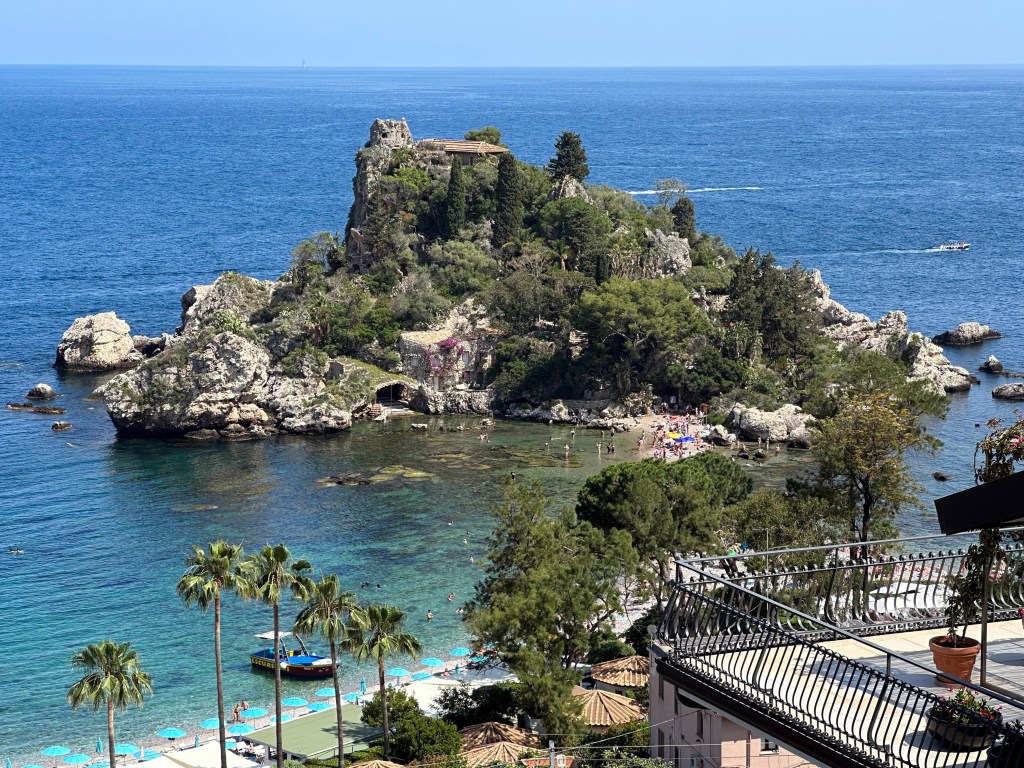
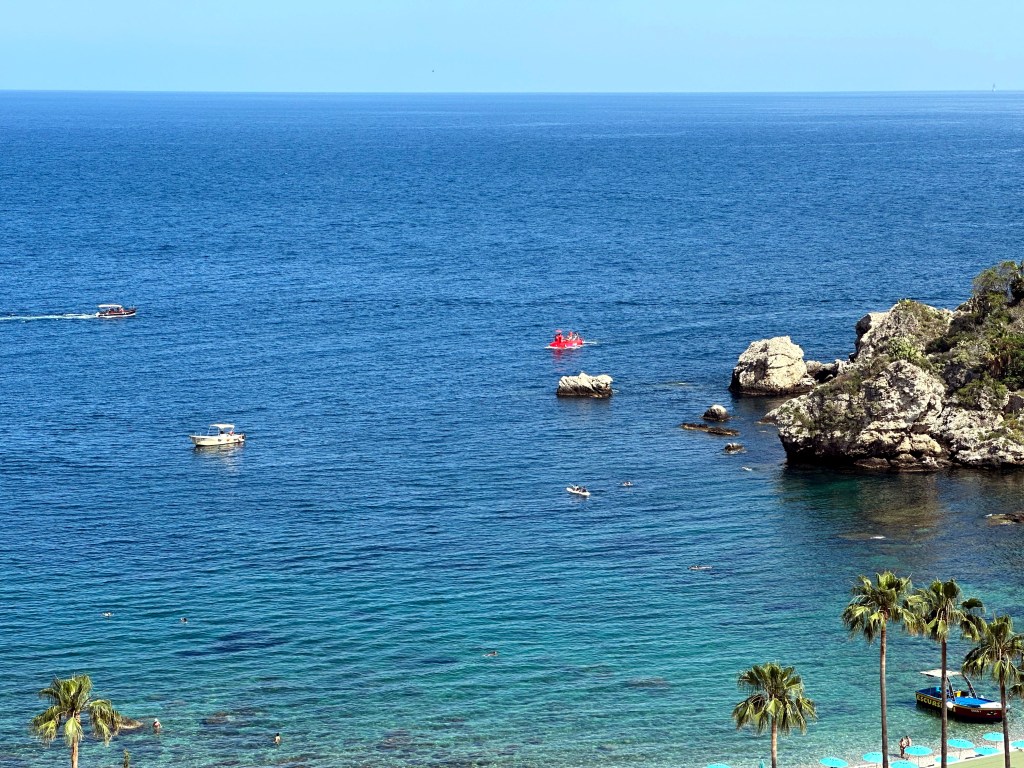
Oh, and we’d occasionally see the goofy tourist sub (ubiquitous in coastal towns, it seems) go out and back from our place.
And also the occasional yacht.
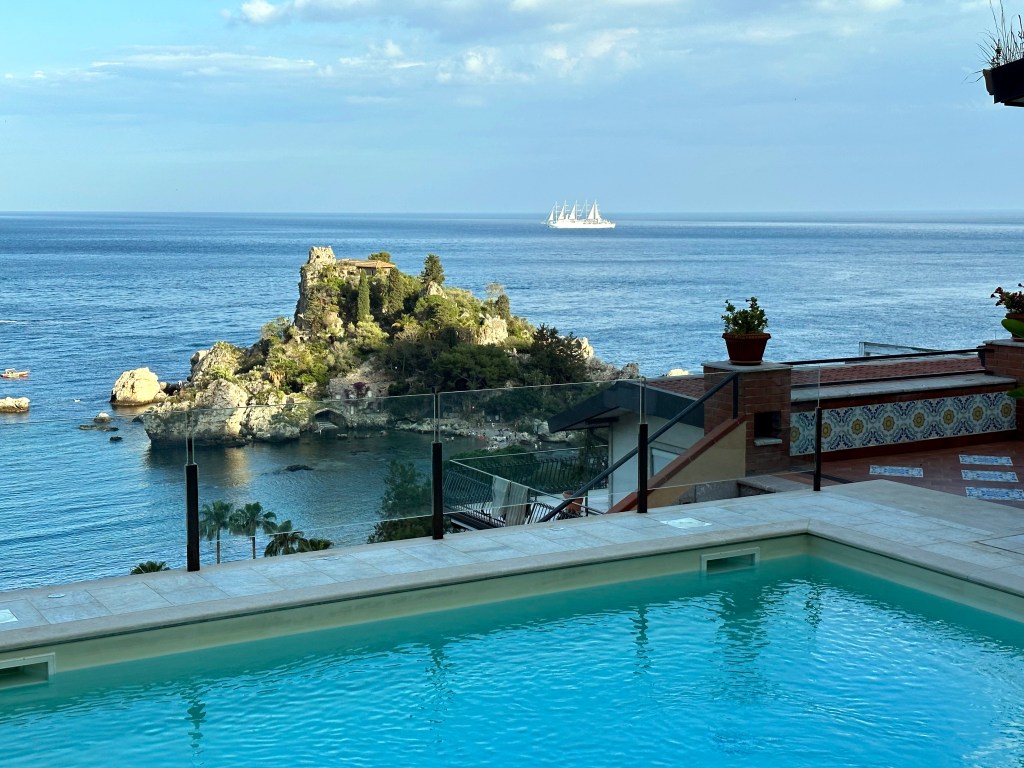
Definitely the right place to stay for our Taormina tour.