Taormina offered three notable experiences during our stay:
- The town itself
- An epic hike to Castelmola high above Taormina
- Taormina’s spectacular Roman theater
Our last post addressed the first item above. This second one will bring completion to the triad.
Hike to Castelmola
To reach Castelmola, we hiked the Sentiero dei Saraceni (Path of the Saracens):
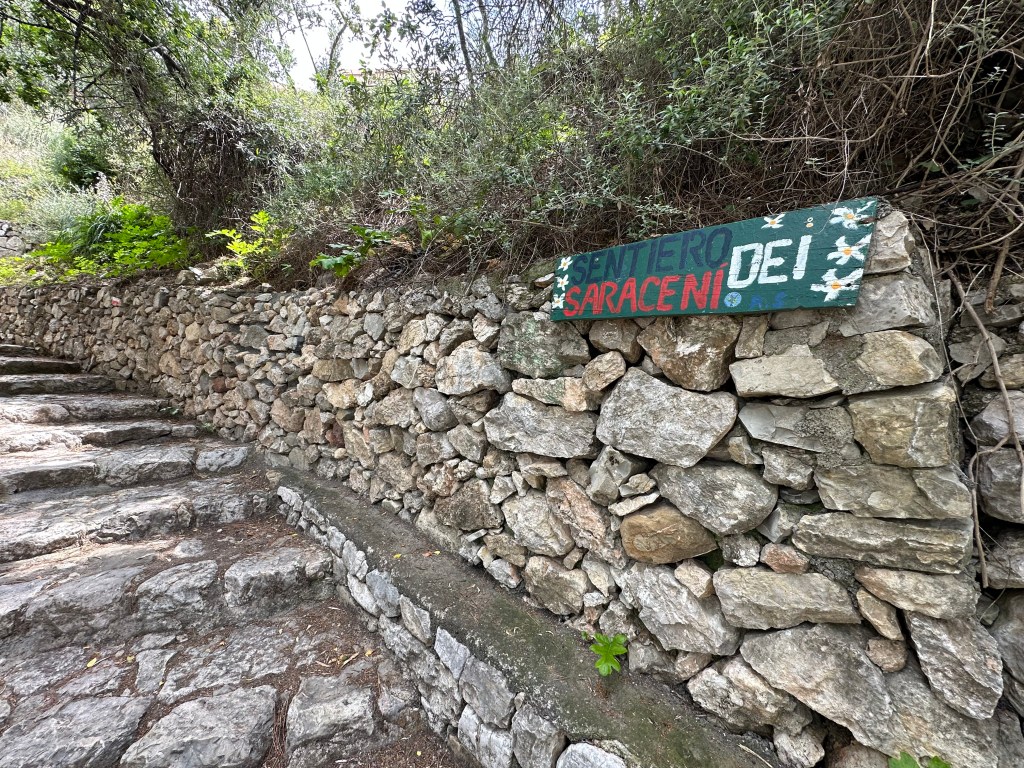
But to reach the trailhead, we first had to leave our place on the water, take the gondola to Taormina’s centro storico, then wind through town, and then finally deviate from the well-trod Corso Umberto to climb through the labyrinthine streets in the old town’s outskirts. THEN the real climbing began.
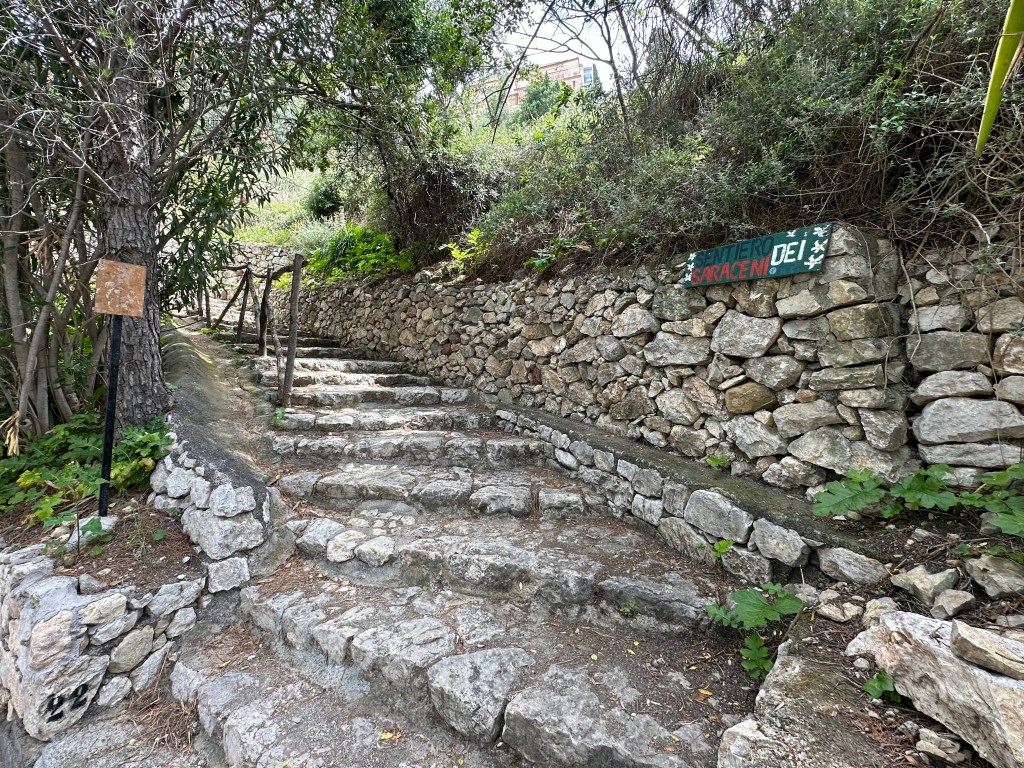
The trail takes its name from the ancient road used by Arab forces during their siege of Taormina in 902 AD.
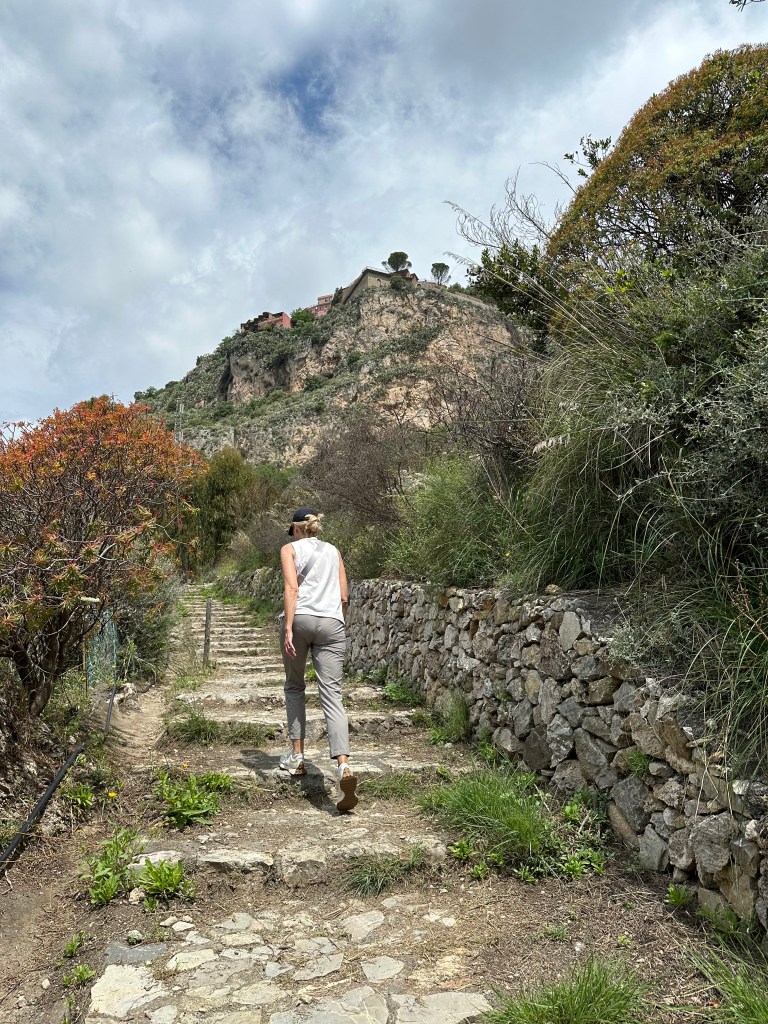
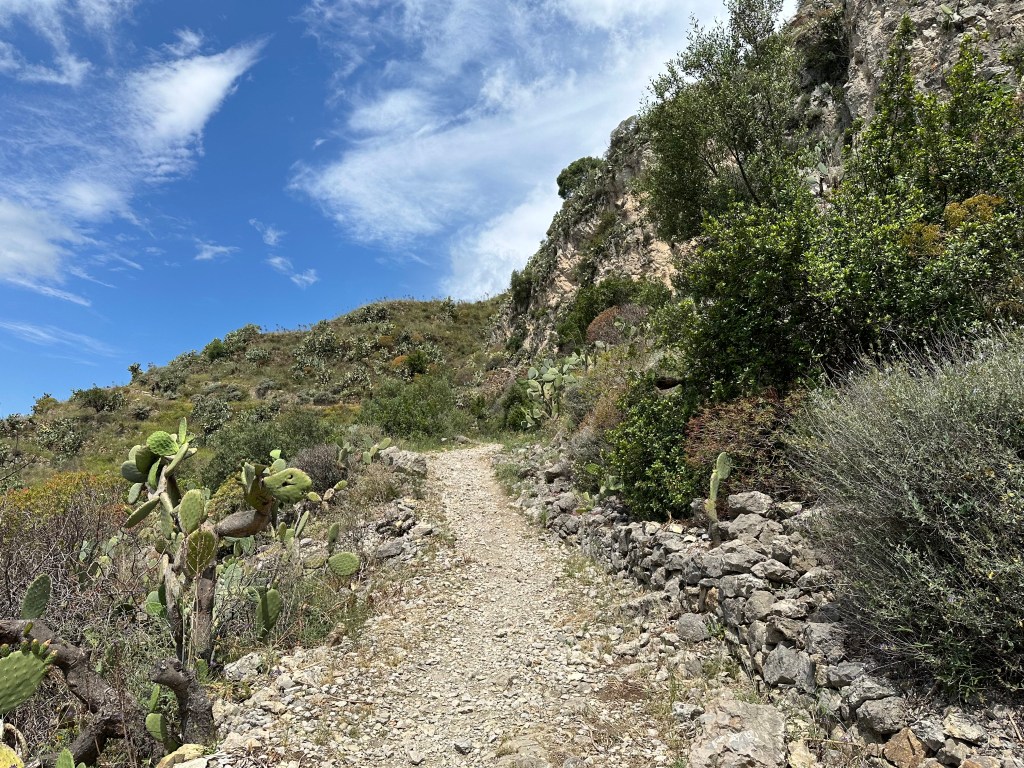
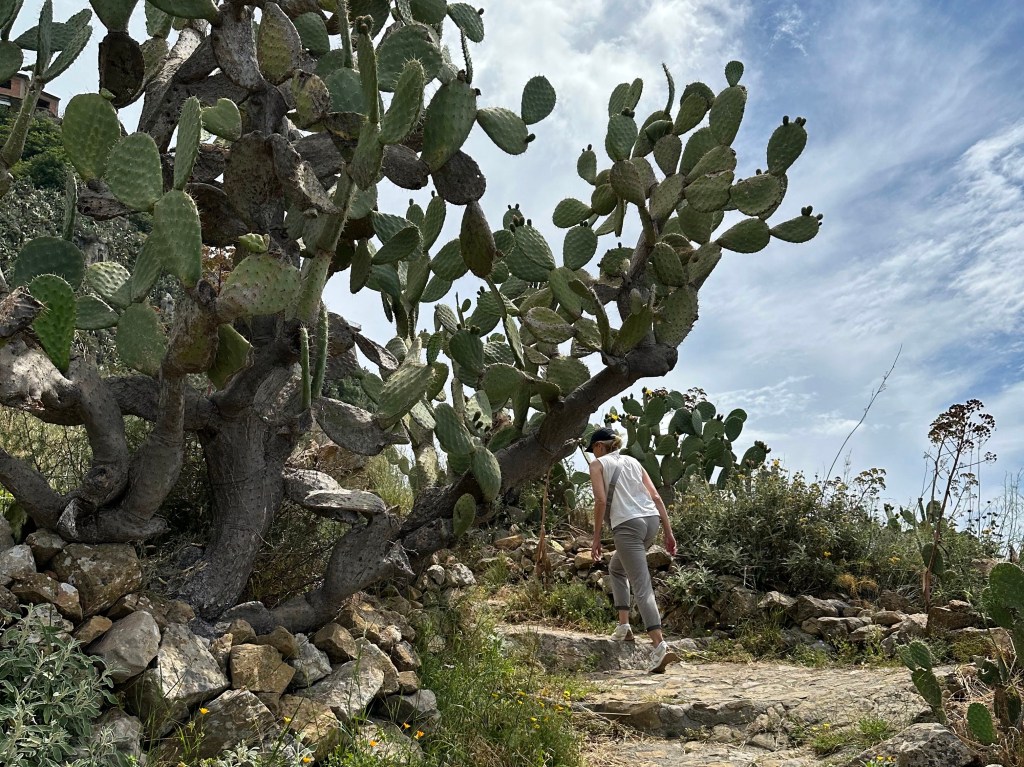
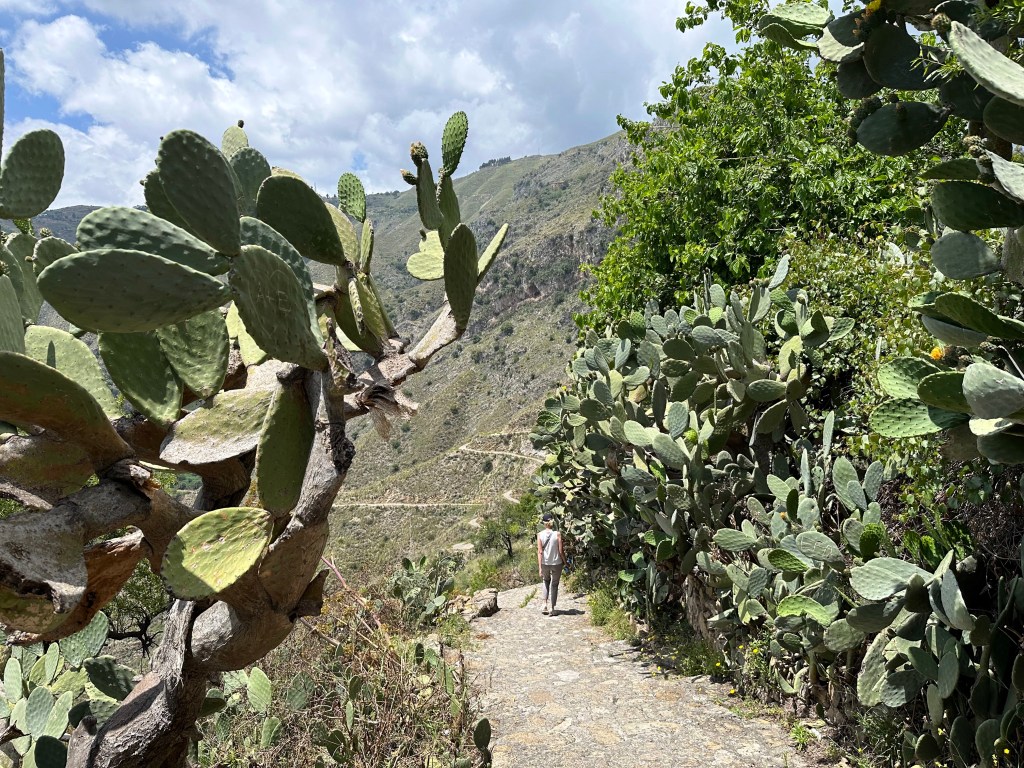
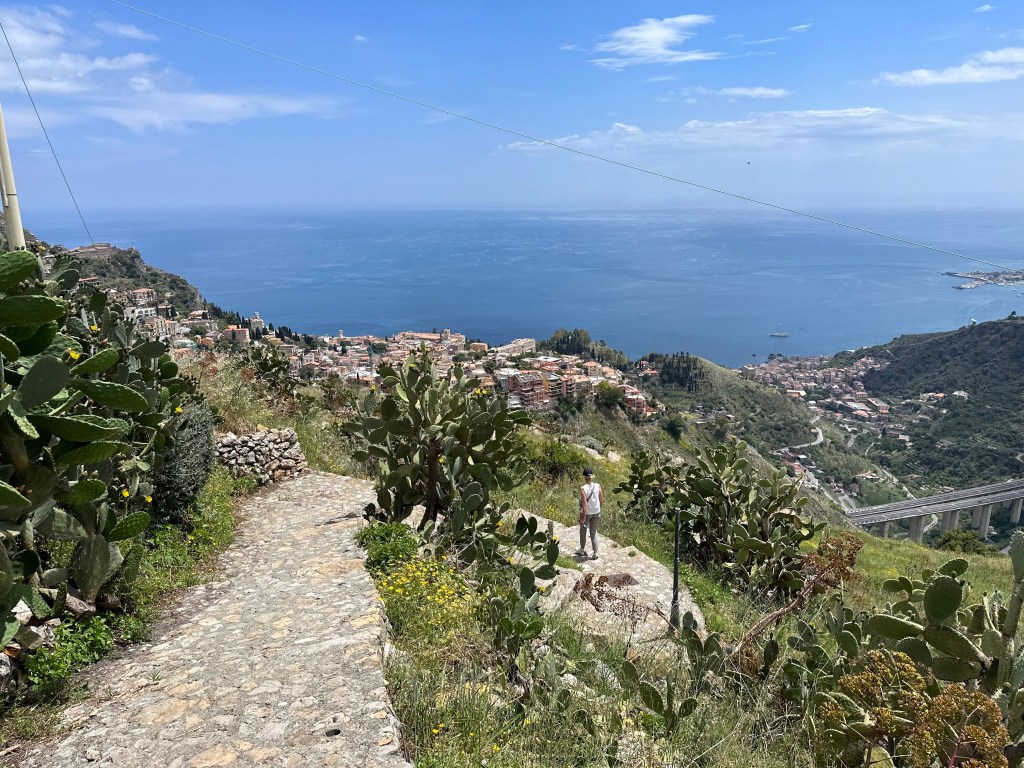
The path itself is an old trazzera — a Sicilian dialect word for a country track — worn into the landscape by the constant passage of mules and horses through a wild terrain of fig trees and prickly pears.
Although not nearly as taxing as the Path of the Gods (Sentiero degli Dei) that we hiked on the Amalfi Coast earlier in the trip, the 7+ mile hike did have 1220 feet of ascent. And we also hiked on a pretty hot day. (In addition to the route on the map below, you can also identify Isola Bella and our AirBnB location on the right side.)
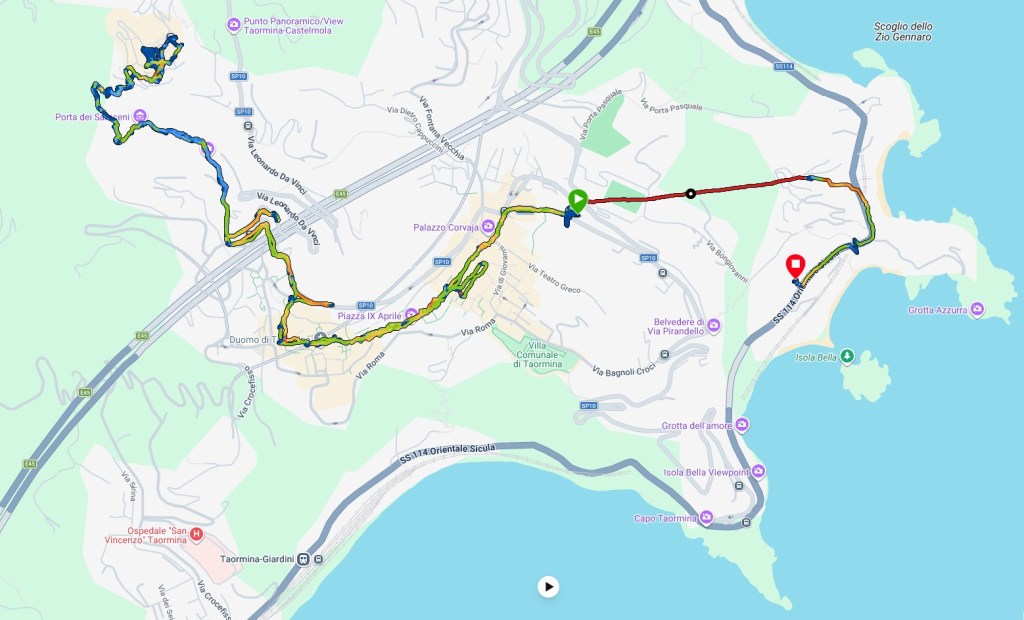
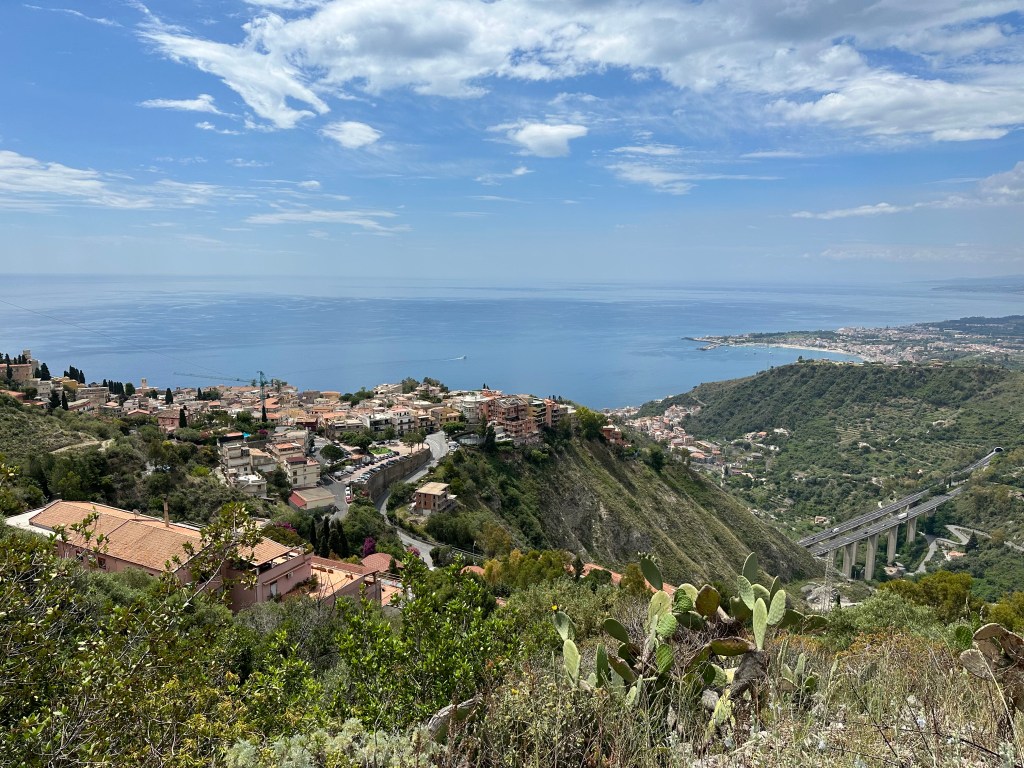
The path is an ancient way to access Castelmola from the southern slope of Monte Tauro, the mountain that looms above Taormina. Starting from Piazza Duomo in Taormina, the initial walk winds through the town’s streets, then the trail transitions to a combination of dirt and rocks — mostly steep stone steps.
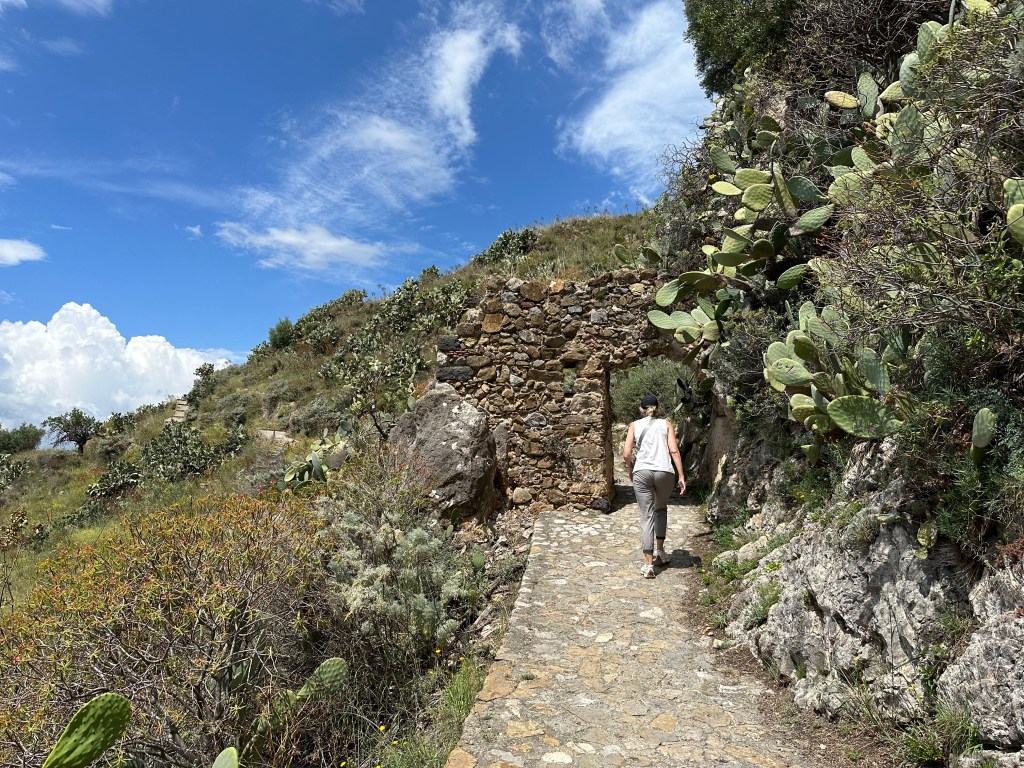
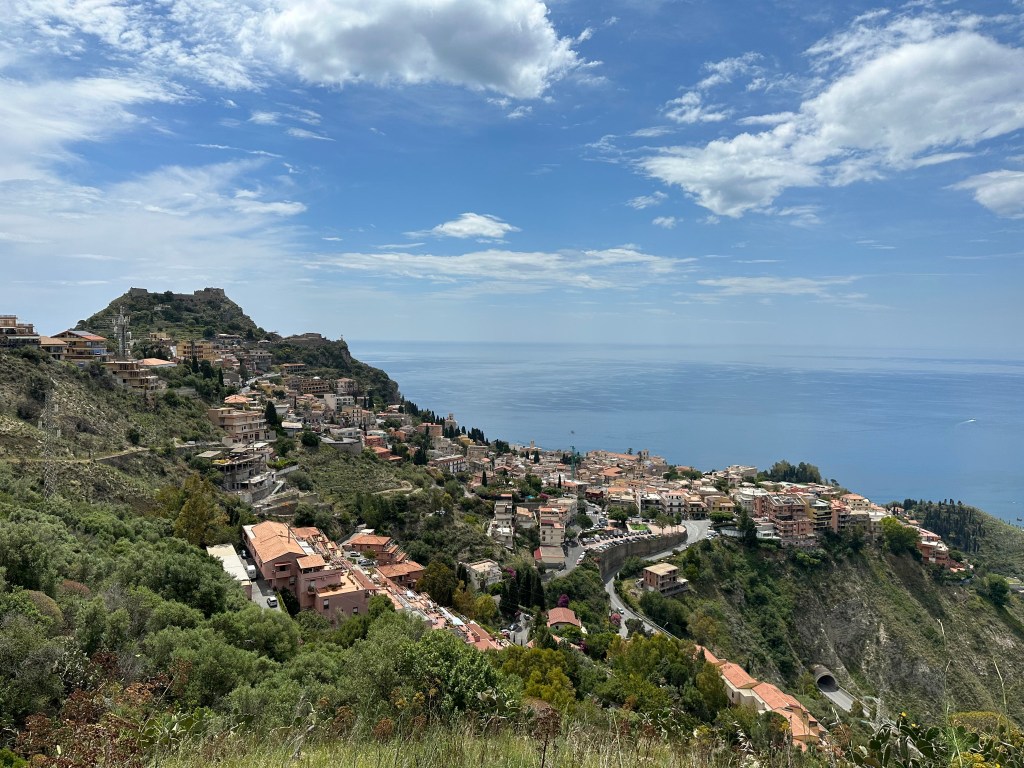
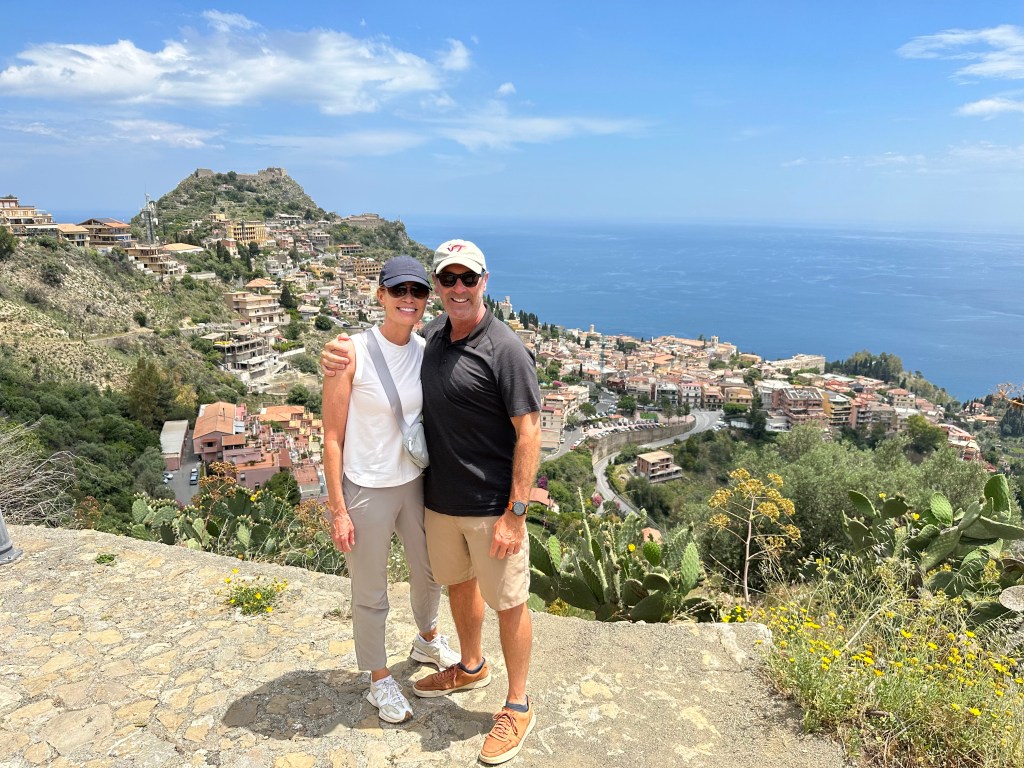
You definitely get rewarded with some great views along the way.
And a forest of cactus.
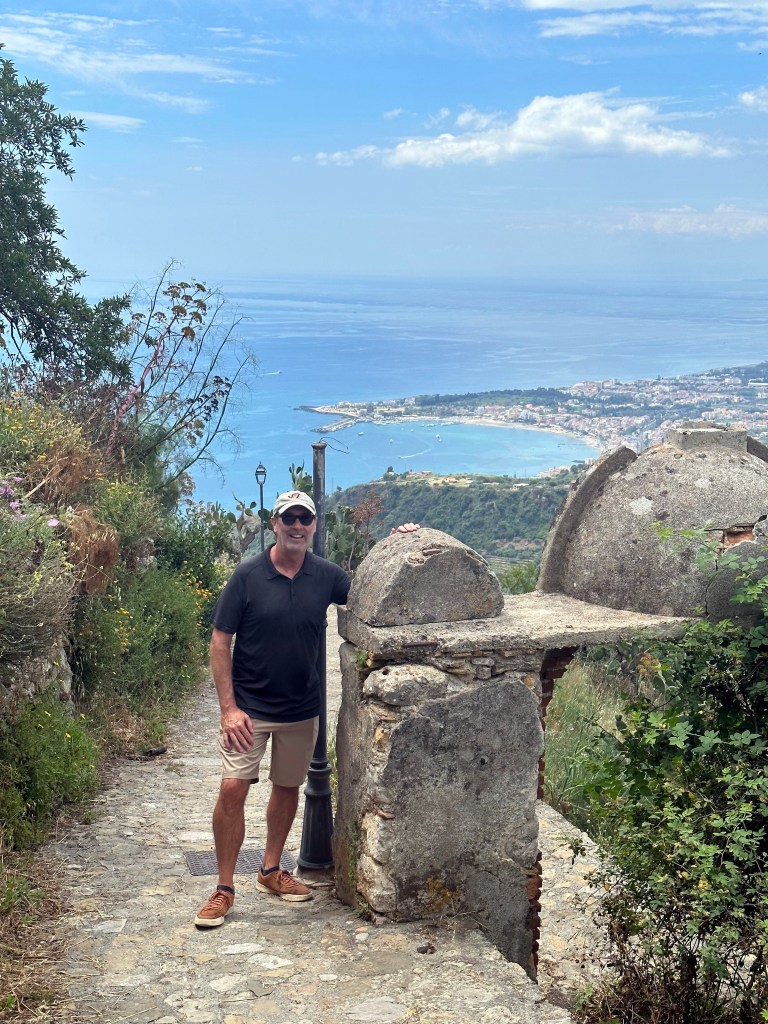
A sign that we’re reaching the apex of our hike at the hill town of Castelmola:
The site was first fortified by the Byzantines around 800 AD, serving as an outpost for and above Taormina. In 902, the fortification fell to Muslim forces after fierce resistance. The Saracens broke into Castelmola’s forts and destroyed much of the village, sparing only the castle — and the access gate to the historic centre is still called the Porta dei Saraceni because of this event.
In 1078, Norman Count Roger I reconquered the area and built a new castle incorporating the original walls. Most of what remains today dates to a 16th-century version of the structure. A 10th-century plaque with Greek-Byzantine engravings on the cathedral façade reads: “This castle was built under Constantine, patrician and strategist of Sicily” — almost certainly referring to Costantino Caramalo, who defended the territory from Arab attacks in the 9th century.
Throughout later centuries, Castelmola sided with the Swabians and Aragonese against the Angevins, eventually becoming part of the Kingdom of the Two Sicilies in 1738 and then the Kingdom of Italy in 1860.
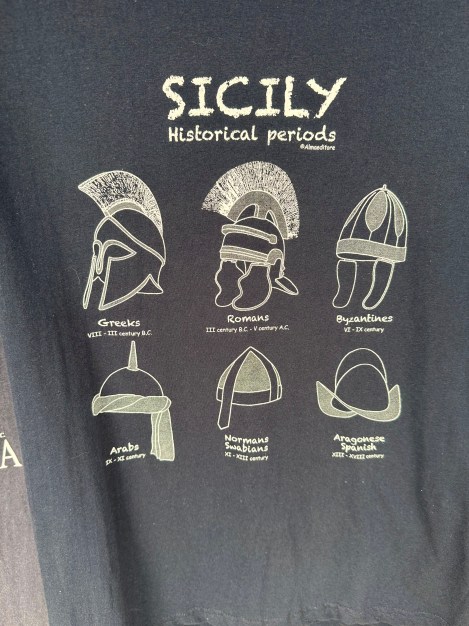
In addition to some great historical context for Castelmola’s many lives, this recitation also recalls the convenient history-of-Sicily-on-a-t-shirt introduction in our first Sicily post. (The t-shirt, as it happens, actually was spotted during our stay here in Taormina.)
Regardless of the events that led up to Castelmola’s current iteration, it proved to be a pretty charming little hill town.
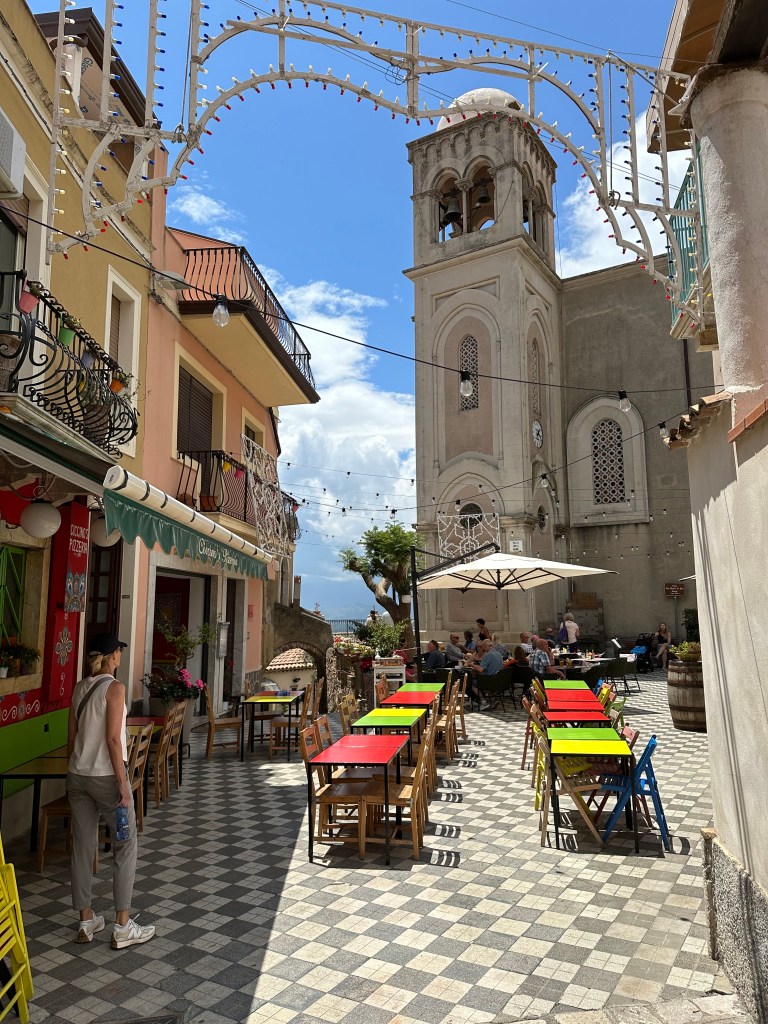
With a little cafe just for WolfeStreetTravel’s resident figeater:
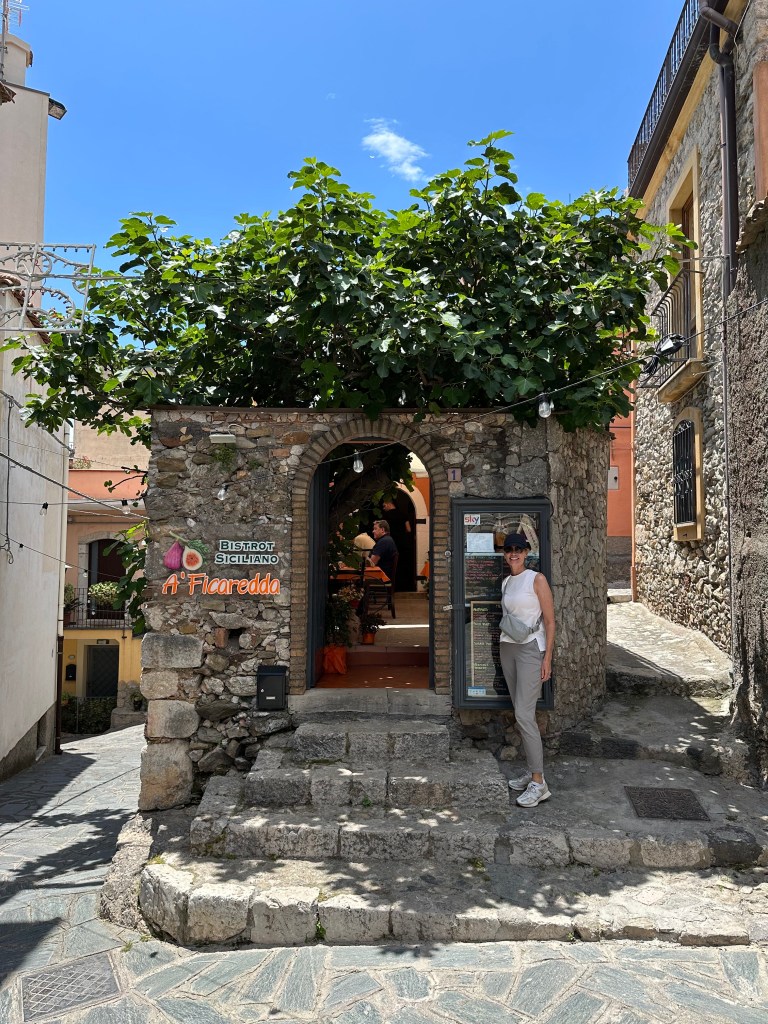
And then there’s Castelmola’s chief attraction:
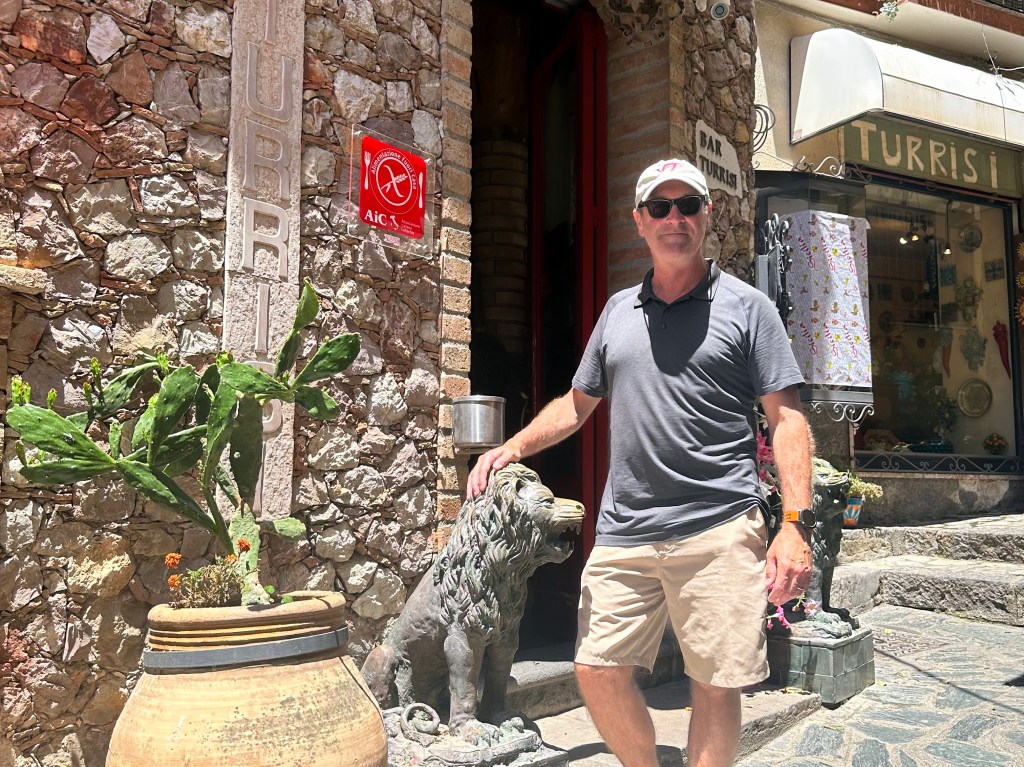
Bar Turrisi, or. . .
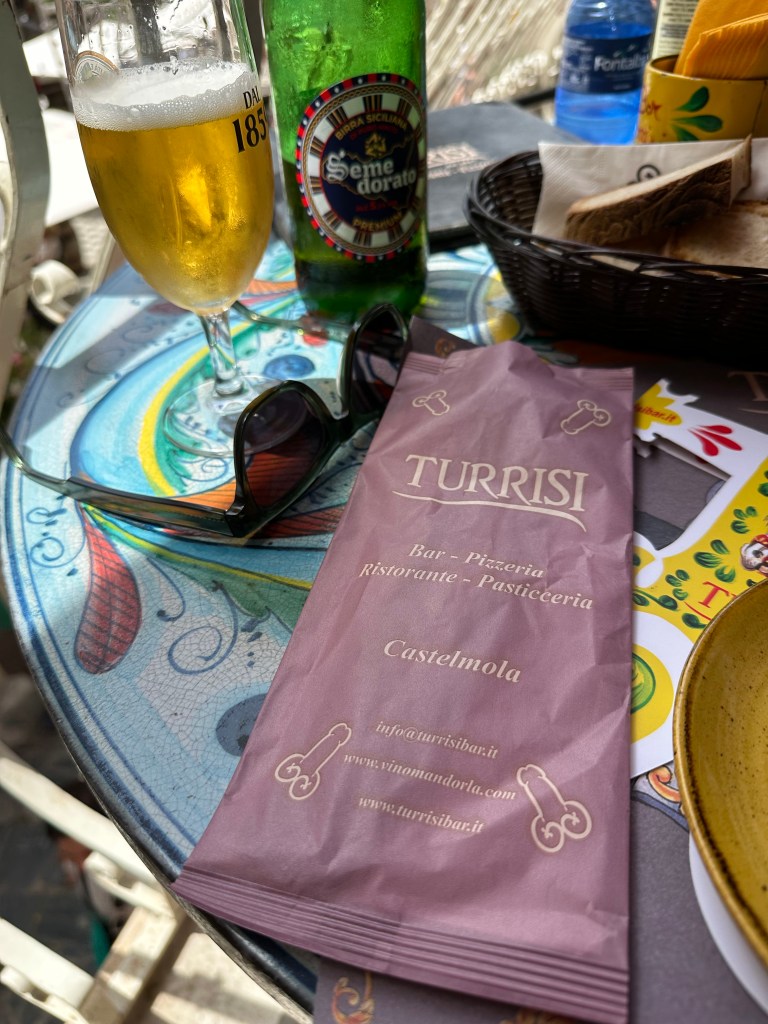
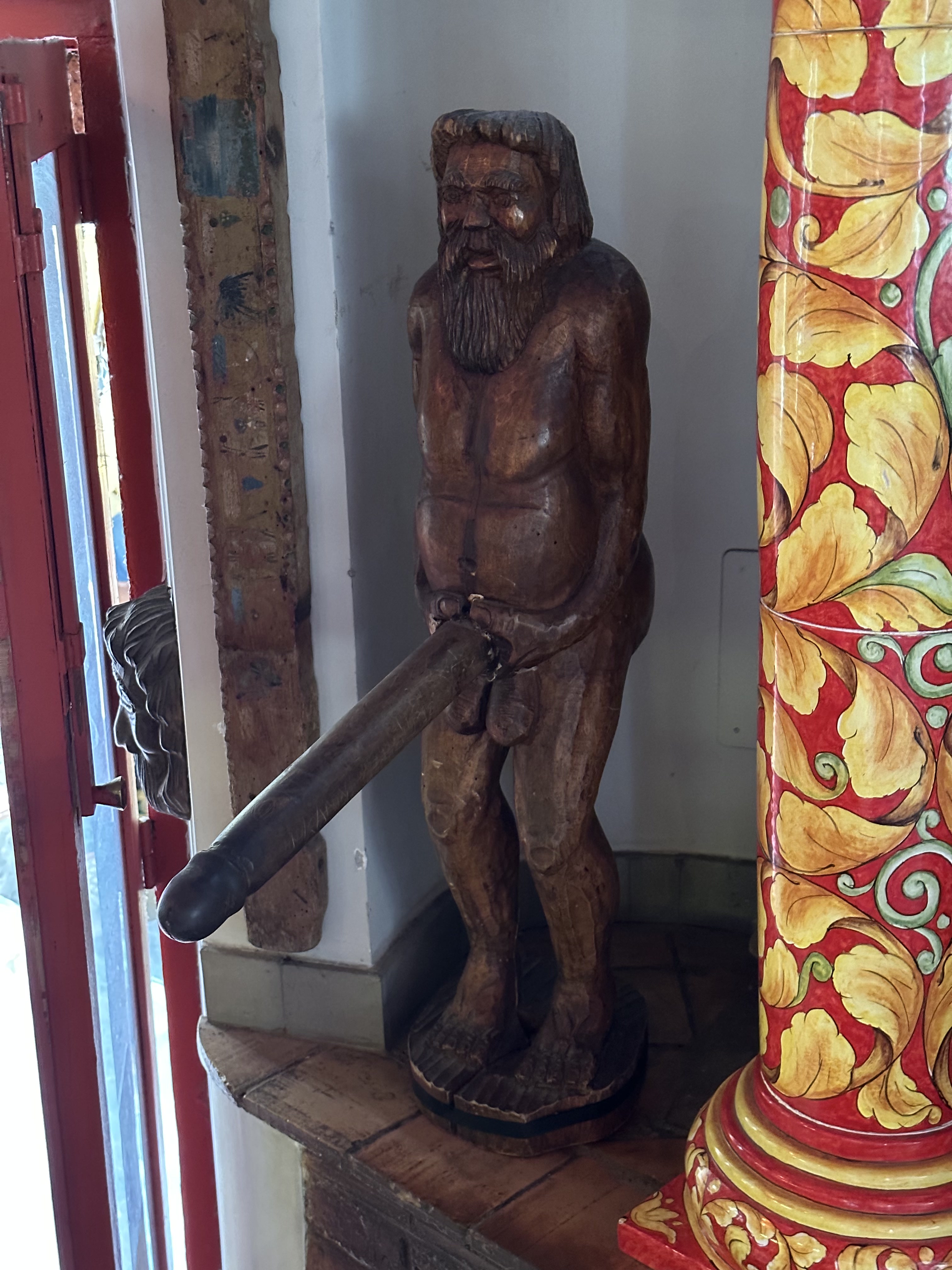
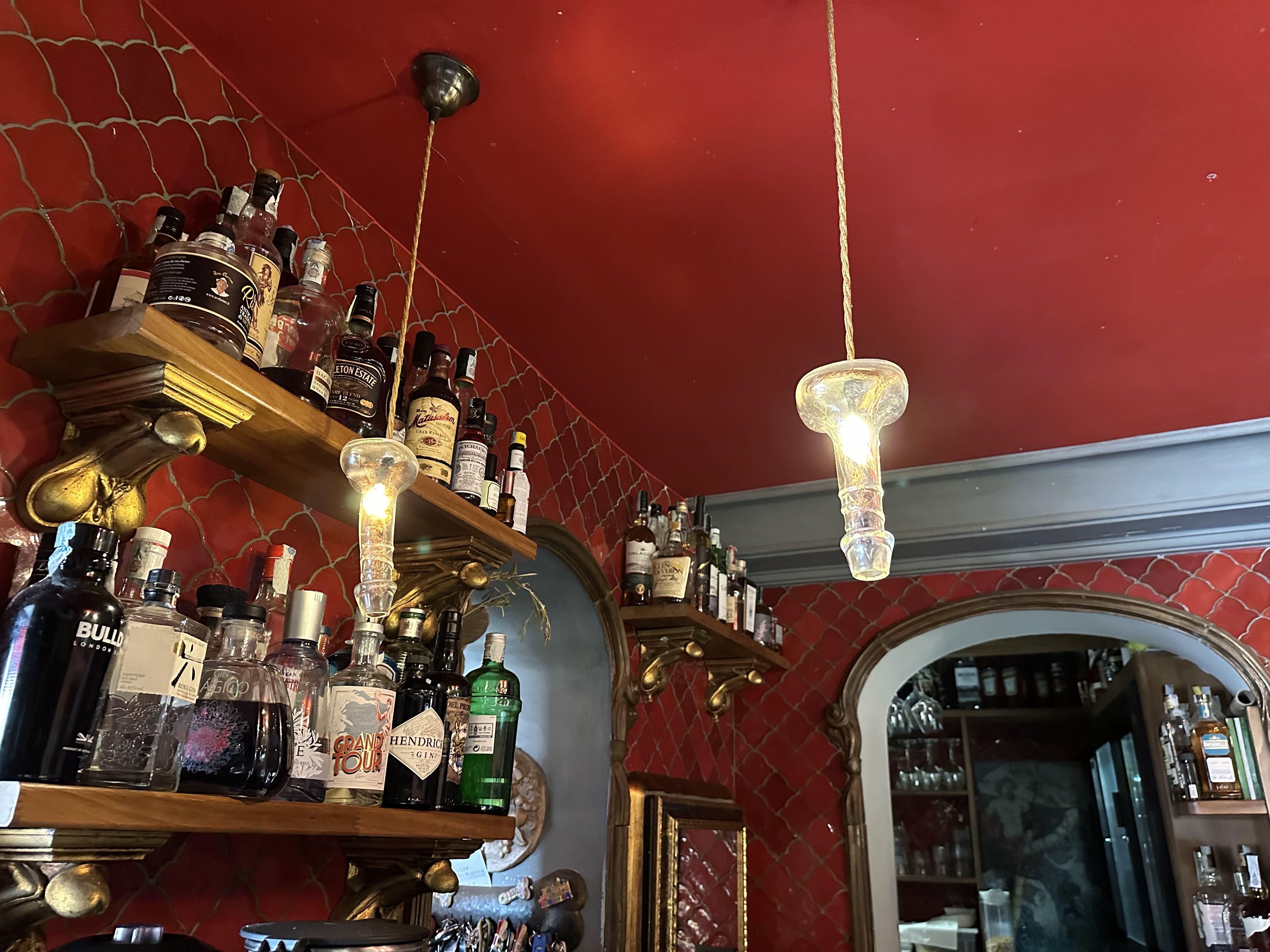
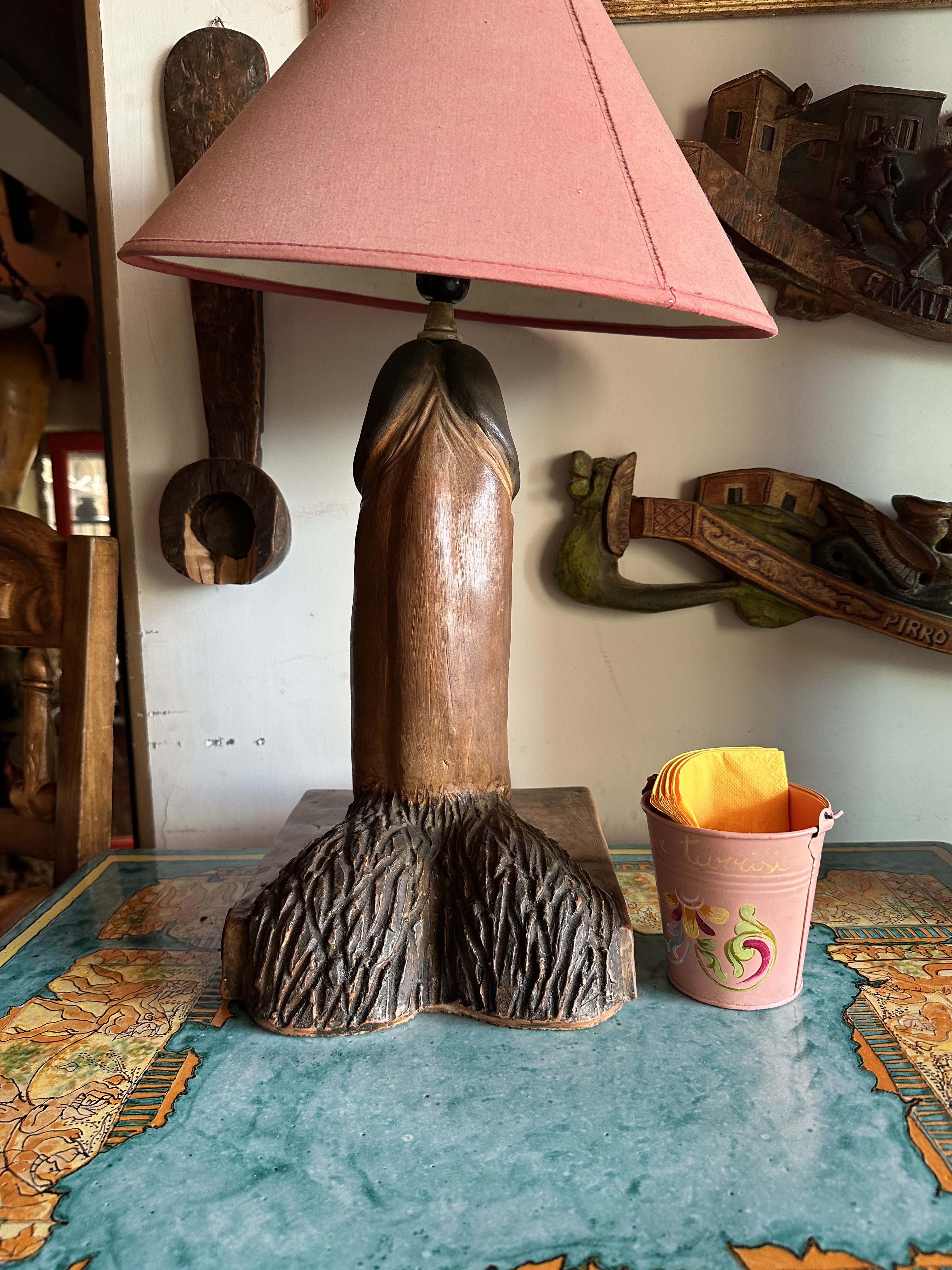
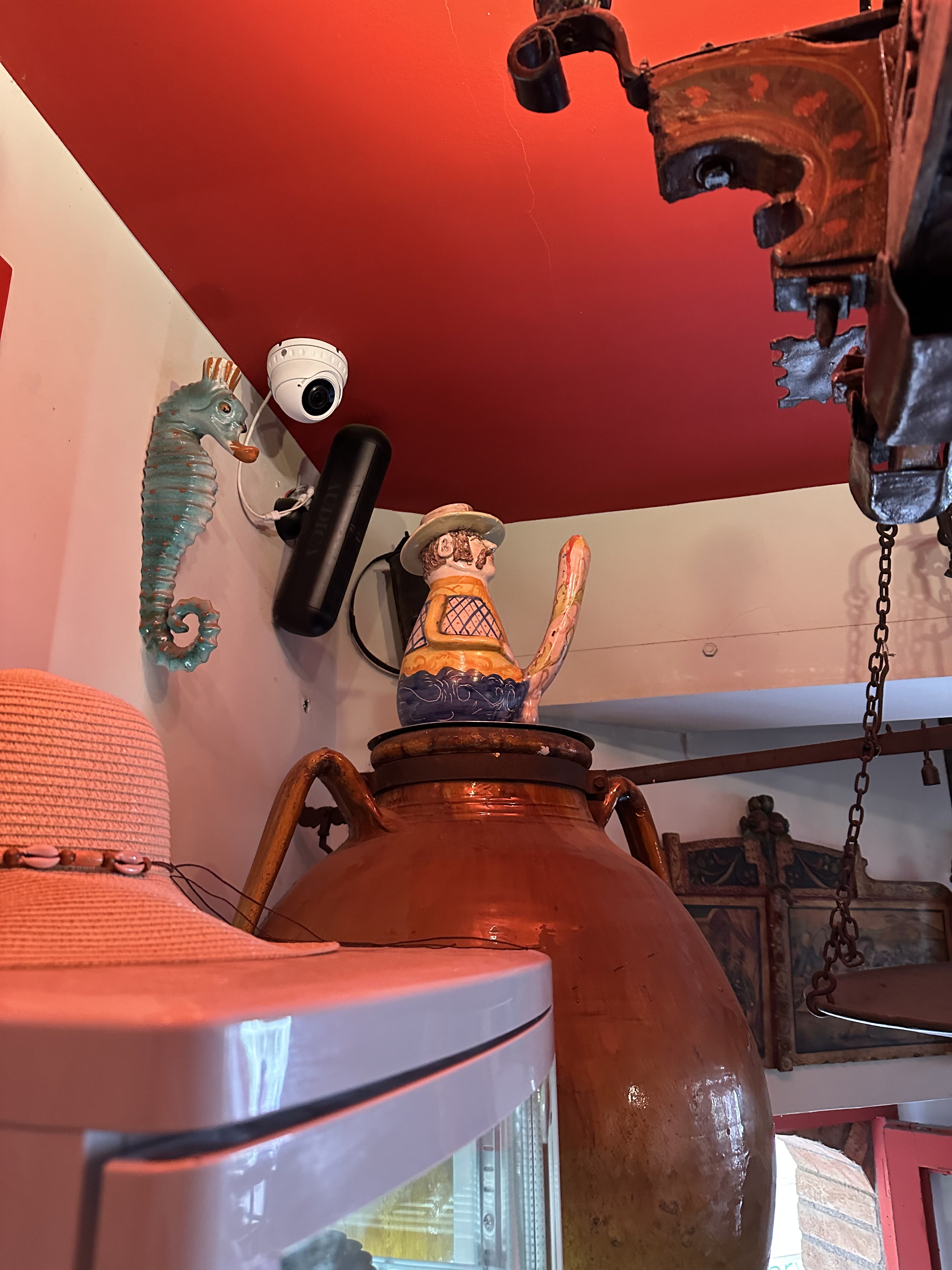
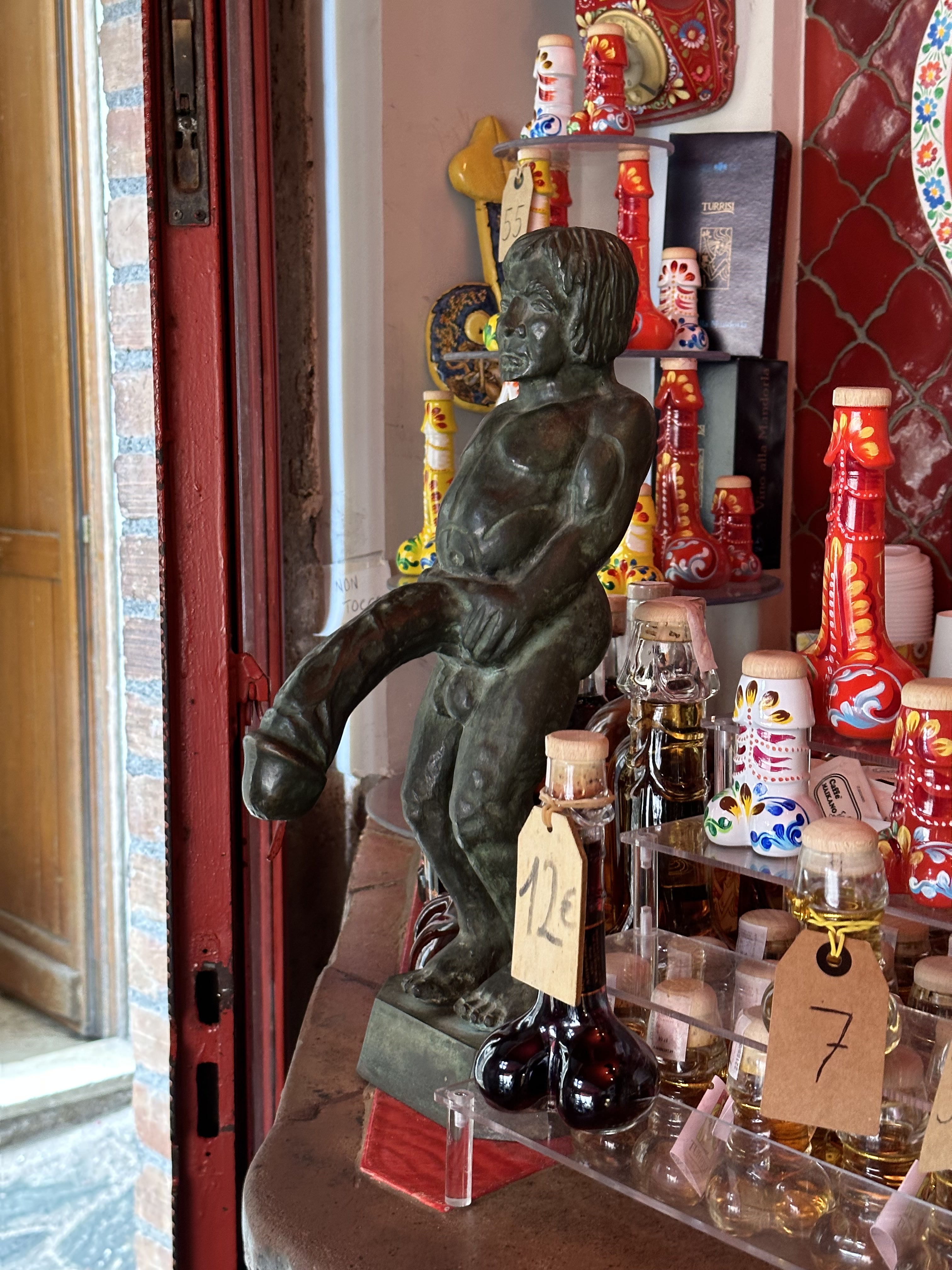
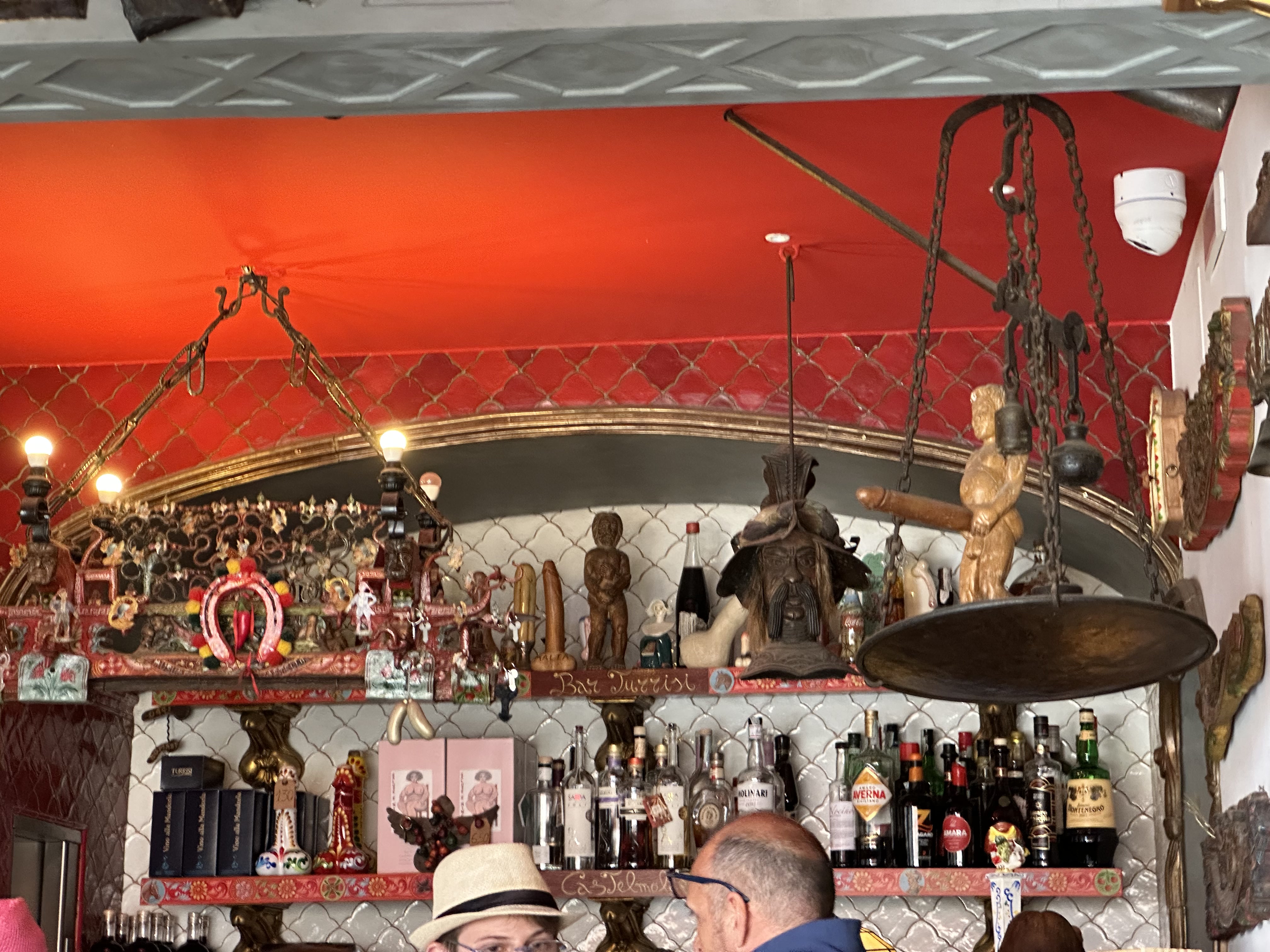
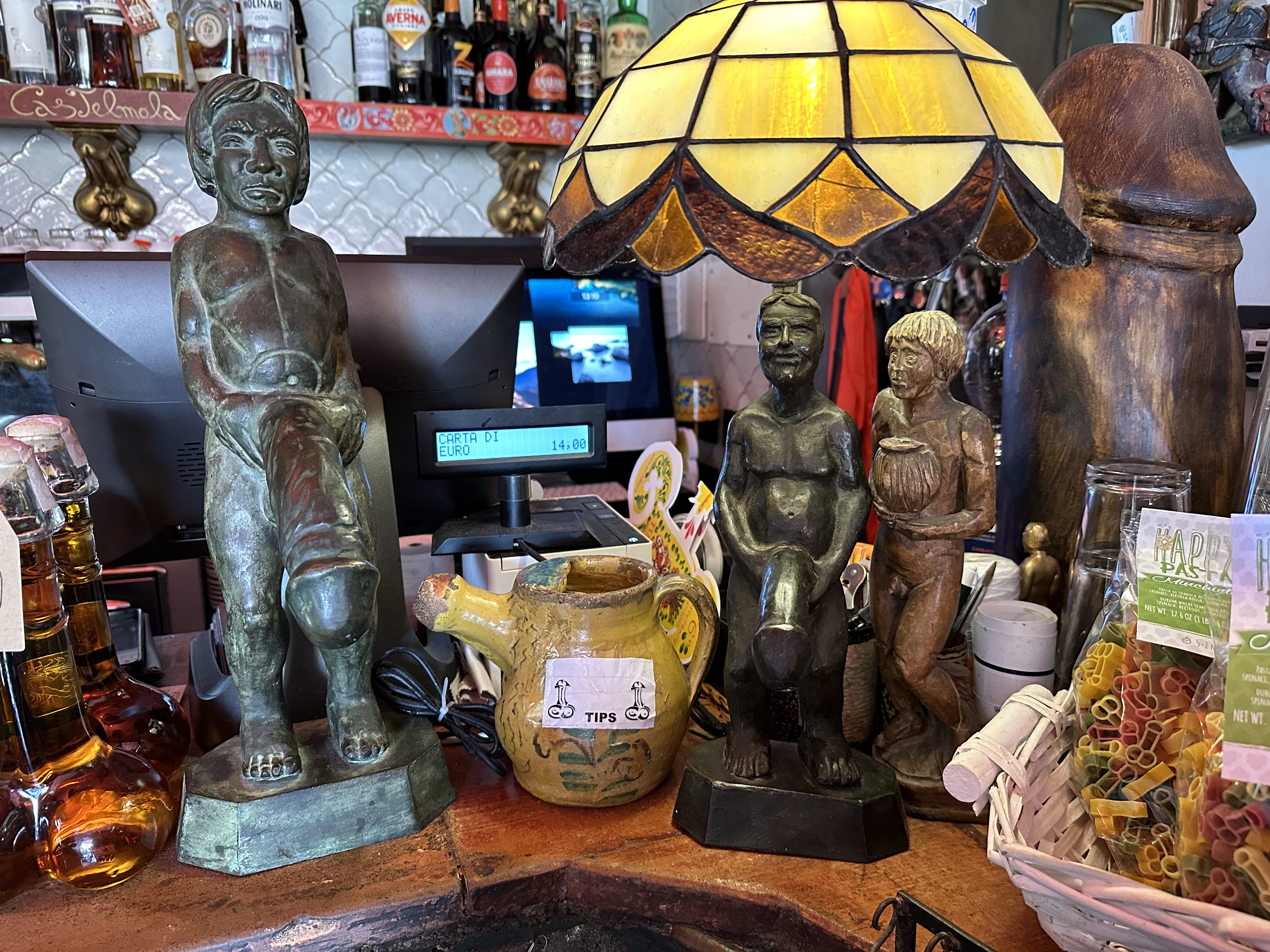
the dick bar.
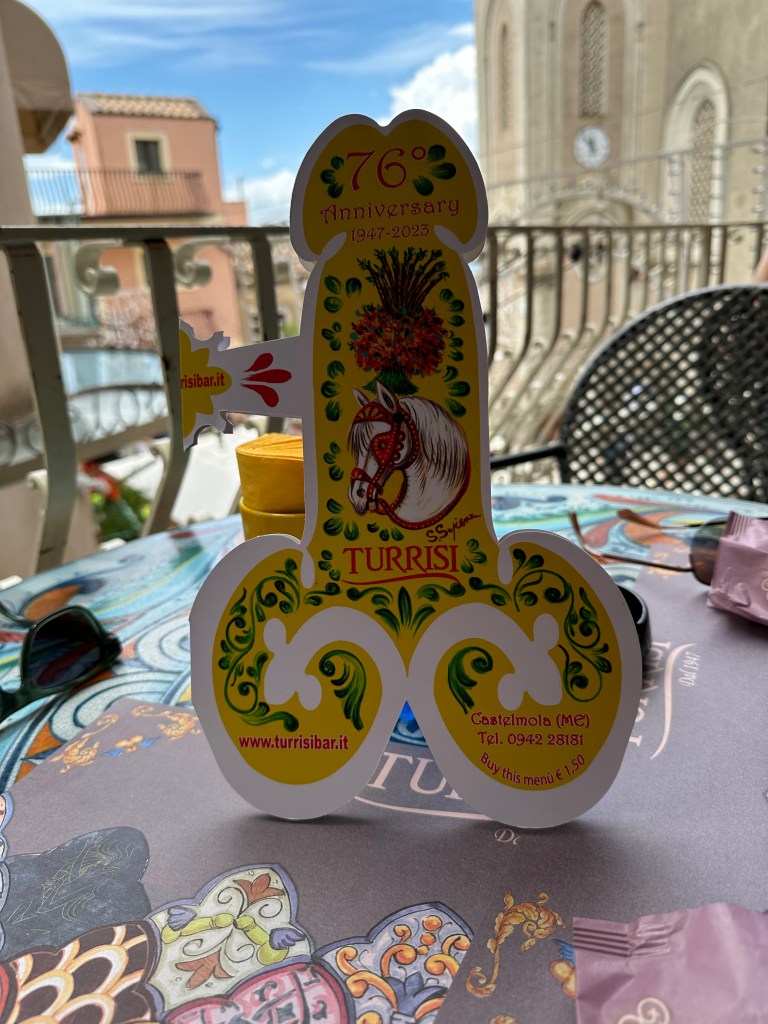
The bar was founded in 1947 by Salvatore Turrisi, who later had three sons in 5 years and decided to celebrate this by absolutely filling this place with dicks.
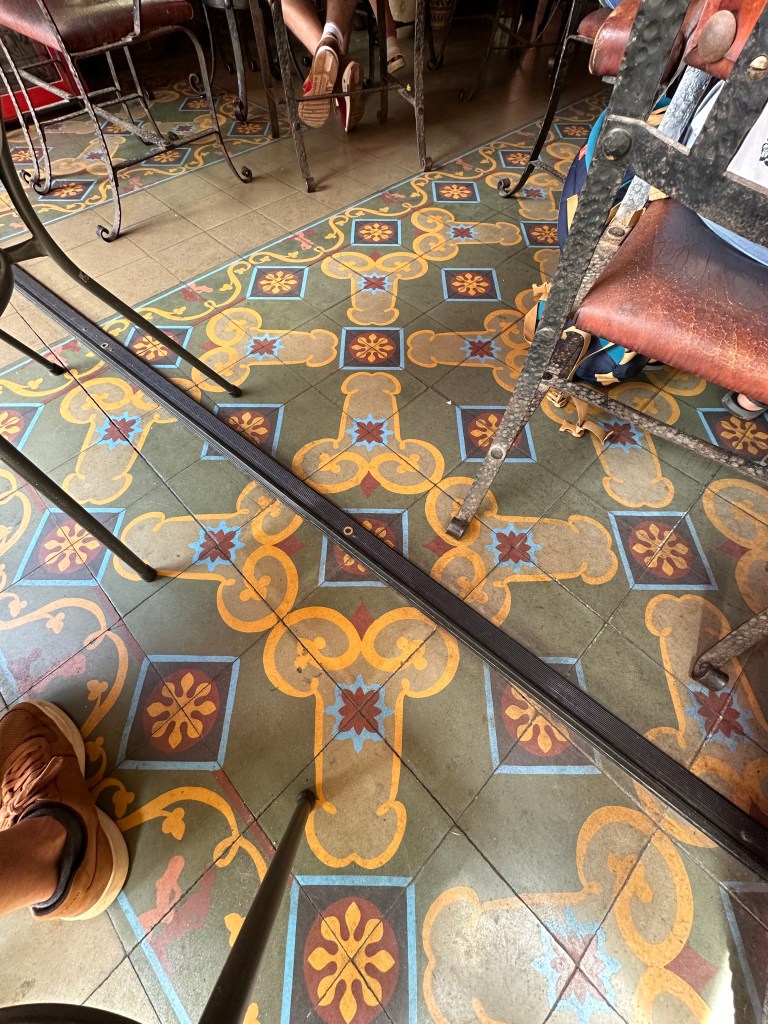
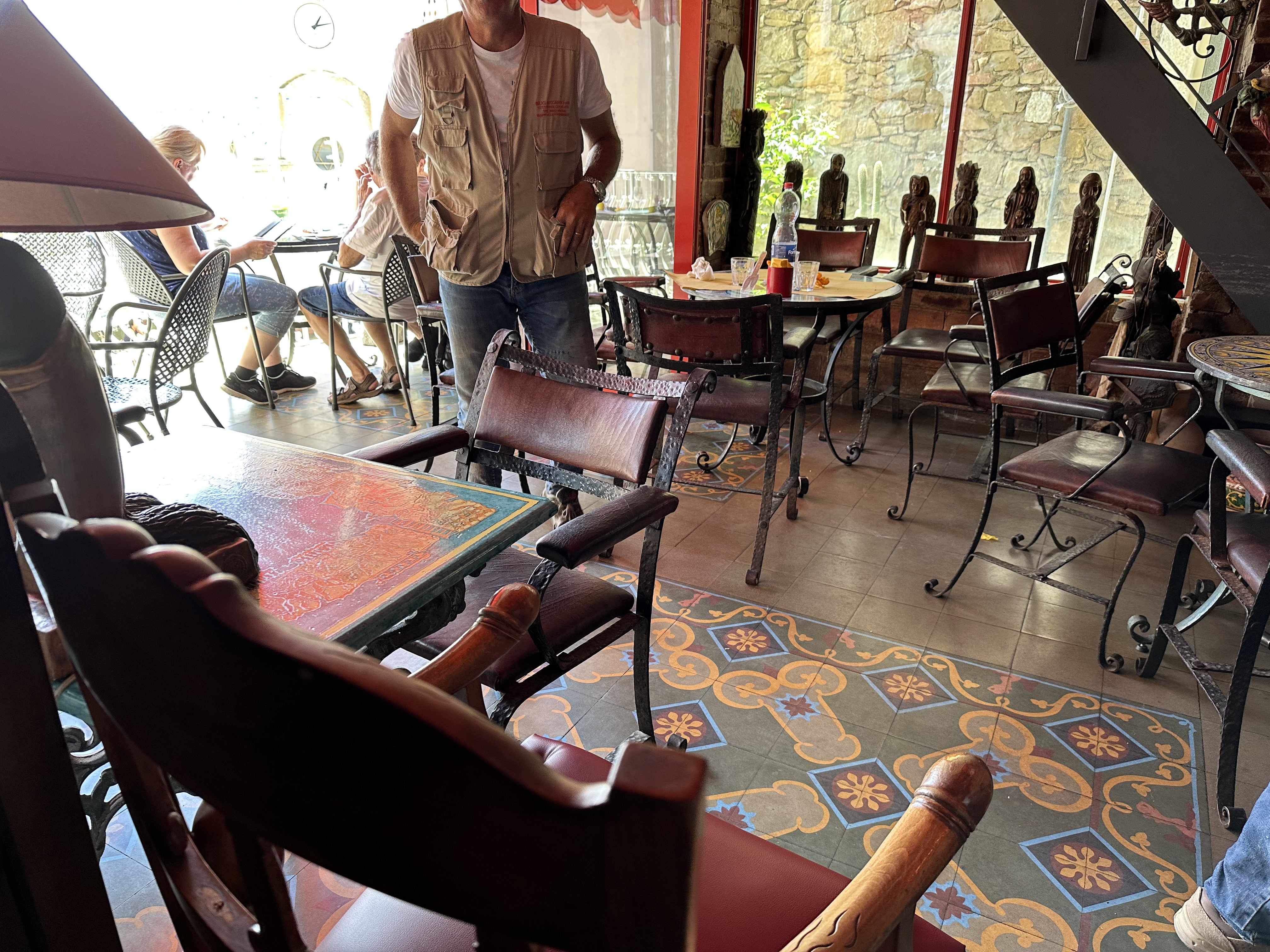
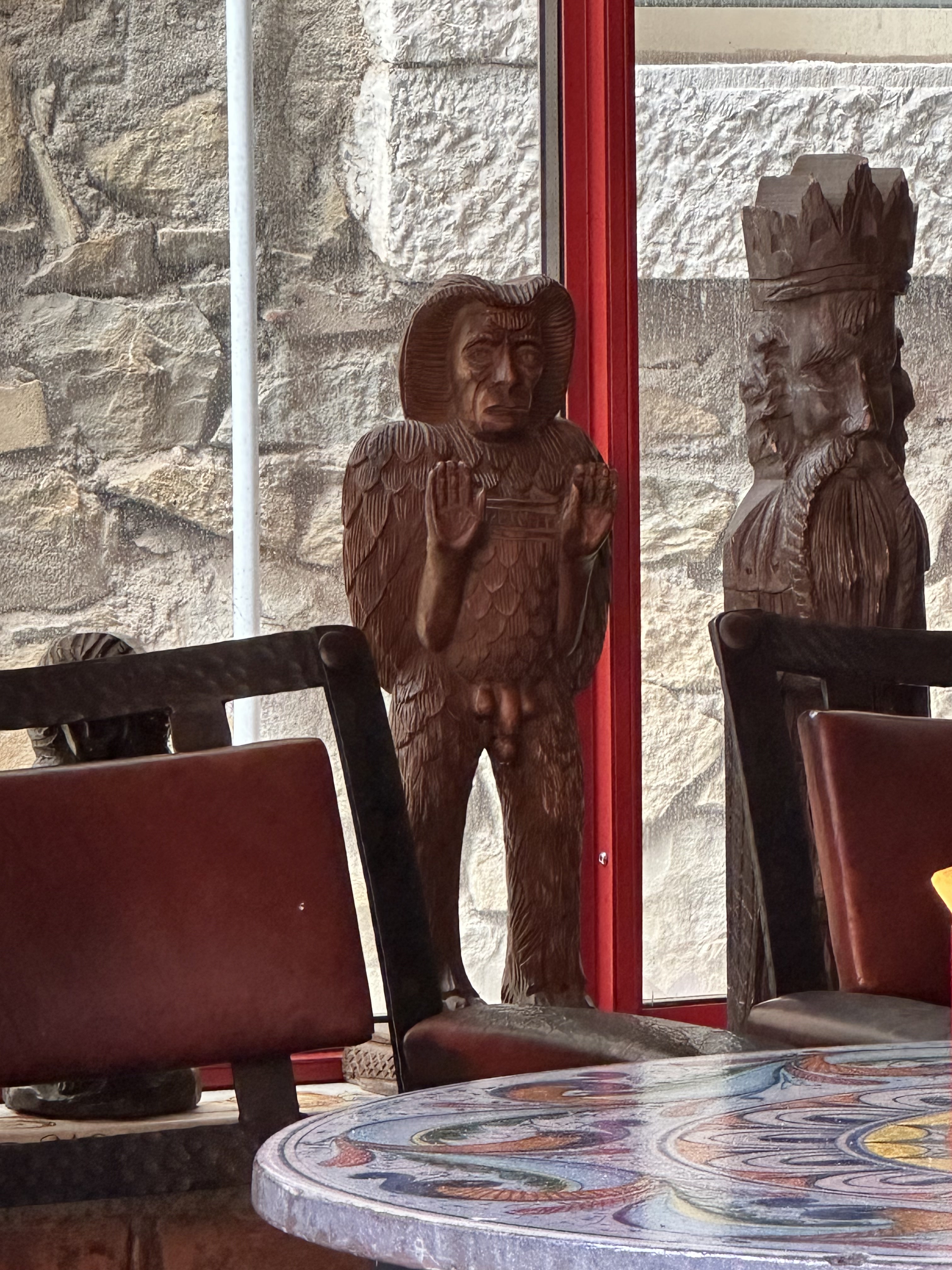
It’s a riot of phallic symbols (all of them, btw, created exclusively by Sicilian artisans, for what it’s worth):
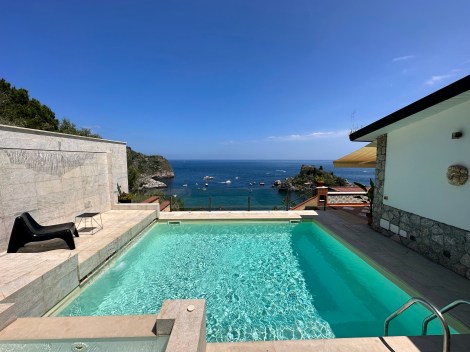
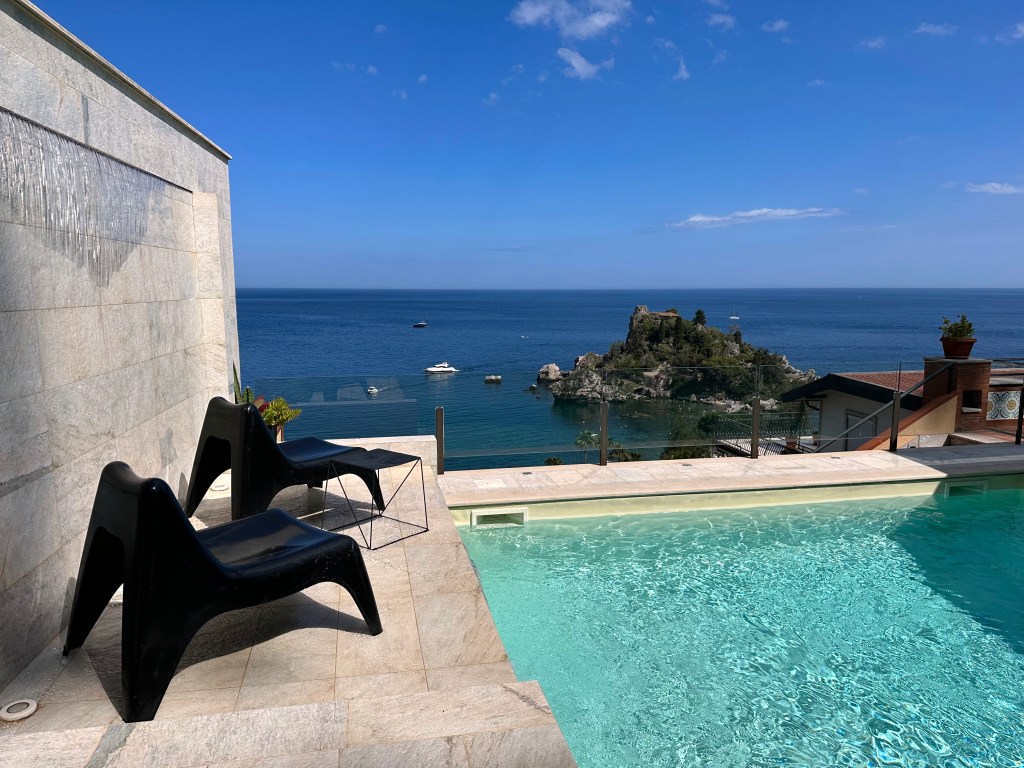
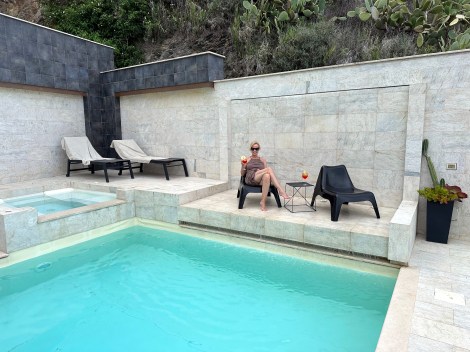
After some beers and pizza, we headed back down to Taormina, where our oasis awaited.
Definitely a welcome respite after the hike.
Roman Theater
Taormina’s Teatro Antico offered the last of the three highlights during our stay.
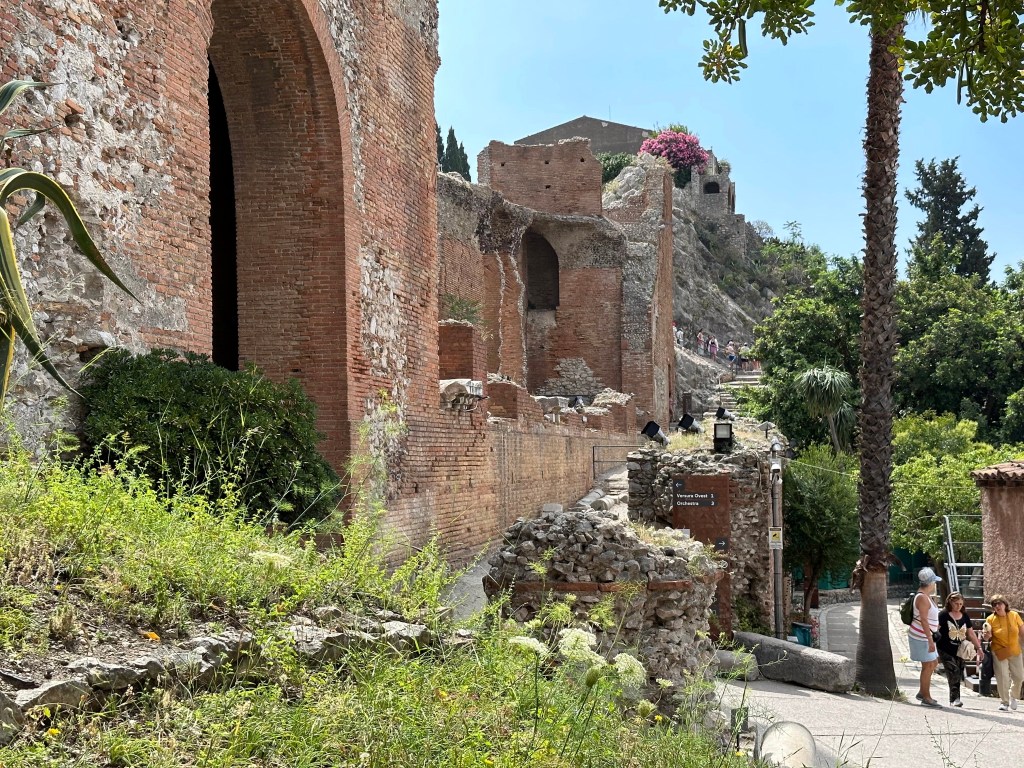
Although its known for the role it played during the Roman period, the theatre originally was constructed during the Hellenistic period, circa 265–215 BC. It is one of the oldest theatres in Magna Graecia to feature a curved cavea rather than the older trapezoidal design. The structure was carved directly into the rocky hillside of Monte Tauro, using the natural slope in the classical Greek manner to create optimal sightlines and acoustics.
Originally designed for dramatic performances, it hosted plays by ancient Greek playwrights such as Sophocles, Aeschylus, and Euripides. These performances were often part of religious festivals and reflected the myths and social issues of the time. Acoustics were engineered so that even whispers on stage could be heard in the highest seats.
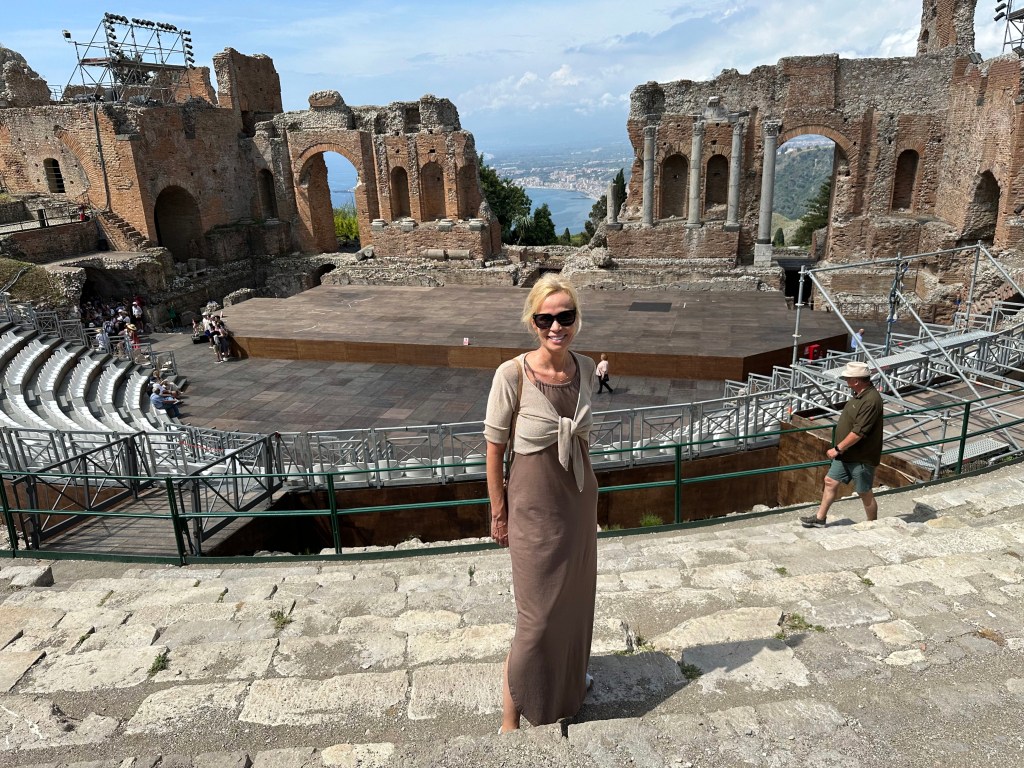
During the Roman rule over Sicily, the Romans did not merely maintain the theatre — they systematically rebuilt and repurposed it over roughly two centuries, in three distinct phases.
Phase I & II — Expansion under Trajan and Hadrian (98–138 AD)
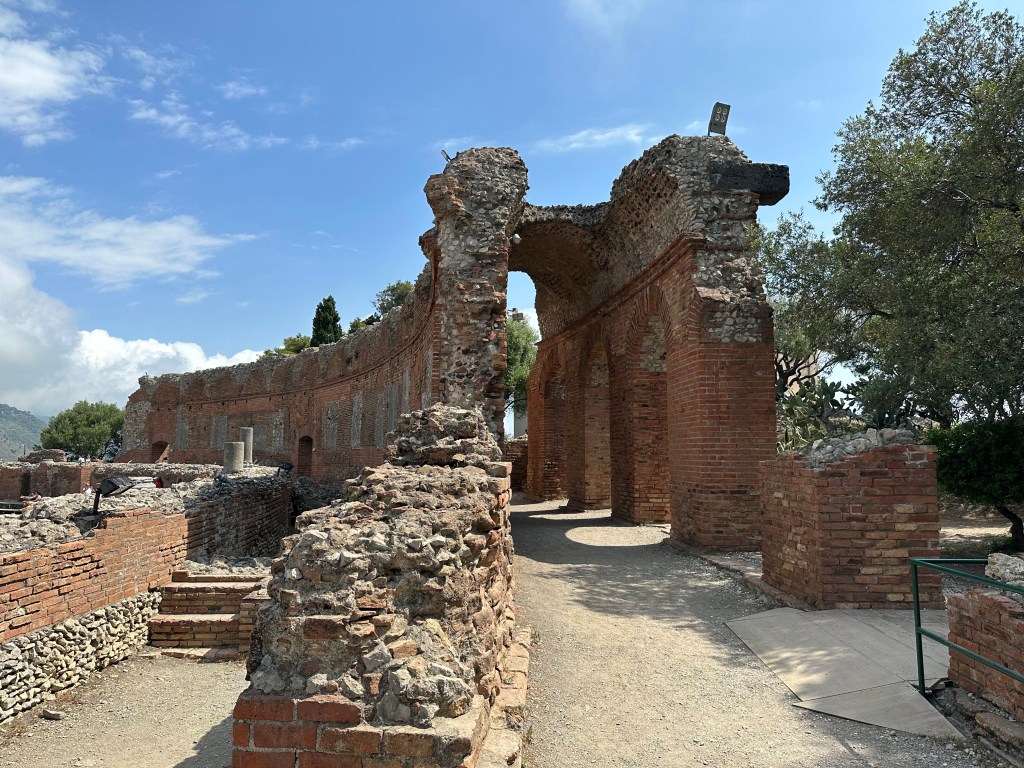
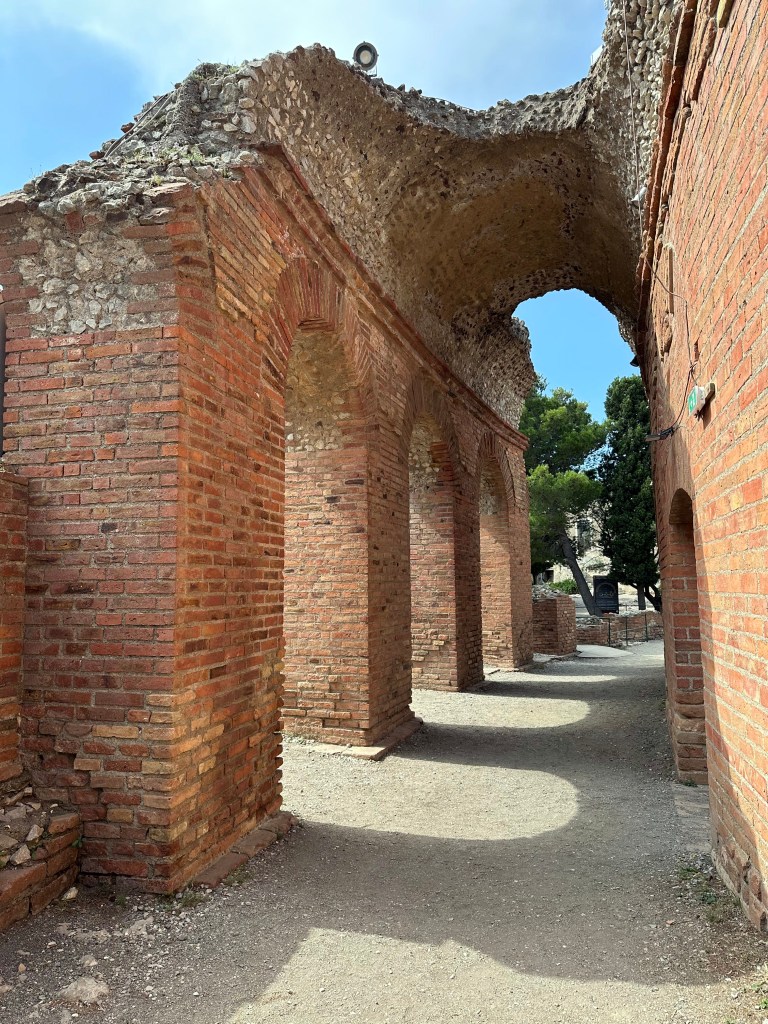
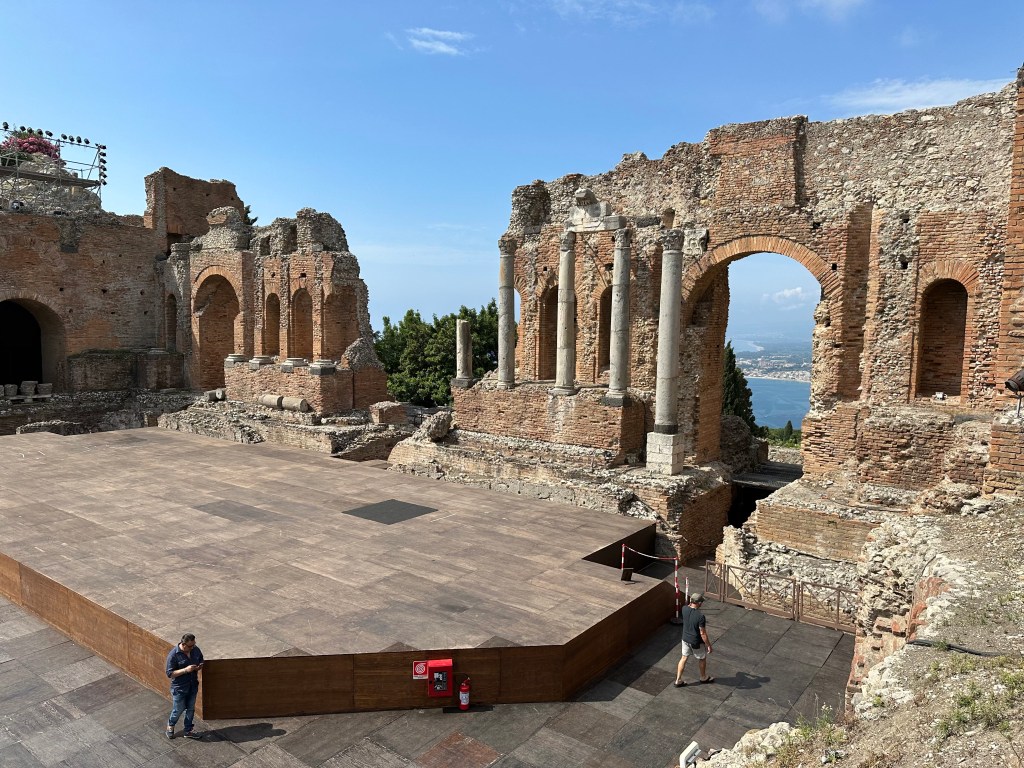
The major Roman renovation expanded the cavea, modified the retaining walls to run parallel with the stage, and constructed an elaborate multi-story scaenae frons (the ornate architectural backdrop behind the stage). This phase created the theatre in its most magnificent form. The first intervention enlarged the theatre’s capacity with the construction of an external ambulatory and a complete reconstruction of the scaenae frons. Scholarly research confirms the architectural ornament of that stage front is definitively Trajanic or Hadrianic in style — and the architect of the theatre at Taormina used illusionistic column effects closely similar to those at the South Theater at Gerasa, suggesting Eastern influence on its design.
Phase III — Conversion to Arena (Late 2nd / Early 3rd Century AD)
The second Roman intervention involved changes to the stage and an expansion of the orchestra to transform the theatre into an arena capable of hosting gladiatorial games. A ring corridor was built, closed by a raised parapet, along with underground spaces used as shelters for equipment and animal cages. Three vaulted passageways were built under the scaenae frons to provide access for gladiators and animals.
Phase III — Conversion to Arena (Late 2nd / Early 3rd Century AD)
The second Roman intervention involved changes to the stage and an expansion of the orchestra to transform the theatre into an arena capable of hosting gladiatorial games. A ring corridor was built, closed by a raised parapet, along with underground spaces used as shelters for equipment and animal cages. Three vaulted passageways were built under the scaenae frons to provide access for gladiators and animals.
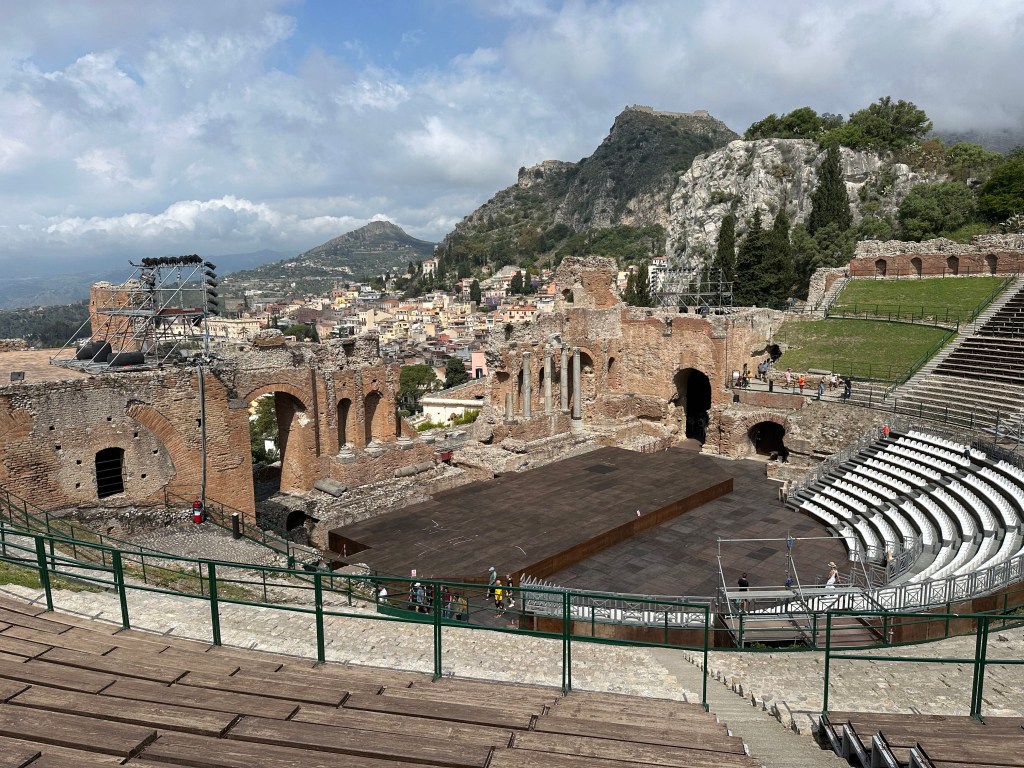
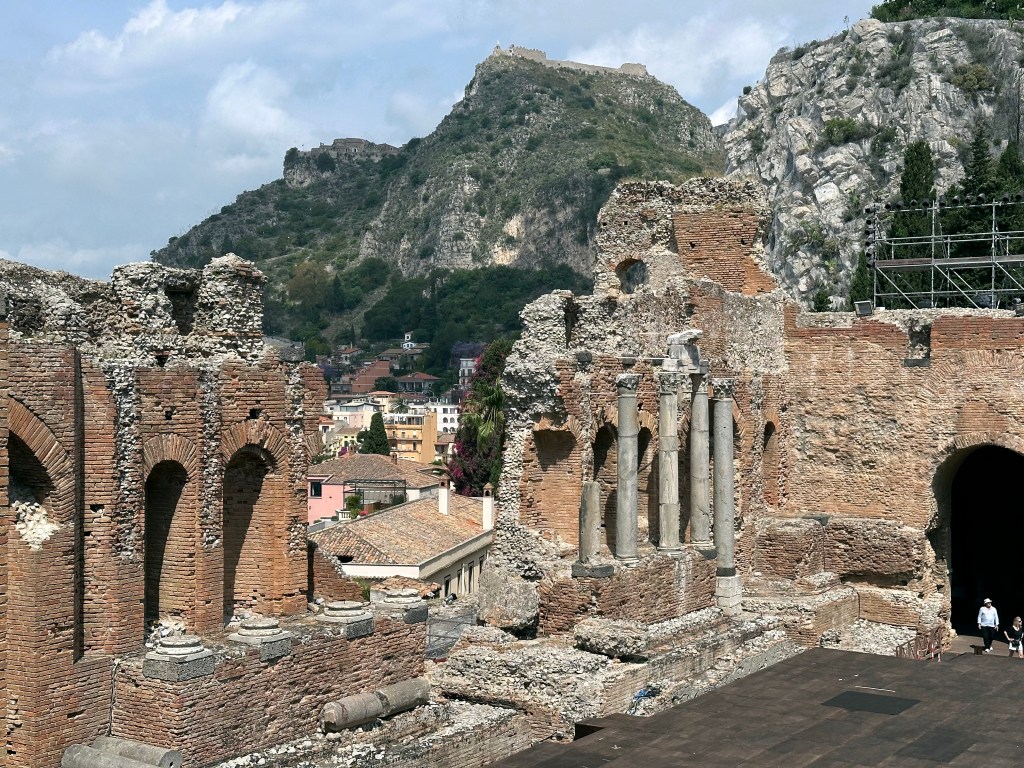
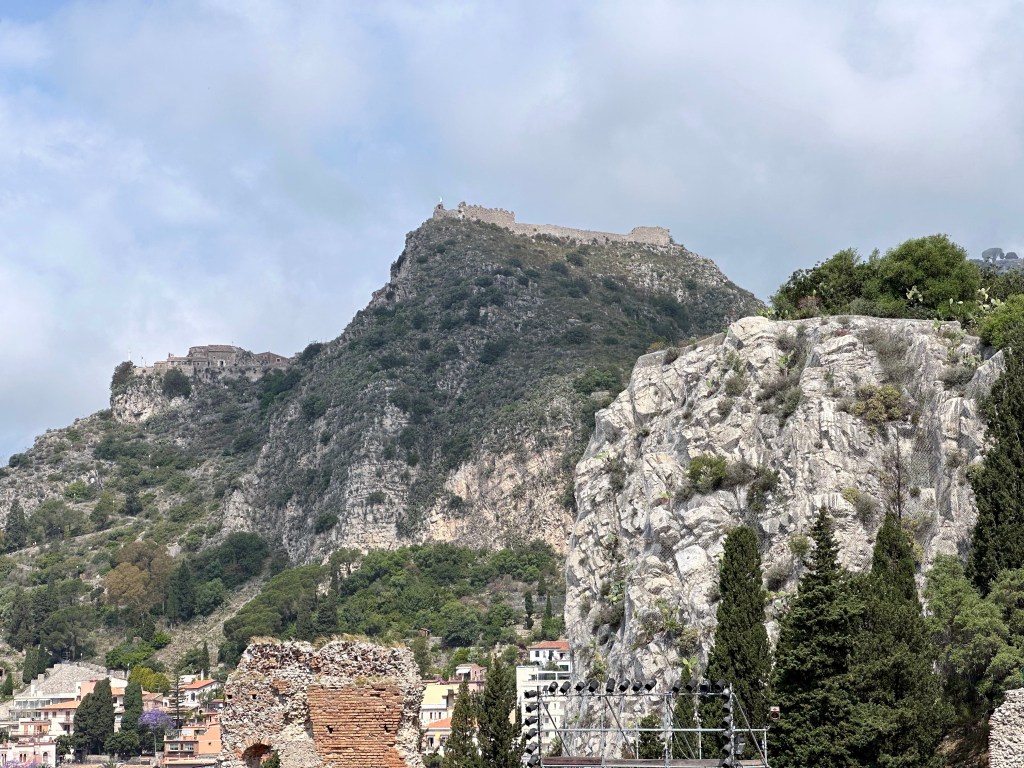
A view up to Castelmola, the destination of our hike the previous day and home to the dick bar.
The theatre has a horseshoe-shaped cavea with a diameter of 107–109 meters, an orchestra measuring 28–29 meters across (later expanded to 34 meters during the arena conversion), and a seating capacity estimated at 8,900 to 11,150 spectators across more than 40 rows divided into nine cunei and three maeniani (levels). It is the second largest of its kind in Sicily, behind only the Greek Theatre of Syracuse.
The setting is arguably the theatre’s most famous feature. Oriented to face south-southwest, it frames a panorama of Mount Etna and the Ionian Sea simultaneously — a view that has captivated visitors for millennia.
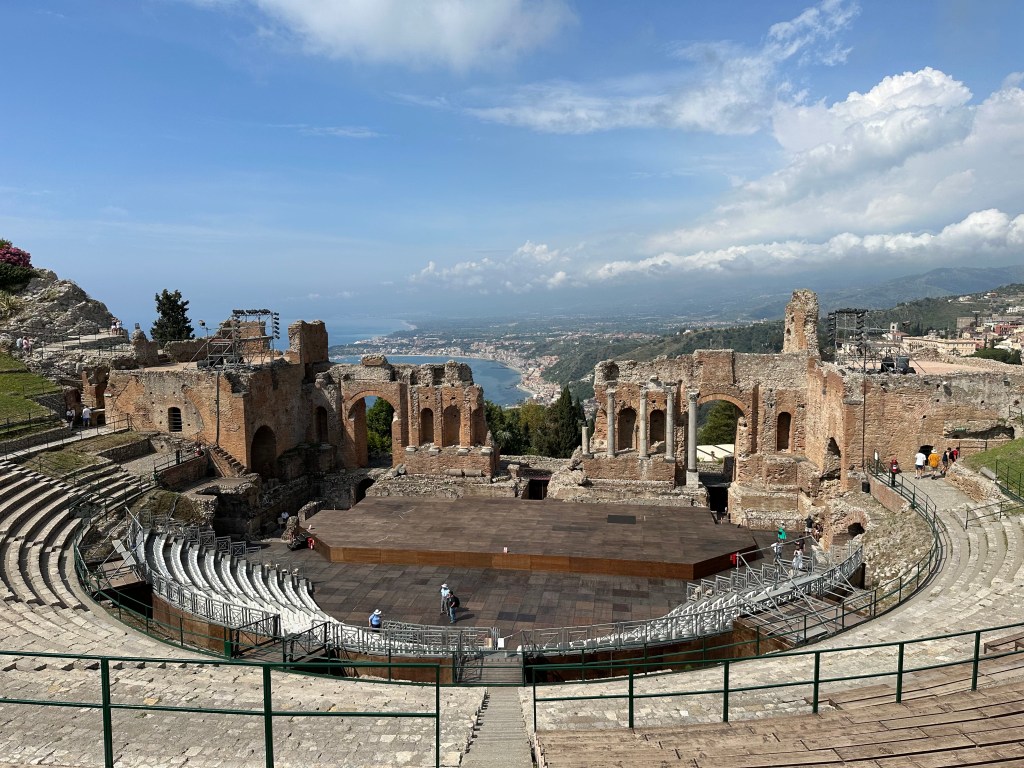
During the Middle Ages, parts of the theatre were reused to build private residences and religious buildings, including Taormina Cathedral. It was the Grand Tour of the 18th and 19th centuries that restored the theatre to international fame. Johann Wolfgang von Goethe visited in 1787 and wrote in his famous Italian Journey: “Never has a theatre audience enjoyed such a view.” His words became perhaps the most quoted description of the site and drew generations of European travelers in his wake.
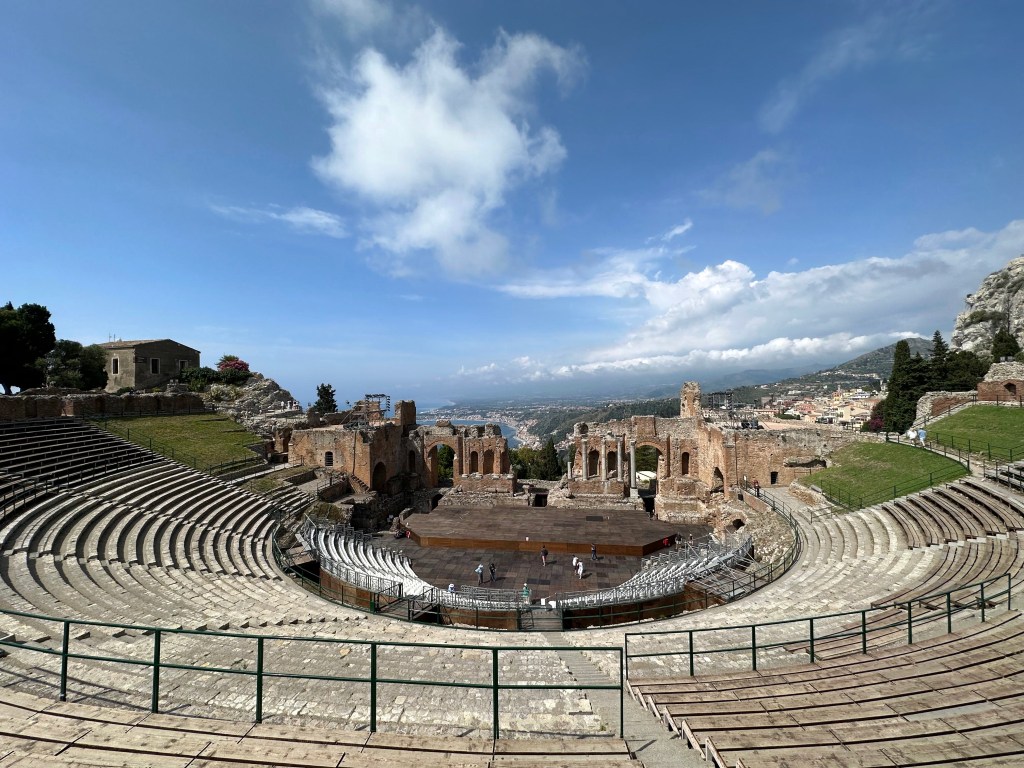
The theatre today is far more than a museum piece — it remains an active cultural venue. Since 1983 it has hosted the Taormina Arte festival and other cultural events. Since 1971, the Taormina Film Fest has been held in the Ancient Theatre, with premieres and new film screenings taking place here.
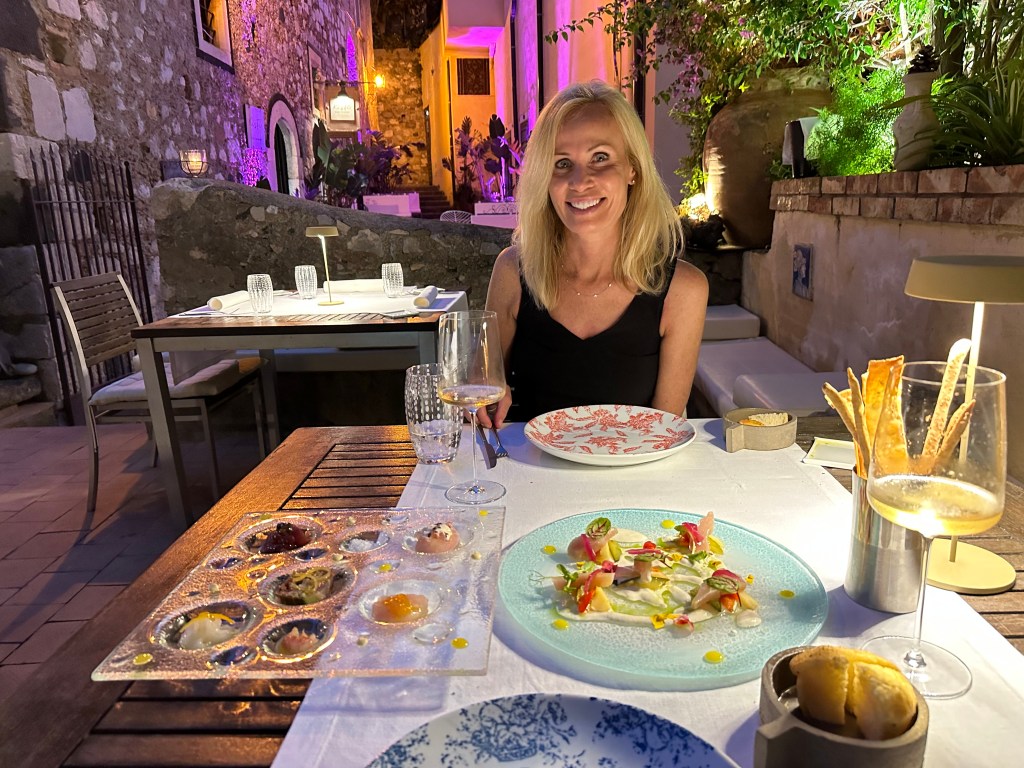
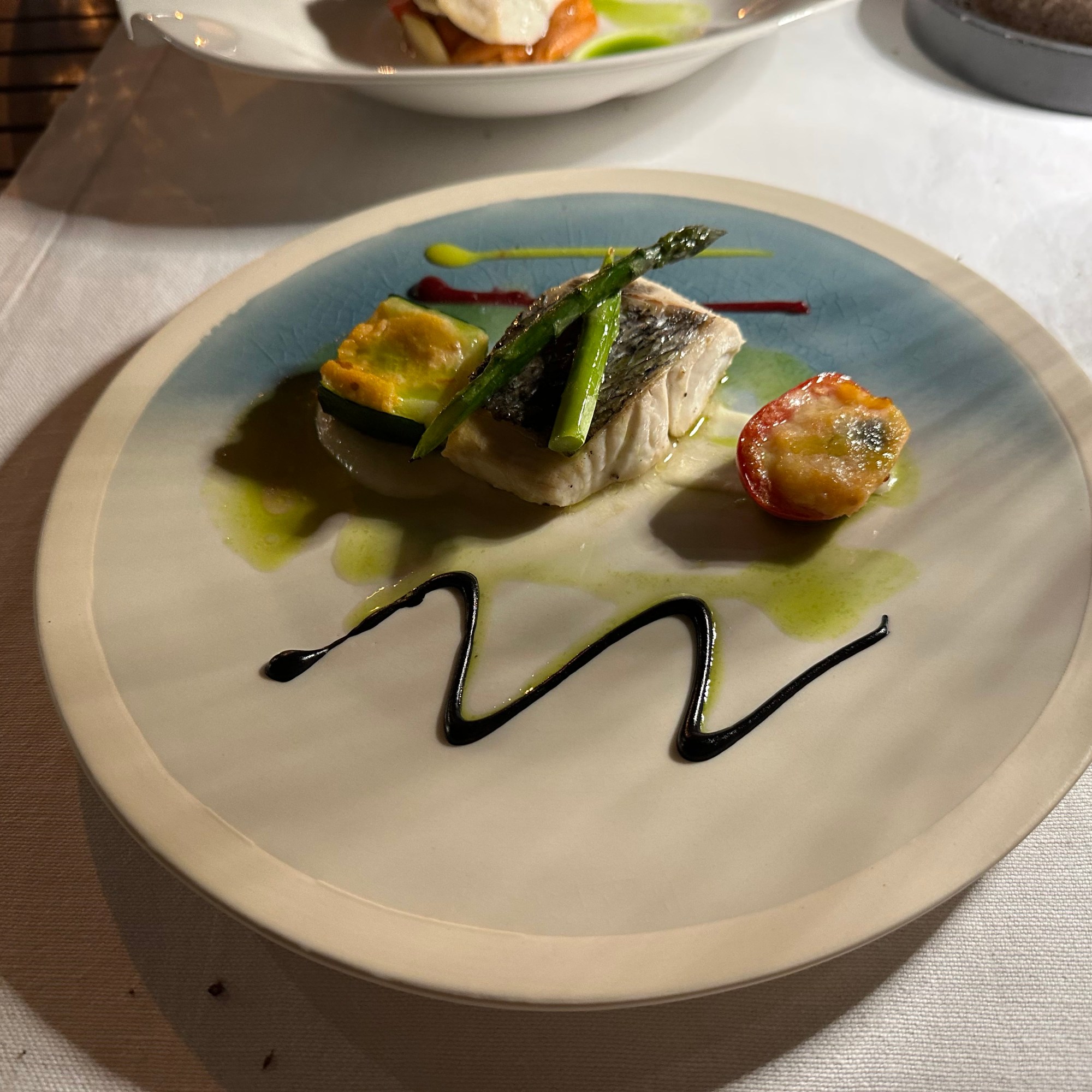
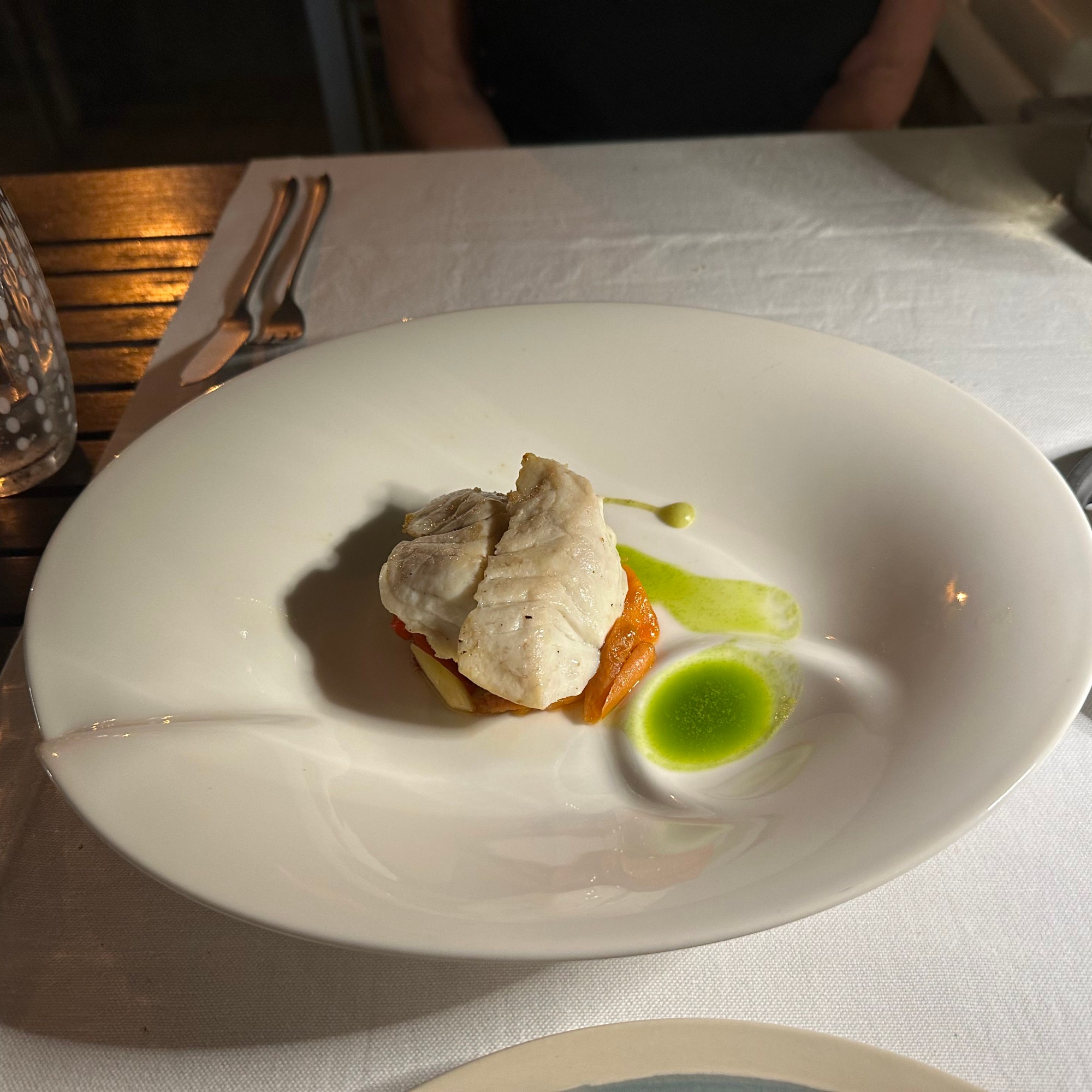
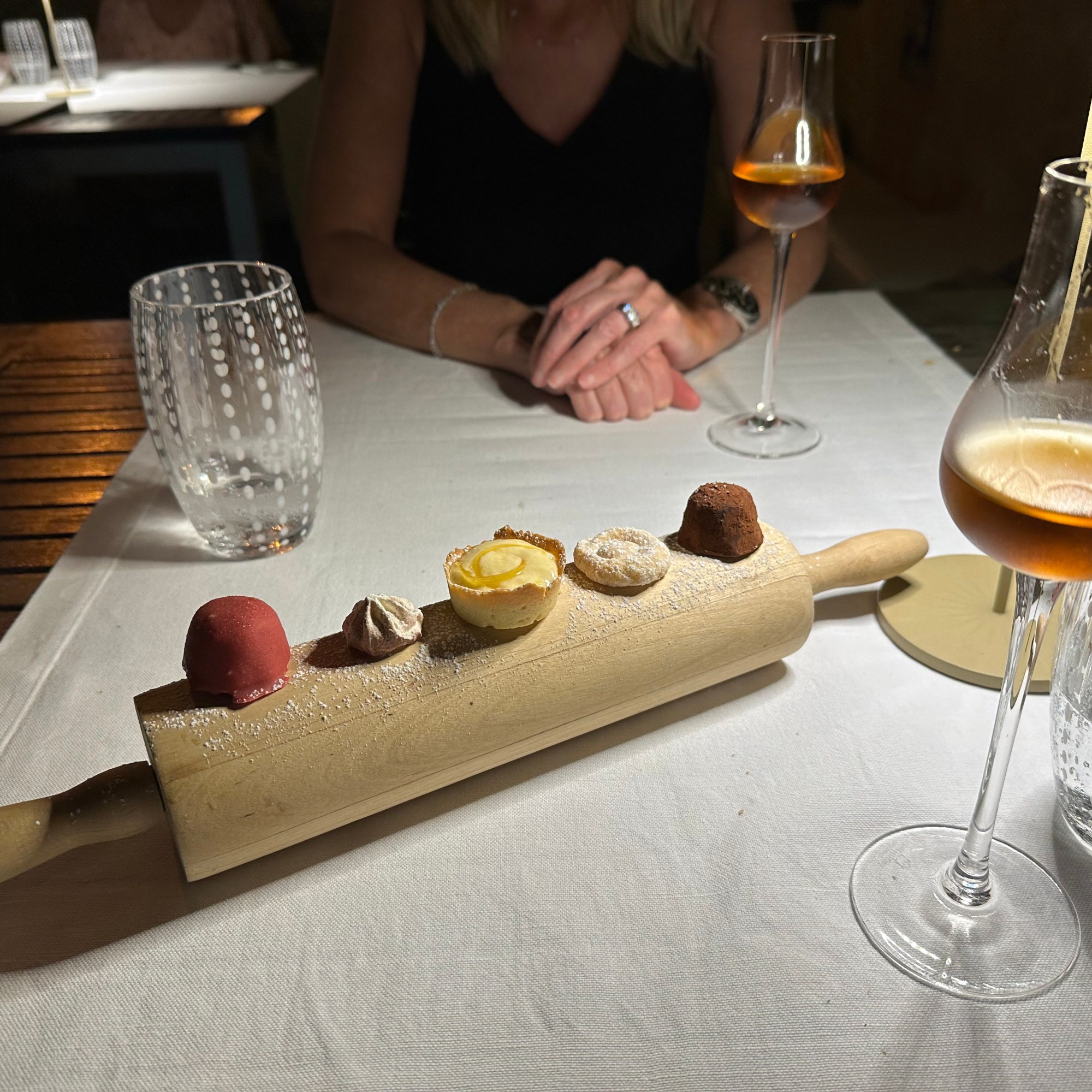
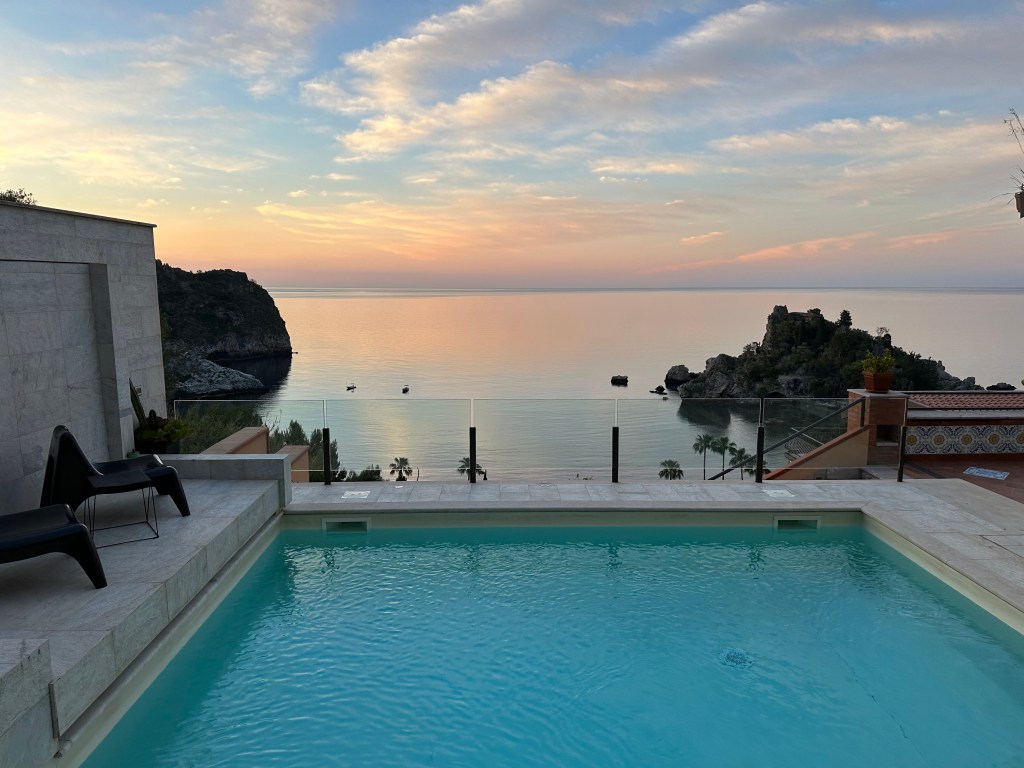
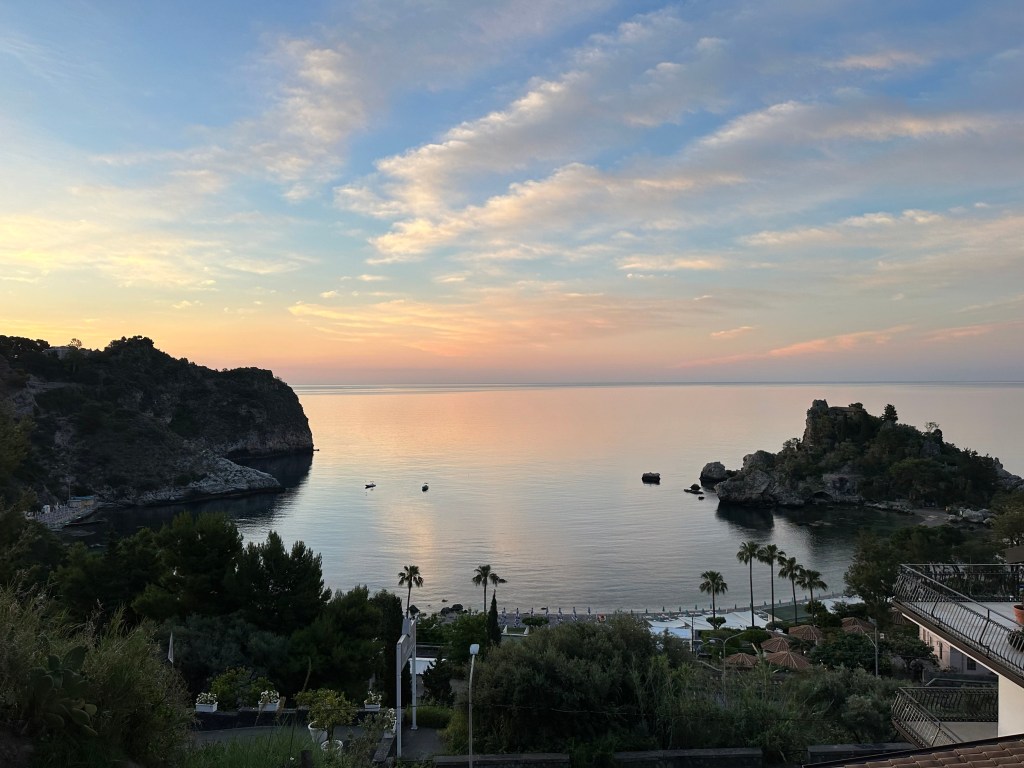
Final night in Taormina (and in Sicily):
On to Malta!
